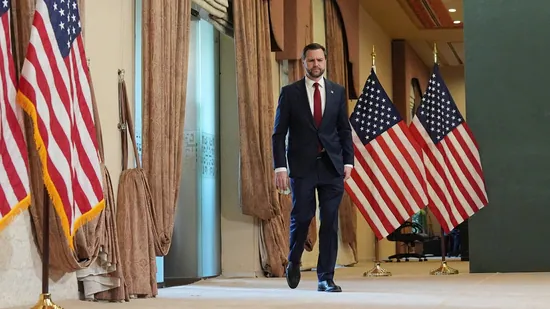
Almost a full day of negotiations ended with a terse three-minute press conference—and without a deal. Talks between America and Iran began on Saturday afternoon and continued through the night, almost 21 hours in all. The sun had risen in Islamabad, the Pakistani capital, by the time J.D. Vance emerged to brief reporters. “We have not reached an agreement,” the American vice-president said. “We’ve made very clear what our red lines are… and they have chosen not to accept our terms.”
U.S. Vice President JD Vance arrives for news conference after meeting with representatives from Pakistan and Iran, Sunday. (REUTERS)
The mood on the Iranian side was equally downcast. Esmaeil Baqaei, the foreign-ministry spokesman, said the talks took place amid “mistrust and suspicion”. State media blamed America’s “excessive demands” for blocking an agreement. The leaders of both delegations have now headed home without fixing a date for another meeting.
The failure of one summit does not mean that diplomacy is dead. There is time for further talks: the ceasefire announced on April 8th is meant to last for two weeks, and can be extended by mutual agreement. Though Mr Vance made it sound as if there was no more room to negotiate, presenting a “final offer” and then walking away is itself a negotiating tactic. Yet the outcome in Islamabad underscores how hard it is to end a war that both sides believe themselves to be winning.
There were a few reasons for optimism. These were the highest-level negotiations between America and Iran since the Islamic revolution in 1979. The Iranians were pleased that Mr Vance led the American delegation, hoping that a self-professed sceptic of wars in the Middle East and a presidential hopeful would have strong motivation to reach a deal. Sitting across from him was Mohammad Baqer Qalibaf, the speaker of Iran’s parliament, whose title belies his real importance: he is one of the most powerful men left standing.
Diplomats say the talks were serious and substantive. There were few leaks. Each side brought a team of experts to discuss details—a welcome break from past negotiations, when Steve Witkoff, Mr Trump’s Middle East envoy, often tried to blag his way through complex nuclear issues.
For days, Iran had threatened not to show up at all unless the ceasefire also forced a halt to Israel’s war in Lebanon. America asked Israel to limit its air strikes in the country but did not stop the war altogether. In the end, Lebanon was not a central part of the talks. Diplomats briefed on the negotiations say they instead focused on three issues: money, ships and uranium.
Mr Vance suggested that the nuclear issue was the dealbreaker. “We need to see an affirmative commitment that they will not seek a nuclear weapon, and they will not seek the tools that would enable them to quickly achieve a nuclear weapon,” he said. He did not elaborate. In the previous two rounds of talks, though, America had insisted that Iran give up not only its stash of more than 400kg of highly enriched uranium but its right to enrich any uranium at all. Iran has repeatedly rejected that demand.
Yet they were never likely to resolve that dispute in two weeks, let alone a single meeting. The last time America and Iran negotiated a nuclear deal, in the 2010s, it took two years. The more likely outcome of these talks is an interim deal that addresses at least two of the three main issues and buys time for further talks. Iran would need to relinquish its control of the Strait of Hormuz and, perhaps, its near-weapons-grade uranium. America would need to offer economic benefits, perhaps by unfreezing billions of dollars in Iranian oil revenue frozen in overseas banks due to sanctions.
The dilemma is as much about sequencing as substance. Take the uranium. Iran sees it as a powerful bit of leverage, worth trading for a comprehensive agreement but not a temporary one. The Americans would rather deal with it quickly, lest it remain in Iran’s hands during a protracted negotiation.
Each side expects the other to cave. The Iranians believe they have the upper hand, having endured six weeks of bombing by far stronger foes and having inflicted enormous pain on the global economy. They see time as an ally. To them, Mr Trump looks bored of the war and desperate to end it before soaring energy prices sink his Republican party in the midterm elections in November.
America has the opposite view. Though the war has not achieved many of its main objectives, it has battered Iran’s leadership, its armed forces and its economy. The next round would probably be more painful: even if Mr Trump does not make good on his most harrowing threats, America and Israel would be likely to escalate their attacks on infrastructure and economic targets.
The risk is that the two adversaries misread one another. Iran may be willing to endure another round—and may also underestimate Mr Trump’s willingness to start one. He has already made good on two previous threats to attack Iran if negotiations faltered. “There’s a lot of hubris in Iran right now,” says an Arab diplomat.
Mr Trump’s threats look equally serious this time. The Pentagon has already deployed thousands of marines to the region, and more forces are on the way: a third aircraft carrier is sailing across the Atlantic and an amphibious-warfare group is crossing the Pacific. Both should arrive before the ceasefire expires. On Saturday two American destroyers transited Hormuz, the first time American warships have sailed through the strait since the war broke out. The Pentagon said this was the start of an operation to clear Iranian mines from the waterway.
Despite Iran’s promise to open the strait during the ceasefire, it remains largely shut. Three tankers laden with oil managed to transit on Saturday. When two tried to enter the Persian Gulf the next morning, though, Iran’s Islamic Revolutionary Guard Corps warned them off.
After the talks ended Mr Trump said on social media that he had ordered America’s navy to impose its own blockade on the strait and to “seek and interdict” every vessel in international waters that had paid a toll to Iran. Iran is exporting as much oil as it did before the war (or perhaps even more), and charging much higher prices for it. Some Gulf officials had urged Mr Trump to start intercepting Iranian ships. There is still a chance to reach a deal; there is also a chance the war, and the chaos in energy markets, is about to get worse.