Trump’s grand vision of a nationalist Europe has been decisively rejected by Hungarian voters leaving America more isolated, more distrusted, and more alone than at any point in living memory
There is a moment when an ally becomes a liability, when the calculations shift, the patience runs out, and nations that have stood together for generations begin, quietly but irrevocably, to walk away. Europe has reached that moment.
And the clearest signal yet that the tide has turned came not from a NATO summit or a diplomatic cable, but from the ballot boxes of Hungary, where Donald Trump’s political project just suffered one of its most humiliating defeats.
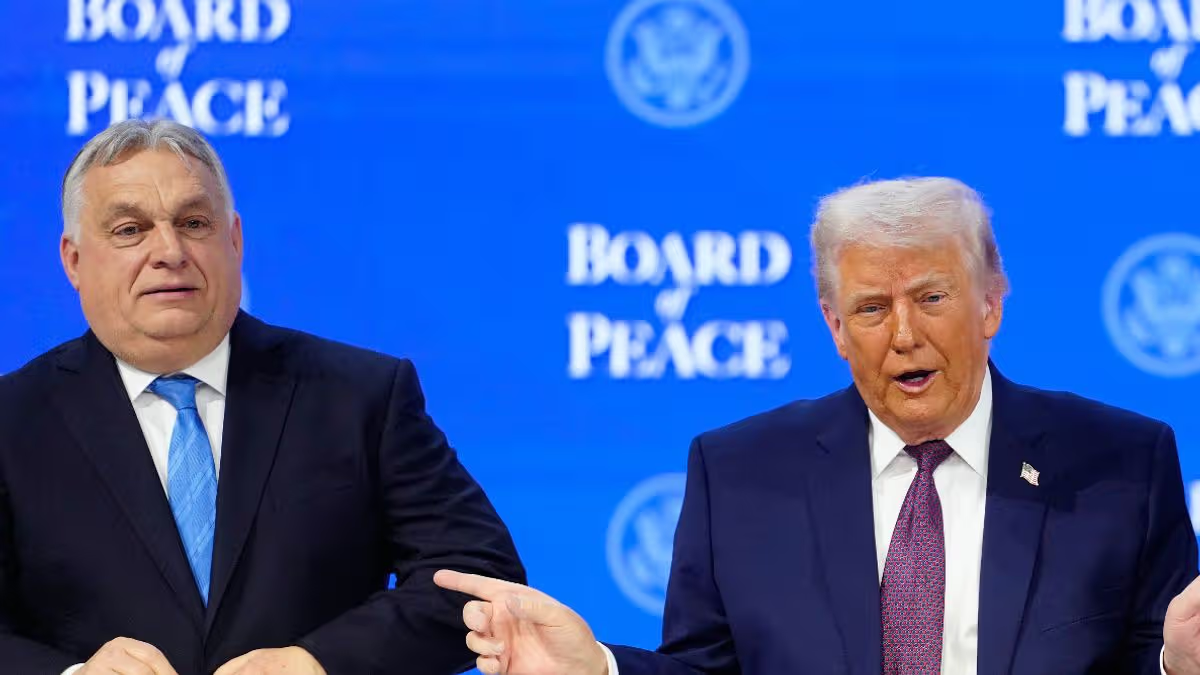
Viktor Orbán was supposed to be the crown jewel of Trump’s European vision. The proof of concept. The living demonstration that nationalist strongmen could hold power indefinitely, that Brussels could be defied, that the authoritarian playbook, authored by Trump, need never be rewritten.

READ MORE: Viktor Orban ousted in landmark defeat amid jibes Trump and MAGA will fall next
For 16 years, he had clung to power, dismantling judicial independence, strangling the free press, and positioning Hungary as a Trojan horse for Kremlin interests inside the European Union. Trump adored him for it. Called him a great leader. Welcomed him to Mar-a-Lago. And when the Hungarian election loomed, he did what any man convinced of his own indispensability does – he sent his vice president to make sure his man won.
JD Dunce, sorry Vance, arrived in Budapest like a conqueror. He stood shoulder to shoulder with Orbán on the rally stage, declared him a defender of western civilisation, and even patched Trump through on the phone to address the crowd directly because, apparently, his own star power was not quite sufficient to move the Hungarian electorate.
One local political analyst noted, with understatement, that Vance was simply “much less known, or cared for, among Hungarian voters.” It should have been a warning. It was not heeded. Then yesterday, the people of Hungary voted. And they did not deliver the result the White House had ordered.
Orbán, Putin’s puppet in the EU and NATO, was swept from power in a landslide of historic proportions; his Fidesz party collapsed to just 55 seats while Péter Magyar’s Tisza party surged to 138. Sixteen years of authoritarian entrenchment, undone. Trump’s great European champion, finished. And Vance, who had flown across the Atlantic to guarantee victory, left with nothing but the wreckage of another catastrophic intervention.
This is the pattern that now defines the Vice President and, by extension, the administration he serves. He is a man who transforms everything he touches into rubble. At the Munich Security Conference, he lectured Europe’s leaders about their own democracies, nudged Germans toward the far-right AfD, and delivered a speech so toxic in its reception that the following year, he simply did not attend.
In the Oval Office, he ambushed Ukraine’s wartime president, told a man whose country was fighting for survival that he ought to show more gratitude, and when Zelenskyy asked whether Vance had ever visited Ukraine, he replied that he had watched videos. The minerals deal collapsed. The press conference was cancelled. Russian state media celebrated. Now Hungary. The heir apparent to Trump’s movement cannot win a single room he walks into.
But the defeat in Budapest is larger than Vance. It is larger even than Orbán. It is a referendum on the entire political philosophy that Trump has been attempting to export to Europe – the idea that strongman nationalism is the future, that liberal democracy is exhausted, that the Brussels establishment can be broken from within by a network of Kremlin-friendly populists flying the flag of western civilisation while quietly dismantling it.
Hungarian voters looked at that offer and rejected it with overwhelming force. Europe, it turns out, is not as conquered as the White House believed. And that rejection sits within a far broader turning of the tide.
For 16 months, Trump has treated Europe with a contempt so sustained it can only be read as deliberate. He has imposed punishing tariffs on allies without apology. He has treated NATO as a protection racket rather than a partnership. He threatened to seize Greenland from Denmark, a fellow NATO member, and seemed genuinely baffled that it caused offence. He undermined Ukraine at every turn while cosying up to the man destroying it.
The response from Europe has hardened from discomfort into action.
France and Spain have openly condemned American conduct. Italy, whose Prime Minister was once Trump’s most loyal European ally, denied American military aircraft use of a Sicilian base. Germany has begun seriously rethinking its security dependencies. The European Commission has called, plainly and deliberately, for the continent to reduce its reliance on the United States and build the strategic independence that would make Washington’s friendship optional.
The UK, meanwhile, has rejected Trump’s European takeover at every turn. So too his demand Britain back his senseless Iran war. These are not the words of enemies. They are the words of friends who have stopped pretending.
Trump dispatched his vice president to Hungary to demonstrate that his movement was unstoppable, that his allies were unassailable, that the new nationalist Europe was rising. Instead, Vance delivered him a landslide defeat, another diplomatic humiliation, and the clearest possible message from a European electorate that it has seen enough.
America First, the voters of Hungary have reminded the world, does not mean Europe follows. It means Europe decides, for itself, by itself, which direction it walks. And right now, it is walking away.