
Iran’s Parliament Speaker Mohammad Bagher Ghalibaf fired an unusual salvo at the United States this week — not in the language of diplomats or even satirists, but using a formula from mathematics.
In a post on X, Ghalibaf warned that American pressure on Iran could trigger a chain reaction in global oil markets, so severe that Americans would look back fondly on today’s fuel prices.
“Enjoy the current pump figures. With the so-called ‘blockade’, soon you’ll be nostalgic for $4–5 gas,” he wrote.
With it he wrote a statistical formula: ΔO_BSOH > 0 ⇒ f(f(O)) > f(O). Looks intimidating, so we’ll come to that.
How Ghalibaf used math to make his point
Mohammad Bagher Ghalibaf holds a PhD, like many other Iranian leaders. His doctorate is in Political Geography from the Tarbiat Modares University in Tehran. He served as the Mayor of Tehran (2005–2017) among other posts. There are some reports that he studied engineering too.
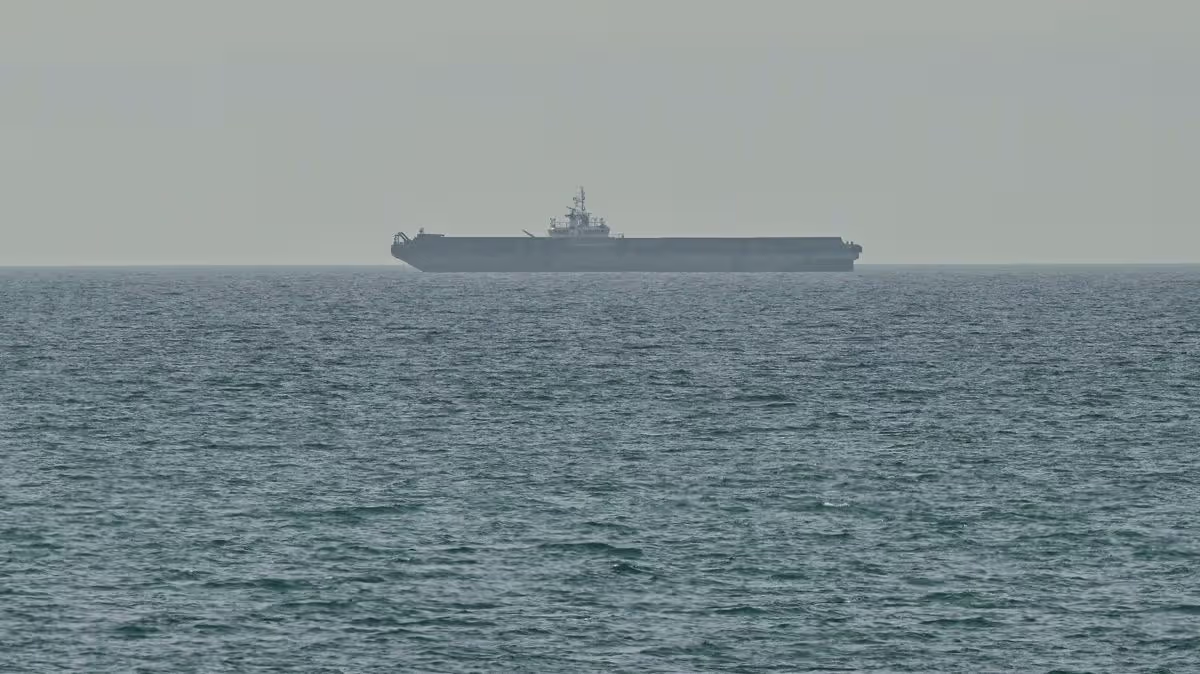
He’s dealt with roads, freight, pipelines, and shipping lanes, like the Strait of Hormuz. A geopolitical flashpoint, the strait has become a chokepoint in global logistics for oil. A narrow channel between Iran and Oman at the mouth of the Persian Gulf, the waterway is, at its tightest, just 33 kilometres wide.
It is the only sea exit from the Gulf towards the ocean towards South Asia and beyond. Roughly 20% of the world’s entire oil supply passes through it every single day, if it’s not blockaded. Iran has held a blockade on it as leverage in the ongoing war with the US and Israel.
After peace talks failed in Islamabad last week, US President Donald Trump said the US would blockade it too, not allowing Iran to selectively allow some ships, some of which are reportedly being charged $2 million by the Islamic Republic.
Saudi Arabia, Iraq, Kuwait, the UAE, and Qatar all ship their oil out through Hormuz. The alternative routes just don’t work as well. This has already thrown global oil supplies off a cliff. Prices have soared, as they do when supply is squeezed.
That’s where Ghalibaf’s formula comes in.
Economist Javed Hassan, a former chairman of the National Vocational and Technical Training Commission (NAVTTC) of Pakistan, broke it down on X. “Ghalibaf is mathematically making the point that the oil prices will be much worse as a result of BSOH = Blockade Strait of Hormuz,” Hassan wrote.
Taking a cue from him, and some help from AI-based models, here is what each piece means in: ΔO_BSOH > 0 ⇒ f(f(O)) > f(O).
‘O’ here is the current price of oil. For instance, the $4-5 per gallon that Americans are paying for petrol or gasoline.
‘BSOH’ stands for Blockade of the Strait of Hormuz.
‘ΔO_BSOH > 0’ with the ‘delta’ sign upfront, simply means the blockade causes oil prices to rise.
‘f(O)’ means first-order effect: the immediate and direct consequence. So, oil tankers cannot move through the Hormuz Strait; therefore supply drops; and prices spike. This is predictable.
He then uses ‘f(f(O))’ to speak of second-order effects. When the oil spikes, but the strait remains blockaded, shipping companies refuse to send tankers into the war zone, or insurance premiums become so steep that costs rise further. That cost gets passed on to consumers. Costs explode across the board.
The original price shock now has a multiplier effect. One triggers another.
Ghalibaf also shared a map with US petrol pump prices at “gas station(s) near White House”.
Suez example
There have been similar instances before of chokepoints having a domino effect.
In 2021, a single container ship called ‘Ever Given’ ran aground and blocked the Suez Canal for just six days. The result was billions lost per day in delayed trade, reports at the time said. Supply chains were disrupted for months, and there were shortages of goods that had nothing obvious to do with shipping — because it’s all connected.
The Strait of Hormuz carries five times the strategic depth of Suez. The blockade is already beyond six weeks, while Suez was blocked for just six days.
After talks failed
Ghalibaf led Iran’s delegation at the peace talks in Islamabad last weekend, where 21 hours of negotiations with US Vice President JD Vance and his team ended without a deal.
Within hours of the talks collapsing, President Trump ordered the US Navy to begin blockading the Strait of Hormuz. Ghalibaf posted his equation the same day.
The US administration’s underlying bet is that it can squeeze Iran economically by not allowing it to police the strait. Ghalibaf’s argument is that it will trigger consequences for American consumers and the global economy.