
WASHINGTON—The Trump administration is scaling back tax enforcement, leaving fewer federal employees to audit returns, collect unpaid tax debts and deter Americans from skirting the law.
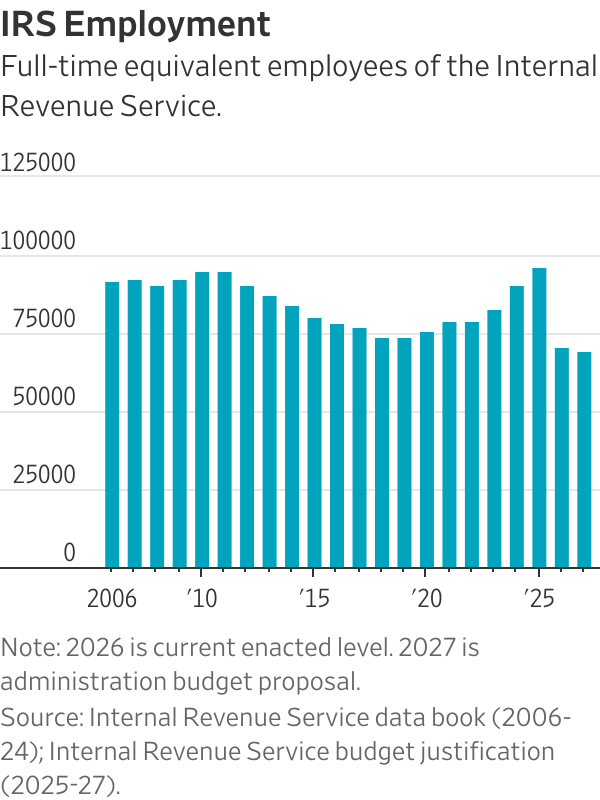
The Internal Revenue Service has shed thousands of enforcement workers since President Trump returned to office, and his fiscal 2027 budget proposal seeks further cuts amid the administration’s broader pullback of white-collar law enforcement. The IRS enforcement workforce would fall below 30,000, fewer than at the end of Trump’s first term and about a third less than the Biden-era peak.
The retrenchment is spurring a vibe shift across the tax landscape ahead of the April 15 deadline, and lawyers say they see more taxpayers and tax-shelter promoters eager to cut corners or cheat.
“There’s seemingly this mentality building which is, ‘The IRS isn’t going to catch me,’” said Carolyn Schenck, a former IRS national fraud counsel, now at law firm Caplin and Drysdale in Washington.
Audits of people with at least $10 million in income dropped 9% last year, and they are on track to decline another 39% this year. Partnership audits declined, reversing an attempt to scrutinize private-equity firms and other complex entities that have long bedeviled the government.
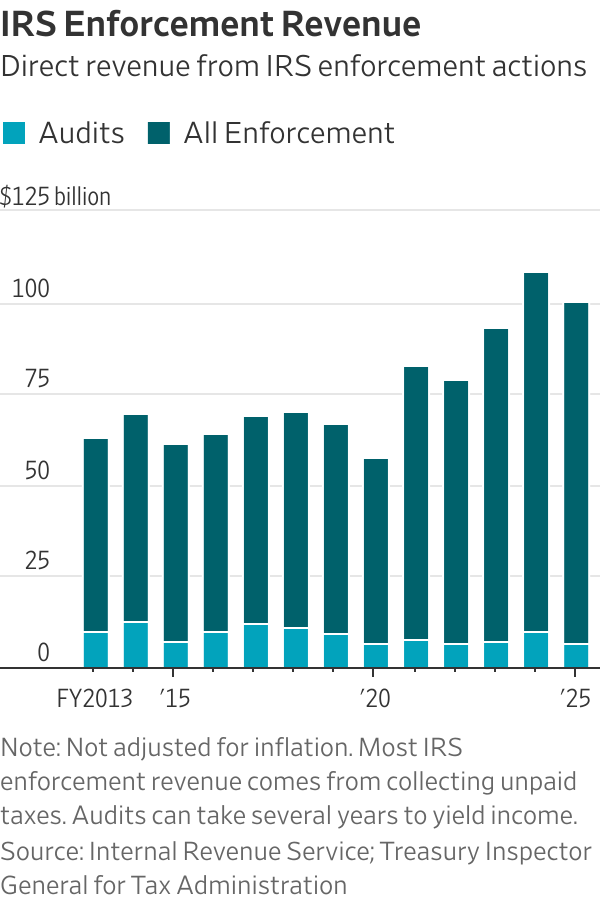
In fiscal 2025, the IRS collected less direct revenue from audits and appeals than in any year since at least 2012, though the money can arrive years after audits start. The IRS said Sunday that total enforcement revenue was up 12% through the first five months of fiscal 2026.
Even without the proposed cut for next year, inflation-adjusted spending on tax enforcement is already the lowest in at least 20 years, according to the progressive Center on Budget and Policy Priorities.
“They have defunded the police,” said Matthew Rappaport, a tax lawyer at Falcon, Rappaport and Berkman in New York. “There’s no more succinct way to describe what’s happened.”
The cutbacks will be costly for the government’s bottom line and expand budget deficits. The administration’s own IRS budget document acknowledges that chasing scofflaws generates more money than it costs. “Reductions in enforcement spending create missed opportunities and lost revenue for the United States,” the document said.
The IRS workforce reductions so far would cut an estimated $46 billion in federal spending over the next decade and reduce revenue collections by $643 billion, according to The Budget Lab at Yale, a nonpartisan center run by former Biden administration officials.
In Trump’s second term, the administration has shifted law-enforcement priorities broadly, emphasizing fraud in government benefits programs and shrinking the Consumer Financial Protection Bureau. Some IRS criminal investigators were reassigned to immigration enforcement and the federal policing surges in Washington and Memphis, deployments scheduled to end next month.
The president, who has complained about his own IRS audits, pardoned people convicted of tax crimes last year. Those include reality TV stars Todd and Julie Chrisley, as well as a nursing-home owner accused of a $38 million employment tax fraud whose prison sentence was touted by prosecutors in Trump’s own Justice Department.
Trump administration officials say they are trying to make tax enforcement more efficient, using artificial intelligence to improve decisions about which tax returns to audit. IRS chief executive Frank Bisignano told a congressional committee last month that the agency will increase compliance with plans to improve service by making it easier for taxpayers to connect with the IRS online.
Bisignano and Treasury Secretary Scott Bessent also have talked about improved tax collection, though they haven’t specified what that means. Cash revenues typically rise each year because of inflation and economic growth.
Tax enforcement, though shrunken, hasn’t disappeared. Lawyers say current audits are particularly thorough. The government hasn’t backed off long-running court cases, including attempts to make hedge-fund managers pay higher employment taxes and multibillion-dollar international tax litigation against Meta Platforms, Coca-Cola and others.
The IRS initiated more audits of large corporations last year than in 2024. It also opened more criminal investigations, driven by increases in identity theft and money laundering, though probes of abusive tax schemes declined.
“We are successfully undertaking a long overdue digital upgrade to ensure that we are more effective for the needs of our customers and also maintain strong tax compliance,” Bisignano said Sunday. IRS criminal investigators, he said, “work diligently to identify and prosecute those who seek to circumvent what is owed to the American people.”
Tax dodging isn’t evenly distributed. Wage-earners cheat less often because they know the IRS can check their reported income against W-2s. Business owners have more ways to fudge: It is harder for the IRS to know if they underreport cash income or overstate business expenses—claiming, for instance, that $1,000 in new office furniture cost them $10,000.
Even low-income Americans can gain when enforcement declines. Unscrupulous tax preparers often guide people to claim inflated tax credits.
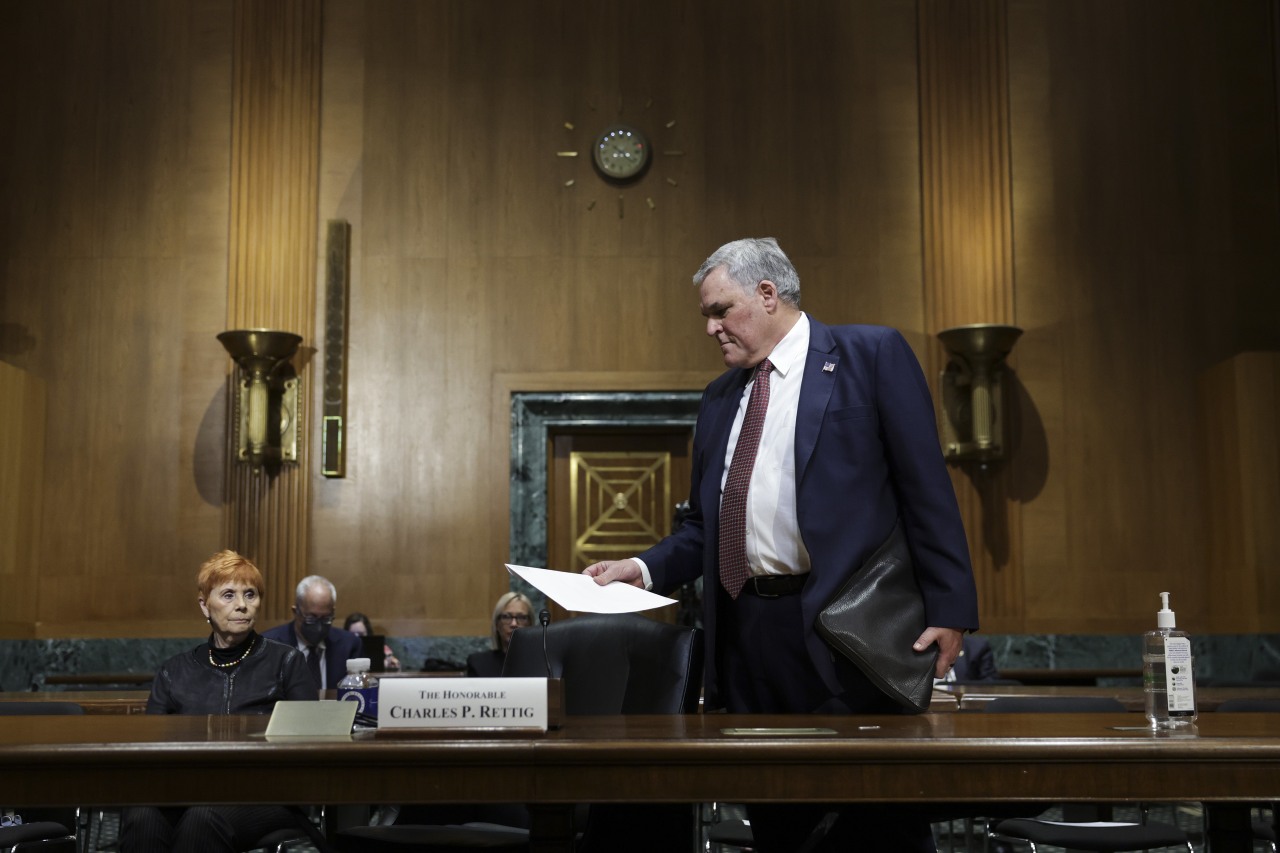
“The expenses of operating the United States do not disappear if the IRS suffers,” said Charles Rettig, who was Trump’s first-term pick to be IRS commissioner. The people who benefit from IRS understaffing, he said, are those who aren’t complying with the law.
Enforcement bust
Tax enforcement goes through boom-and-bust cycles, often fueled by public outrage against tax dodging and then public frustration with aggressive enforcement. The IRS budget peaked early in the first Obama administration. Then Republicans won the 2010 midterm election, driving the IRS head count downward while pointing to the agency’s controversies.
The first Trump administration began laying the groundwork for reviving tax enforcement. Treasury Secretary Steven Mnuchin said during his confirmation hearing that it would take a “quick conversation” to show Trump the benefit of adding people at the IRS and making money. In 2020, Mnuchin directed the agency to audit at least 8% of taxpayers with incomes over $10 million. The agency later changed course after officials determined that many of the audits yielded nothing.
While in office, Rettig described the agency as outgunned by wealthy, well-advised taxpayers. He estimated that the tax gap—the difference between taxes owed and paid—was approaching $1 trillion a year.
The IRS says taxpayers as a group pay 85% of what they owe as they file returns, a compliance rate that climbs to 87% after audits and collections. Getting to 100% compliance would require more intrusive government than Americans would tolerate. IRS officials have said for years that they can bring the current numbers up with additional enforcement, regulation of tax preparers and more information about taxpayers’ incomes.
“You need strong, visible enforcement as a deterrence to keep the honest taxpayer honest. It’s the empty police car,” Rettig, whose term as IRS commissioner ended in November 2022, said in an interview.
Democrats in 2022 provided nearly $80 billion to the IRS, with $46.7 billion earmarked for enforcement through 2031. Biden administration officials hailed the step as a transformative investment that would yield hundreds of billions of dollars. That isn’t what happened.
Republicans campaigned against the IRS spending that year with warnings of 80,000 gun-toting agents and burdens on small businesses. The GOP won the House, and the anti-IRS mood was so pervasive that a funding-repeal bill was the first legislation the chamber passed in 2023.
Ultimately, in bipartisan deals to redirect funding to other programs, Congress clawed back most of the money. The initial $46.7 billion for enforcement shrank to $3.8 billion.
The IRS started January 2025 with about 103,000 employees. Then Trump returned, determined to undo Biden’s initiatives and shape a pro-taxpayer IRS.
The administration fired probationary government employees, those who held the job for less than a year, which disproportionately hit agencies that just hired heavily, including the IRS. Some later returned after a court challenge. The administration also offered buyouts that were attractive to the aging IRS workforce.
By May, head count at the IRS had declined by more than 25,000, including about a quarter of auditors. The 2027 budget calls for 69,000 total employees, putting the IRS under its 2018 low point.
“I understand that we have less people, but I’m not sure that there’s anything that ever said what the right staffing level was,” Bisignano told lawmakers at the hearing last month.
The Trump administration also shuffled agency leadership. Many top officials left or were pushed out, and the IRS cycled through eight different leaders.
The acting IRS commissioner job is vacant, and senior officials are doing double-duty. Bessent oversees both the agency and the Treasury Department. Bisignano runs IRS day-to-day operations and leads the Social Security Administration. Kenneth Kies, the acting top IRS lawyer, is also the senior Treasury tax-policy official. IRS civil enforcement chief Jarod Koopman also leads criminal investigations.
Doing less with less
The IRS is ramping up data analytics and artificial intelligence to identify potential noncompliance, raising the question of how effectively AI can replace people.
“This concept of ‘Do more with less’ doesn’t really work,” Koopman said at a Florida tax conference in January. “You do less with less. But you can do more at the end result if we implement the right technology, implement the right functions in the right way.”
Koopman said the idea of an understaffed IRS backing off key areas was a “false narrative,” and that the agency’s new digital-first approach aims to boost compliance and efficiency.
“We’re getting better at case selection and identification,” said Koopman, a longtime IRS criminal investigator and cybercrime specialist. “We’re trying to get away from some of these other hunt-and-peck methods.”
For now, technology can generate leads, but humans do the core accounting and legal work.
Over the past year, tax lawyers say they have seen the effects of shrinking IRS staffing, including fewer audits and faster case closures. They have seen revenue agents leave the government, passing their work to replacements midway through a case. Other matters just end abruptly. In some cases, said New York tax lawyer Bryan Skarlatos of the Kostelanetz firm, the IRS let legal deadlines expire, eliminating its ability to challenge taxpayers.
“The agency is trying to do at least some modicum of what they were doing before with catastrophically lower resources,” said Schenck, the former IRS fraud counsel.
David Carrone, a retired revenue agent in the New Orleans area, said workers face pressure to wrap up cases more quickly. “If you’re not even auditing those returns, a taxpayer’s like, ‘Roll the dice. Put an extra zero here. Make up an expense,’” said Carrone, who is still active in the IRS employees’ union.
Many tax lawyers favor a well-funded, competent IRS, because they prefer dealing with people who know the issues and resolve disputes efficiently for their clients.
“Things are so bogged down because those appeals officers are so overloaded,” said Joshua Ungerman, a former IRS attorney now at Meadows Collier in Dallas. “It’s difficult to get your opportunity to make your case to the appeals officer because there’s so many people in front of you.”
Skarlatos says he was seeing fewer audits but that IRS agents are asking more focused questions and have more information, often gleaned from database searches and publicly available data.
Tax lawyers caution against assuming that IRS enforcement has vanished. The government typically gets three years to start an audit after a taxpayer files a return and longer in some cases. If the enforcement wave turns back, people skirting the law now could be on the hook in 2029 or beyond.
Rappaport, the New York tax lawyer, said he expects long-lasting damage because of the difficulty of rebuilding the agency and persuading people to work there. He compared the administration’s rapid shrinking of tax enforcement to watching his 3-year-old play with toys.
“They’ve taken the federal government by the plastic dinosaur tail and mashed it ‘til its head came off,” he said.
Write to Richard Rubin at richard.rubin@wsj.com