A team led by a star trader at Vitol, the world’s biggest oil merchant, took a several hundred-million dollar hit early in the Iran war after bets in the petroleum market went awry, people familiar with the matter said.
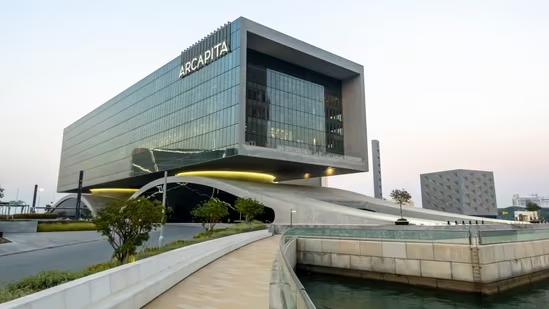
The complex housing Vitol’s offices in Manama, Bahrain.
Yaoyao Liu is legendary in the close-knit trading industry for his huge, often lucrative, wagers on energy derivatives for Vitol. His trades are so big, executives at rival firms have tried to figure out what they are. Among the lossmaking wagers some suspect: bets that diesel prices would rise relative to jet fuel, and that Dubai crude would fall in price compared with benchmark Brent.
Those positions stood to benefit if President Trump pulled back from a military buildup that has sent jitters through energy markets early in the year. Instead, when the war started and Iran shut the Strait of Hormuz, Liu’s bets went bad as price moves cut against him.
His team has since made back some of the loss, one of the people familiar with the matter said, and the firm as a whole is up for the year, another one of the people said.
Vitol plays a linchpin role in the global economy as one of a handful of companies connecting far-flung energy producers and users and managing the movement of billions of dollars of oil and other commodities. Founded in the 1960s by two businessmen in Rotterdam, it buys and sells 8 million barrels of oil a day—enough to supply Japan, Germany, France and the U.K. combined—from a nondescript building a few blocks from Buckingham Palace.
It has investments in storage tanks and gas stations, power plants, refiners and oil fields in the U.S. and West Africa.
When the Trump administration wanted international trading firms to unlock Venezuelan oil exports after the capture of Nicolás Maduro in January, it tapped Vitol and its Swiss rival, Trafigura. In 2025, Vitol had $343 billion in revenue, more than Exxon Mobil. Six hundred or so employees own the firm.
Vitol’s operations churn out data that give an edge to Liu, a Cambridge chemical-engineering graduate who published a paper on quantum chemistry. Born in China, Liu joined Vitol in 2012 after a stint at Goldman Sachs, according to a LinkedIn profile and some of the people familiar with the matter. Wall Street hedge funds that trade in commodities have often tried to poach Liu, who has had a streak of good years, including $2 billion in trading gains in 2022.
With a team of analysts and traders in Dubai, London and Houston, Liu operates what some inside and outside of the firm view as an internal hedge fund. Whereas colleagues move physical tankers of crude and fuel or trade electricity and natural gas, Liu’s team wagers on financial contracts tied to underlying energy markets.
Liu’s positions are a closely held secret inside Vitol so that rivals—or even colleagues—can’t get a read on his trades and move markets against him, some of the people said.
Liu’s losses weren’t the end of Vitol’s problems at the start of the war.
Within weeks of the U.S.-Israeli attacks, two ships carrying fuel for the firm came under attack in the Persian Gulf, killing a sailor. Vitol arranged a $3 billion credit line in case wild price moves led to big cash calls from commodity exchanges, people familiar with the matter said. Vitol hasn’t used the loan facility yet.
Some staffers left the firm’s regional headquarters in Bahrain. Vitol scrambled to replace cargoes trapped behind Iran’s Hormuz blockade.
It is a chastening experience for Vitol, whose partners pride themselves on having dodged many of the pitfalls that hurt rivals. Vitol briefed bankers on some of its problems including enormous insurance and freight-related bills from ships stuck in the Persian Gulf in late March, though it didn’t provide many details, people familiar with the matter said.
The firm has benefited from stowing away profits since the Covid-19 pandemic and the war in Ukraine and doesn’t rely as heavily on debt to fund its trades as some rivals. It stands to gain if energy markets remain volatile.
From its Bahrain base overlooking a manicured cove in Manama, Vitol over decades built a big business supplying Gulf oil to Asia. In years of relative peace in the Middle East, it seemed a sure bet. But when Trump’s attack on Tehran engulfed the region in violence, often targeted at energy facilities, Vitol was exposed.
Unable to ship petroleum and liquefied natural gas it had bought from the region, Vitol had to find replacements to send to customers. Another problem: Derivatives the firm had sold to hedge against price moves for cargoes from the Middle East were suddenly a bet against the crude market just as it was exploding higher.
Other trading firms had similar difficulties but not on the same scale. The trading arm of France’s TotalEnergies, on the other hand, correctly wagered that Dubai crude prices would rocket.
Write to Rebecca Feng at rebecca.feng@wsj.com, Joe Wallace at joe.wallace@wsj.com and Peter Rudegeair at peter.rudegeair@wsj.com