Hungarians are voting in record numbers on Sunday in an election that could end Prime Minister Viktor Orban’s 16-year hold on power — and deprive Vladimir Putin and Donald Trump of their closest ally in Europe.
Orban faces his strongest challenge yet from a former ruling elite insider, Peter Magyar. Over the past two years, his Tisza party has rallied Hungarians by playing on discontent with rampant corruption, a cost-of-living crisis and the poor state of public services.
A defeat for Orban would have an impact far beyond his country of almost 10 million. The European Union’s longest-serving leader has been a persistent obstacle to the bloc’s efforts to project geopolitical power beyond its borders and promote democratic values, most recently by vetoing a €90 billion ($105 billion) loan to Ukraine.
Trump has repeatedly endorsed Orban’s self-styled model of “illiberal democracy” as a blueprint for the MAGA movement in the US. For Putin, the Hungarian leader has been a willing ally, ready to help Russia from inside the EU and NATO. Magyar says he plans to bring Hungary back to the European mainstream.
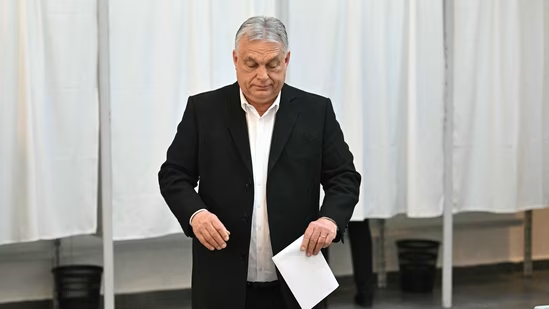
Magyar and Orban both voted in the morning, with initial participation levels confirming expectations for a record turnout. Magyar called the election a “fateful” crossroads where Hungarians would decide between “East and West.” The pro-Kremlin Orban, for his part, urged Hungarians to vote for Fidesz for their security. Both leaders said they’d respect the result of the election.
Polling stations will close at 7 p.m. local time. Hungary’s election office said it will start posting partial results on its website an hour later, with a fuller count expected later in the evening. No exit polls are expected.
Voter turnout rose to 66% by 3 p.m. and was on track for an all-time high. It exceeded the participation rate at that hour four years ago by 13 percentage points.
Contracts on Polymarket for the likelihood of Magyar becoming the next prime minister increased to as much as 88%, an all-time-high as turnout numbers trickled in, with about $69 million traded.
The Key Numbers to Watch
Magyar and Orban are both vying for at least 100 seats in the next parliament, which would ensure a majority in the 199-seat chamber. That’s the first goal their supporters will be looking for.
But the magic number is 133 seats. That would give the next government the two-thirds majority it needs to implement widespread reforms of the political system and that’s what Magyar has been targeting in order to clear away the structures and people left over from Orban’s long years in power.
Voter Turnout
Magyar has enjoyed popular support, especially among younger, urban and more educated voters. They are also highly motivated. Pollsters expect participation to approach — or exceed — the post-communist high of 72% set in 2002.
But the key question is whether Magyar manages to make inroads among the ruling party’s older, more rural electorate, which has given the prime minister four consecutive wins.
Therefore, on election night, one should watch out for how Orban’s former strongholds including his birthplace of Szekesfehervar, a city southwest of Budapest, are going to vote. They hold the key to the outcome of Sunday’s ballot.
The Quirks of the System
In Hungary, voters cast two ballots — one for a local candidate and one for a national party list. The lawmakers for the country’s 106 constituencies are all elected with a simple majority.
But after that, it gets complicated.
A so-called ‘winner compensation mechanism’ assigns some votes from the districts back into the overall national tally, and another 93 seats are allocated on a largely proportional basis.
The results of those formulae can be unpredictable, though, and smaller parties that fall either just above or below the 5% threshold to enter parliament can have an outsized impact on the overall allocation of seats.
On top of that, votes cast abroad or otherwise away from home will be counted later. So if the result is close, the outcome might not be clear on the night.
That said, the last votes to be counted — many from foreign workers and students — are expected to skew toward the opposition.
Market Reactions
The forint has been gaining over the past year as traders position for a potential opposition election victory, and strategists expect a further rally in the currency and in Hungarian bonds in case of a clean Tisza win.
If Orban holds onto power, the forint would weaken as Hungary’s access to key EU funding would remain curtailed. A contested result or signs of unrest following the outcome would be seen as even more negative for investors, who tend to sell when there is uncertainty.
A narrow victory for Tisza would mean that Magyar falls short of the super-majority required to deliver on his promises to make major changes to Hungary’s political setup. That could hand Orban and his allies continued influence in the new parliament, paving the way for slower change and long-term political bickering.
Fairness of the Vote
While voting itself is conducted with paper ballots and is generally regarded as orderly, the broader campaign environment is widely seen as uneven. Orban benefits from extensive access to state resources and a dominant, taxpayer-funded media ecosystem, while opposition campaigns face constraints in financing and visibility, particularly outside cities.
International observers have also pointed to pressure on economically vulnerable voters and allegations of vote-buying in the poorer regions where Fidesz is dominant, as well as administrative practices that can aid mobilisation for the ruling party.
With emotions running high, both parties have warned that violence could mar the vote or its aftermath. Magyar has repeatedly urged his supporters “not to respond to provocations” from Fidesz. The government, in turn, has alleged that Tisza could attempt to spark clashes in the event of a disappointing result. Neither side has provided any evidence to support their claims.