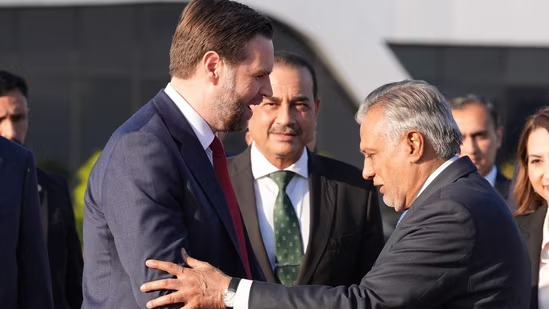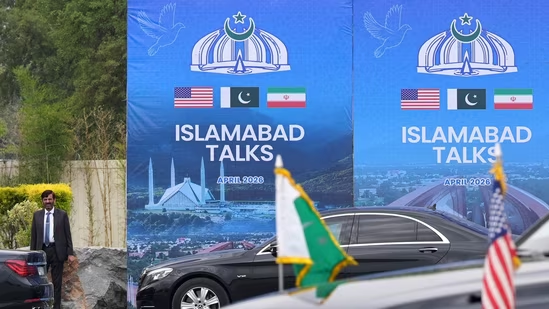
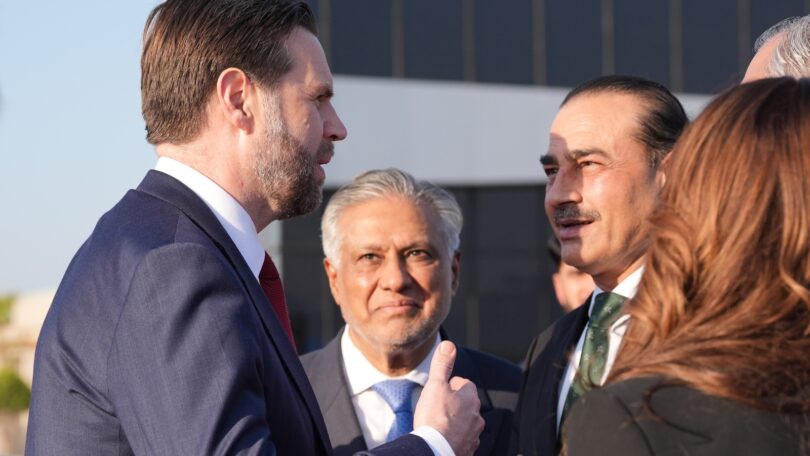
US-Iran war talks live updates: Vice President JD Vance, left, talks to Pakistan’s Chief of Defence Forces and Chief of Army Staff Field Marshall Asim Munir before boarding Air Force Two after attending talks on Iran in Islamabad, April 12, 2026.
US-Iran war talks live updates: The United States and Iran failed to reach an agreement after 21 hours of high-stakes talks in Pakistan over the weekend, with Vice President JD Vance saying that negotiations ended without a breakthrough. “We go back to the United States having not come to an agreement,” Vance told reporters in Islamabad early Sunday, adding that Washington had clearly laid out its position. “We’ve made very clear what our red lines are… and they have chosen not to accept our terms.”
The negotiations, held in Islamabad, brought together senior officials from both sides, including US special envoys Jared Kushner and Steve Witkoff, and a delegation led by Iranian Parliament speaker Mohammad Bagher Ghalibaf including foreign minister Abbas Araghchi.
The aim was to find a path to end the six-week war in the Middle East, but both sides walked away without agreement, according to Fars news agency, Iran is not planning another round of negotiations with the United States, a source said.
Islamabad talks end without breakthrough
A team of technical experts joined negotiators on Saturday in Islamabad, with talks focusing on key issues such as the Strait of Hormuz, a possible extension of the ceasefire, and phased sanctions relief, according to US and Pakistani officials familiar with the discussions, cited by news agency Bloomberg.
However, these discussions largely sidestepped the core trigger areas the Trump administration has repeatedly flagged before the full-blown Iran war.
‘Final and best offer’ from Washington
Vance stressed that the US had pushed for a firm commitment from Tehran on nuclear weapons.
“We just could not get to a situation where the Iranians were willing to accept our terms,” he said, adding that Washington had been “very flexible and accommodating” during the talks.
“We leave here with a very simple proposal, a method of understanding that is our final and best offer. We’ll see if the Iranians accept it.”
Iran blames ‘unreasonable demands’
Iranian state media offered a sharply different account, blaming Washington for the collapse of talks. According to Press TV, “excessive demands by the US prevented a framework from being reached,” with disagreements centred on “nuclear rights and control over the Strait of Hormuz”.
State broadcaster IRIB echoed that line, saying “unreasonable demands” from the US scuppered the negotiations.
“The Iranian delegation negotiated continuously and intensively for 21 hours… despite various initiatives… the unreasonable demands of the American side prevented the progress of the negotiations. Thus the negotiations ended,” IRIB said.
Tasnim News, citing an informed source, added that Iran “is not in a hurry for negotiations.”
Tensions high, atmosphere volatile
Officials described a tense and fluctuating atmosphere during the talks. “There were mood swings from the two sides and the temperature went up and down during the meeting,” a Pakistani source cited by news agency Reuters said, referring to the first round.
Notably, the Iranian delegation arrived dressed in black, mourning those killed in the war, including late Supreme Leader Ayatollah Ali Khamenei.
Strait of Hormuz, a sticking point
The Strait of Hormuz emerged as a central sticking point in the talks, along side the US’ demads over nuclear weapons.
Vance said, “The simple fact is that we need to see an affirmative commitment that they will not seek a nuclear weapon, and they will not seek the tools that would enable them to quickly achieve a nuclear weapon.”
Tehran’s demands reportedly include control over the strait, transit fees, release of frozen assets, war reparations, and a broader regional ceasefire — including in Lebanon.
Washington, meanwhile, is seeking free passage for global shipping and limits on Iran’s nuclear programme to prevent the development of an atomic bomb.
Despite a fragile ceasefire achieved just a week earlier, the failure to secure a deal marks a setback for both sides.
…Read More
The negotiations, held in Islamabad, brought together senior officials from both sides, including US special envoys Jared Kushner and Steve Witkoff, and a delegation led by Iranian Parliament speaker Mohammad Bagher Ghalibaf including foreign minister Abbas Araghchi.
The aim was to find a path to end the six-week war in the Middle East, but both sides walked away without agreement, according to Fars news agency, Iran is not planning another round of negotiations with the United States, a source said.
Islamabad talks end without breakthrough
A team of technical experts joined negotiators on Saturday in Islamabad, with talks focusing on key issues such as the Strait of Hormuz, a possible extension of the ceasefire, and phased sanctions relief, according to US and Pakistani officials familiar with the discussions, cited by news agency Bloomberg.
However, these discussions largely sidestepped the core trigger areas the Trump administration has repeatedly flagged before the full-blown Iran war.
‘Final and best offer’ from Washington
Vance stressed that the US had pushed for a firm commitment from Tehran on nuclear weapons.
“We just could not get to a situation where the Iranians were willing to accept our terms,” he said, adding that Washington had been “very flexible and accommodating” during the talks.
“We leave here with a very simple proposal, a method of understanding that is our final and best offer. We’ll see if the Iranians accept it.”
Iran blames ‘unreasonable demands’
Iranian state media offered a sharply different account, blaming Washington for the collapse of talks. According to Press TV, “excessive demands by the US prevented a framework from being reached,” with disagreements centred on “nuclear rights and control over the Strait of Hormuz”.
State broadcaster IRIB echoed that line, saying “unreasonable demands” from the US scuppered the negotiations.
“The Iranian delegation negotiated continuously and intensively for 21 hours… despite various initiatives… the unreasonable demands of the American side prevented the progress of the negotiations. Thus the negotiations ended,” IRIB said.
Tasnim News, citing an informed source, added that Iran “is not in a hurry for negotiations.”
Tensions high, atmosphere volatile
Officials described a tense and fluctuating atmosphere during the talks. “There were mood swings from the two sides and the temperature went up and down during the meeting,” a Pakistani source cited by news agency Reuters said, referring to the first round.
Notably, the Iranian delegation arrived dressed in black, mourning those killed in the war, including late Supreme Leader Ayatollah Ali Khamenei.
Strait of Hormuz, a sticking point
The Strait of Hormuz emerged as a central sticking point in the talks, along side the US’ demads over nuclear weapons.
Vance said, “The simple fact is that we need to see an affirmative commitment that they will not seek a nuclear weapon, and they will not seek the tools that would enable them to quickly achieve a nuclear weapon.”
Tehran’s demands reportedly include control over the strait, transit fees, release of frozen assets, war reparations, and a broader regional ceasefire — including in Lebanon.
Washington, meanwhile, is seeking free passage for global shipping and limits on Iran’s nuclear programme to prevent the development of an atomic bomb.
Despite a fragile ceasefire achieved just a week earlier, the failure to secure a deal marks a setback for both sides.
Follow all the updates here:
Apr 12, 2026 9:56:27 AM IST
US Iran war talks LIVE updates: What did Pakistan say after Islamabad talks failed?
US Iran war talks LIVE updates: Pakistan has called on Iran and the United States to stick to the ceasefire after their talks in Islamabad ended without an agreement.
Foreign Minister Ishaq Dar said it was crucial for both sides to maintain the fragile truce.
“It is imperative that the parties continue to uphold their commitment to ceasefire,” Dar said.
He added that Pakistan will continue its mediating role and will keep facilitating dialogue between Tehran and Washington in the coming days, even as the latest round of talks ended in a deadlock.
Apr 12, 2026 9:54:14 AM IST
US Iran war talks LIVE updates: Vance leaves Pakistan after Islamabad talks end in impasse
US Iran war talks LIVE updates: US Vice President JD Vance left Islamabad early Sunday after negotiations with Iran failed to achieve an agreement.
Vance boarded his government plane at 7:08 am local time, according to a Reutrs reporter travelling with him.
The exit comes after the US said Iran declined to accept its terms on curbing the development of a nuclear weapon, bringing the high-stakes talks to a close without a deal.
Apr 12, 2026 9:50:40 AM IST
US Iran war talks LIVE updates: Islamabad talks fall apart as war enters seventh week
US Iran war talks LIVE updates: Talks between the United States and Iran in Islamabad collapsed early Sunday after 21 hours of negotiations failed to produce a peace deal, with Vice President JD Vance saying Tehran refused to accept Washington’s key terms.
Vance said, “The simple fact is that we need to see an affirmative commitment that they will not seek a nuclear weapon, and they will not seek the tools that would enable them to quickly achieve a nuclear weapon,” he told reporters.
The vice president added that he remained in constant touch with US President Donald Trump and senior officials throughout the high-stakes talks.
The collapse comes as the war enters its seventh week, with no immediate breakthrough in sight.
Apr 12, 2026 9:32:42 AM IST
US Iran war talks LIVE updates: Pakistan urges ceasefire commitment amid stalled talks
US Iran war talks LIVE updates: Pakistan’s Foreign Minister Ishaq Dar has stressed the need to sustain the fragile ceasefire following the inconclusive US-Iran talks in Islamabad.
“It is imperative that the parties continue to uphold their commitment to ceasefire,” the minister said, adding that any breakdown could further destabilise the region.