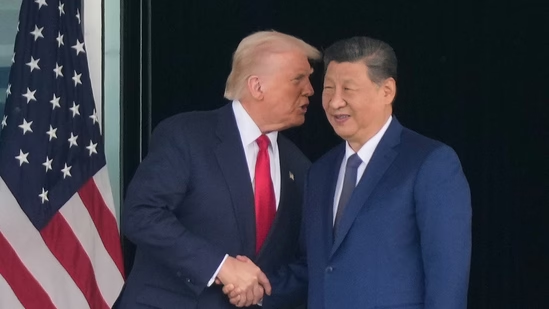
While peace talks were about to begin in Islamabad on Saturday, an incident in the Strait of Hormuz nearly derailed the fragile ceasefire between the US and Iran, also putting the high-stakes negotiations mediated by Pakistan at risk.
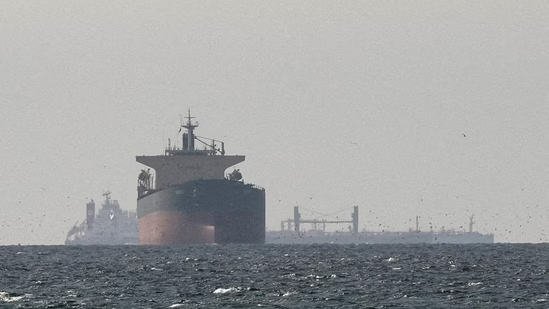
Two US Navy destroyers transited through the Hormuz as American and Iranian leadership exchanged demands, in Islamabad in Pakistan, to bring an end to the six-week war in the West Asia region. This move was seen as Washington challenging Iran’s claim of controlling the strait. US President Donald Trump also claimed on his Truth Social account that the US was now clearing the Hormuz.
What transpired between US and Iranian forces in Hormuz waters?
The US Central Command (CENTCOM) confirmed later on Saturday that two Navy guided-missile destroyers conducted operations to remove mines in the Hormuz to ensure the safe passage of vessels.
“USS Frank E. Peterson (DDG 121) and USS Michael Murphy (DDG 112) transited the Strait of Hormuz and operated in the Arabian Gulf as part of a broader mission to ensure the strait is fully clear of sea mines previously laid by Iran’s Islamic Revolutionary Guards Corps,” read a statement from CENTCOM.
Placing sea mines in the Hormuz was one of the ways Iran controlled the crucial passage, which handles a significant portion of global energy supplies from the Gulf region.
The operation was seen as a message from the US to Iran that, even as talks were ongoing, Washington intended to ensure the strait remained open.
Iranian officials in Islamabad were informed about the incident and immediately asked Pakistan to urge the US to turn back its ships within 30 minutes or face a strike from the Islamic Revolutionary Guard Corps (IRGC).
Tensions escalated in the Hormuz waters as IRGC forces repeatedly warned the US destroyers to turn back or face consequences. A radio exchange, reportedly recorded by crewmembers on a nearby civilian ship and cited by the Wall Street Journal, captured the confrontation.
“This is the last warning. This is the last warning,” Iranian forces radioed to one of the destroyers.
The US ship responded: “Passage in accordance with international law. No challenge is intended to you, and I intend to abide by the rules of our government’s ceasefire.”
Earlier reports suggested the destroyers had made a U-turn, but the Wall Street Journal later confirmed that they transited through the Hormuz without informing Iran.
CENTCOM also reiterated this in its statement, adding that US forces, including underwater drones, would join the clearance effort in the coming days.
The talks ultimately failed to produce a conclusive agreement. “The bad news is that we have not reached an agreement — and I think that’s bad news for Iran much more than it’s bad news for the United States of America… We go back to the United States having not reached an agreement,” US vice president JD Vance said after the Islamabad talks concluded.