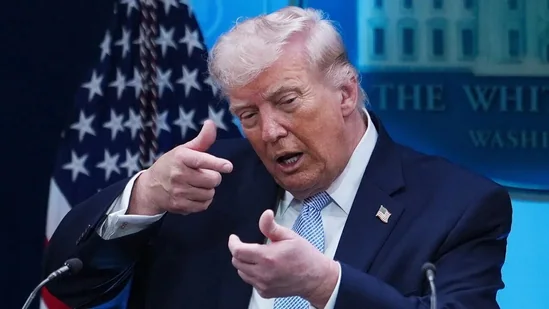
“A whole civilisation will die tonight,” the president wrote. A few days on, we know that a whole civilisation did not die. The people who feared this was a nuclear threat look like they overreacted, again. Those who rolled their eyes and said the president was bluffing were right.
A whole civilisation will die tonight,” the president wrote. (AP)
A couple of weeks ago in this newsletter I wrote about Trumpism as a method rather than an ideology. Make threats, see what happens, use force, see what happens, make new threats. This is another example. This particular threat may even have advanced a fragile ceasefire—talks begin this weekend in Islamabad. So why are those six words still so unsettling?
The clichéd response is that words matter, and the president’s words matter more. But that is unsatisfying, the sort of thing people who already agree with one another say, nodding before moving on. Why do those words matter, even now that we know the threat was not carried out?
When the president talks to foreign leaders, he speaks on behalf of all Americans. When he talks of wiping out a nation of 93m people, its ancient buildings, its schools, its shopping malls, Americans become complicit in that threat. The proposed destruction would be paid for by their taxes.
Many Americans still have a powerful belief in their country’s goodness. This is challenged when, for example, their army fires missiles that hit an elementary school for girls. Still, that sense can persist even when the country is doing terrible things. America, another president once said, is the “last best hope of earth”. He said that in the middle of a civil war. The point is not that America is always good, but that it aspires to be. Having a leader who does not share that aspiration destroys something of America’s own civilisation.
Here, in case you missed it, is the full thing: “A whole civilization will die tonight, never to be brought back again. I don’t want that to happen, but it probably will.” Hear that passive voice? He doesn’t write that he will kill an entire civilisation. The civilisation will die. It is as if someone else is going to do the wiping-out. A genocide will just happen.
There is a thrill in the sheer might at his disposal. How many men in history have been able to threaten the destruction of a whole civilisation and have that threat be taken seriously? There is a setting of terms. If you defy America, you will be erased. It’s inevitable, a force of nature that even the person making the threats cannot resist (“I don’t want that to happen, but it probably will”). He attributes the action to someone else. I may choose to wipe out your civilisation, but it will be your fault if I do. You are doing this, not me.
If those six words modify America’s character, how must they seem to Iranians? Or to other non-Americans? They suggest no remorse or pity for people who have suffered doubly, from six weeks of bombing and from their own oppressive government. Remember that a few months ago the president was trying to encourage Iranians to rise up against the ayatollahs and Iran’s torture-happy Revolutionary Guard? There are Iranian dissidents who have been sent to jail, where they sit malnourished, filthy and forgotten, just because they want their government to be like America’s.
In 2008 the Chinese dissident Liu Xiaobo wrote about how miraculous Barack Obama’s election victory—a bloodless revolution—seemed to a person stuck in a country where one party always ruled. For holding this view, and other similar ones, he was sentenced to 11 years in prison. America used to inspire people like Liu Xiaobo. It was not that long ago. If you are someone brave enough to go to prison for Jeffersonian principles, where do you look for inspiration when the president of the United States talks about erasing civilisations?
Perhaps I am overdoing this. Write in if you think I am. But I find this one hard to just move on from as the news cycle turns towards the next big thing. James Bennet, Charlotte Howard and I discussed the war, and the maybe-ceasefire, on this week’s podcast, so please listen to that and let us know what you think. You can reach us at checksandbalance@economist.com.