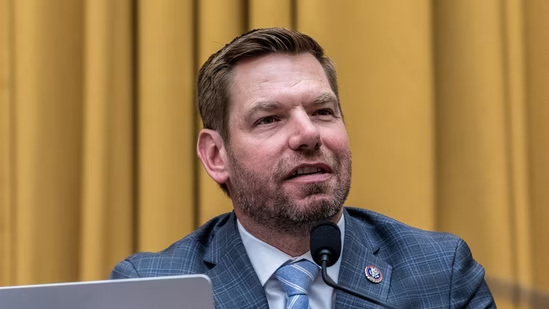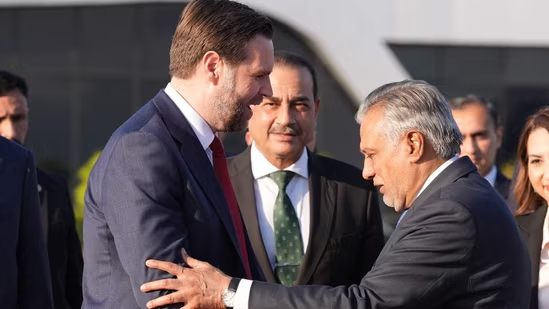

After 21 hours of negotiations, the United States and Iran failed to reach a breakthrough for a deal during their talks in Islamabad. The US delegation, led by Vice President JD Vance stated that the inconclusive talks were “bad news” for Tehran.
Delegations from Washington and Tehran arrived in Pakistan on Friday with the aim of working towards a deal and a possible permanent end to the ongoing conflict in the West Asia region.
The US delegation was led by Vice President JD Vance and comprised of special envoy Steve Witkoff, Trump’s son-in-law Jared Kushner, Deputy National Security Advisor Andrew Baker and Special Advisor to the Vice President for Asian affairs Michael Vance.
The Iranian delegation was led by parliament speaker Mohammed Bagher Ghalibaf and comprised of foreign minister Abbas Araghchi, secretary of the supreme national defence council Ali Akbar Ahmadian, central bank governor Abdolnaser Hemmati, and former IRGC commander Mohammad Bagher Zolghadr.
Ahead of the talks, both nations agreed to a two-week ceasefire in order to boost diplomatic efforts to end the war. However, Israel and the US’ exclusion of Lebanon from the peace deal has been a point of contention and has made the truce even more fragile.
Why did the talks fall apart?
As per US VP JD Vance, Iran has chosen “not to accept” the terms put forth by the US, which it has stated comprised some of its red lines.
While details of the talks have not been revealed, it is presumed that the key issue between the US and Iran was its nuclear programme.
“The simple fact is that we need to see an affirmative commitment that they will not seek a nuclear weapon, and they will not seek the tools that would enable them to quickly achieve a nuclear weapon,” said Vance, not going into much detail.
The vice president further stated that his team presented a very simple proposal, which served as their “final offer.” Vance, in previous interviews, has stated that Iran’s nuclear programme is a “red line” for the Trump administration, especially for the US President.
At the Islamabad talks, the American leader reiterated the same.
However, Iran has stated that it is not pursuing an atomic bomb and once again stated that the US is making “unreasonable demands.”
“The Iranian delegation negotiated continuously and intensively for 21 hours in order to protect the national interests of the Iranian people; despite various initiatives from the Iranian delegation, the unreasonable demands of the American side prevented the progress of the negotiations. Thus, the negotiations ended,” said state broadcaster IRIB on the talks.
Despite this statement from Tehran, the US delegation maintains that their demands were “quite flexible and accommodating.”
What are Iran’s demands for a deal with the US?
Before the talks began, Iran laid out some key demands for an end to the war, which included economic compensation for the damage caused by US-Israeli attacks, a halt to all regional hostilities against proxy groups and sovereignty over the Strait of Hormuz.
Whereas for the US, the key demands are the opening of the Strait of Hormuz and an end to Iran’s nuclear and uranium enrichment programme.