The “key” has become a running metaphor for Iranian official handles on social media as the country continues to use its lock on the Strait of Hormuz as leverage against the US and Israel, and demands that attacks on Lebanon also be stopped as part of truce struck earlier in the week.
“The key is in Lebanon’s hands,” the Iranian embassy in Bulgaria posted on X on April 9, Thursday, a day after the two-week temporary ceasefire was reached. Israel insists that its parallel war in Lebanon — where hundreds of civilians have been killed as Israel says it’s attacking Iran-backed militia Hezbollah — is not part of the truce.
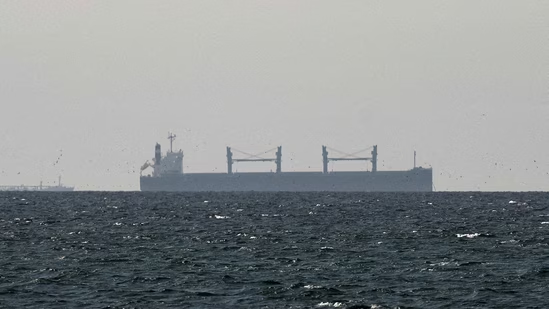
Iran differs; its officials have said a ceasefire in Lebanon is a key condition for reopening the Strait of Hormuz, the oil route through which a fifth of global supplies are shipped usually.
Before the conflict, over 100 ships passed through the strait each day — many carrying oil to Asia. With the ceasefire in place, only 12 have been recorded passing through. Reports say a toll of up to $2 million is being sought or charged.
Follow: Live updates on the US-Iran conflict
Key as metaphor
Right through the war that began with American and Israeli attacks on Tehran on February 28, Iranian embassies have carried out a coordinated and deeply satirical social media campaign.
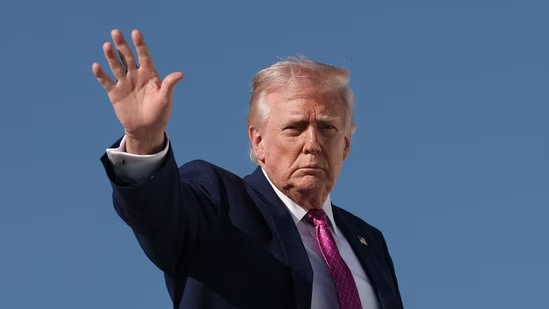
The “key” as its central metaphor first emerged as a direct response to US President Donald Trump’s ultimatum, in which he demanded that Iran reopen the Strait of Hormuz or he would end the very civilisation.
The embassy of Iran in Zimbabwe posted: “We’ve lost the keys.” Shortly after, the Iranian mission in South Africa chimed in with a reply: “Shh… the key’s under the flowerpot. Just open for friends.”
The embassy of Iran in Bulgaria took the mockery further, with a sharp jab at the US President, “Doors open for friends. Epstein’s friends need keys,” referencing the files related to sex offender Jeffrey Epstein’s cases in which Trump features.
The Iranian mission in New Delhi added to that thread, though not referencing the key as such, by telling Trump to “Get a grip on yourself, old man!”
Lebanon key
On April 9, a key image emerged in reply to one such X post.
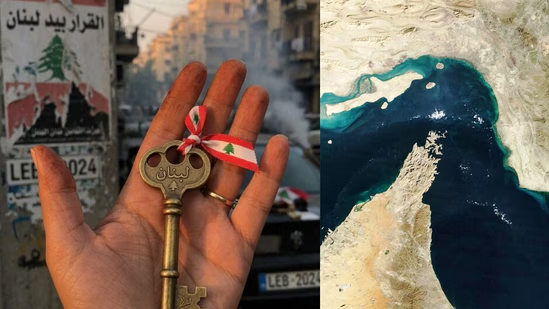
When the Iranian embassy in Bulgaria wrote, “The key is in Lebanon’s hands,” a user named ‘Persian Girl’ (@ShirinLady) shared an illustrative image showing an a key with “Lebanon” (لبنان) inscribed on it. In the image, the key has a ribbon with the Lebanese flag on it.
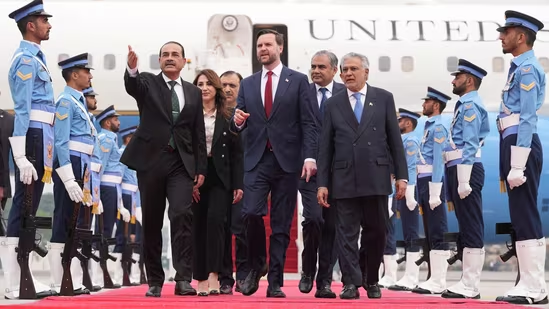
Officials from Iran’s Islamic Revolutionary Guards Corps (IRGC) have reportedly said talks set for Saturday in Pakistan wouldn’t happen unless Israel stops attacks in Lebanon.
US President Donald Trump has complained that Iran is “doing a very poor job” by not allowing the free flow of ships through the strait. He has, however, also claimed Israeli PM Benjamin Netanyahu has promised to “go low key” on Lebanon.
Negotiations between Israel and Lebanon, meanwhile, are expected to begin next week in Washington.
Israel’s insistence that the ceasefire does not include a pause in its fighting with Hezbollah, which joined the war in support of its backer Iran, has threatened to kill the deal. Even the day the truce was announced, Israel pounded Beirut with airstrikes, killing more than 300 people, according to Lebanon’s health ministry. It was the deadliest day in the country since the war began on February 28.
Iran’s parliament speaker, Mohammad Bagher Ghalibaf, has warned that continued Israeli attacks on Hezbollah would bring “explicit costs and STRONG responses”.
Netanyahu, meanwhile, said he authorised the negotiations with Lebanon “as soon as possible” with the aim of disarming Hezbollah militants and establishing relations between the neighbours. Lebanon and Israel have technically been at war since Israel was established in 1948.
In Lebanon, more than 1,888 people have been killed and 1 million have been displaced.
More than 3,000 people have been killed in Iran, a top Iranian medical officer told the state-run Iran newspaper. Iran’s government has not provided any definitive death toll from the weeks-long war.
Over a dozen people have died in Gulf Arab states and the occupied West Bank, while 23 civilians were killed in Israel. Thirteen US service members have also been killed.