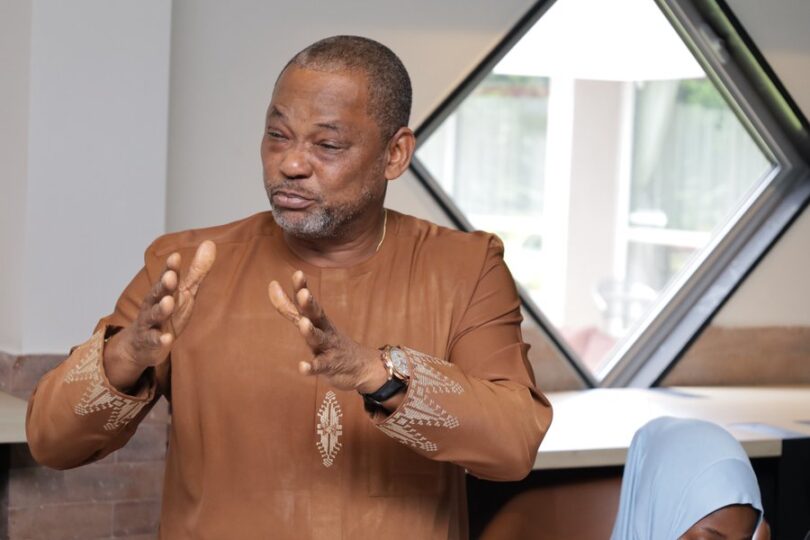

As questions continue about reviving Nigeria’s sports sector back to the glory days of yore, a former zonal director in the erstwhile Federal Ministry of Sports & Youth Development, Dr Ademola Are has suggested the employment of Physical Education graduates for effective operations of the National Sports Commission (NSC).
READ ALSO: Okoye Stars as Udinese Secure Statement Win Over AC Milan at San Siro
Dr Are, who is now a two-term president of Nigeria Rugby Football Federation (NRFF) since 2021 and first vice-president for the Union of West African Rugby Federations (UWARF) since March 2025, gave his suggestion and other revelations in this exclusive interview with Sports247…
Q: Was there a single type of kit for all of Nigeria’s national teams in the past?
A: Yes. At that time, we had a standard uniform for all our teams. Once you saw someone wear it, you would immediately know that person must be a national athlete.
That’s something I think we should go back to, so that our national athletes will have the same canvas shoes, t-shirts, track suits and so on. Let them have the same kit, irrespective of the sport – where hockey, wrestling, athletics or football.
Nowadays, a sports federation president could just decide to do any track suit that will be used for an international competition. That should not be allowed.
We used to have a store for all track suits, and any team going out to represent Nigeria would apply to the D.G. for approval of the national kit that they will use.
It should not be that a team from Nigeria will wear yellow and purple, while another will wear red and black. We should not see NFF’s teams wear black and green when they are representing Nigeria.
We should go back to what they used to do in those days when we had a unified set of kit for all our teams. It was the same jersey, track suits, canvas and everything like that for every Nigerian team.
Q: …but many federations now have contracts with different kit companies…
A: That’s true, but it’s not good enough. Even if a particular company is sponsoring your kit, you should tell them the right colours to use in designing your materials.
Tell them, ‘If you don’t put our national colours, we will not wear them.’ Let’s not sell ourselves cheap, because we are paying them for the kit.
It’s what you tell them that they will do. They will abide by it, because it is a brand you have bought into, and you will present for the country.
Q: That takes us to the issue of corporate sponsorship, which sports federations should acquire, but they keep running to the federal government for funds. Why?
A: It’s a matter of leveraging your achievements and packaging your potential impact. In those days, corporate bodies would even go to schools to pick athletes and sponsor them.
They would show interest deliberately without being invited to go in search of talents on their own. They will scout for athletes on their own and then continue to sponsor the ones that they discover.
At that time, people were trustworthy, and corruption was almost zero. There was always good interface between the sports authorities and corporate bodies.
We used to have competitions sponsored by Coca-Cola, Pepsi, Milo, Bournvita, Maltina, Peak Milk, Cowbell and many others like that in all sports; but all those things are no longer there.
Some people say it’s because of Nigeria’s dwindling economy. They say the country’s economy is not rosy anymore; but I still believe corporate bodies should support sports as a matter of social responsibility.
Q: What suggestions can you give on how to overcome economic challenges that affect corporate sponsorship of sports?
A: I can tell you authoritatively that Ghana still has a lot of corporate sponsorship in sports. If they can do it, why can’t we have the same in Nigeria?
The same companies that are in Nigeria are also over there, yet many of them are involved in sponsoring Ghana’s sports activities, but they won’t do the same in Nigeria.
I saw it when we went for the African Games, and I challenged them about it. They jokingly told me that Nigeria’s ‘big people’ have taken for themselves what they should have used to sponsor sports in the country.
They then told me that they can’t give anything to the society after it has been taken by a so-called ‘Big Man.’ That means the biggest problem in Nigeria is that we prefer to personalise corporate sponsorship, thereby denying the youths privileges they should get from companies.
That’s a big problem, and we have to stop it. Let’s go back to corporate sponsorship of sports, because we can’t rely on the federal government to do everything. It’s not possible.
I understand, though, that the present top management and officials of the National Sports Commission are seriously looking into this issue. That’s what they’re talking about when they mention things like RHINSE, New Hope Agenda, and sports ecosystem.
Q: Is the federal government’s recent reward system also a step in the right direction?
A: It’s a good step, but not exactly what we need. We don’t want one-off sponsorship. We want things that will be continuous, so that there will be assurances of new talents being discovered every day.
Let’s have more solid contributions like Zenith Bank Basketball League.
We want things that will go a long way and which would ensure longevity of sports development.
Let’s ensure a particular company sticks with a particular sport and they will do everything they can to take it to the highest level. That’s the best way we can get good results in sports.
It’s not proper to give one-off rewards … if you win a gold medal or cup, take one million naira. That is not the type of sports sponsorship we need.
We are looking for what a company will contribute over a long period to develop a particular sport. For instance, let a corporate body support Nigeria’s top para-badminton player, Eniola Bolaji, who is already a world champion.
As things are for now, what is she benefitting from her achievements? Not much. In fact, she’s getting virtually nothing in terms of corporate support for her efforts despite being physically challenged.
She’s not getting what people like her and of her level would receive as champions in Europe. That’s why I would love to see a situation whereby some corporate organisations would take her as their own baby and propel her to the highest level, then help her to remain there.
It’s actually difficult climbing to the top, but it’s easier to get there than to stay there. The main issue is how to sustain that position and keep up the momentum.
Q: What roles do you think state governments should play in developing Nigerian sports?
A: State governments, too, should take up athletes who are making Nigeria proud. That’s why I made an appeal to the Kwara State government some time ago that they should ensure Bolaji does not suffer.
My fear is that, the moment she can no longer play actively, she would be left to struggle on her own, especially because she’s a physically challenged person.
Nobody will care for her any longer once she’s not playing again. As it is now, some countries are looking for her, but Nigeria is saying she should not go.
That’s why her state should lead the way for Nigeria to take care of her properly, so that she will not regret her decision to snub those offers that are coming her way. It’s as simple as that.
There’s an age limit in sports, and there are diminishing returns in it. At a point in time, an athlete will have to stop competing actively.
Once you get to that level, you have to toil on your own, because nobody looks for you anymore at that point. That’s where the state you belong to should step in to support you.
Q: Have you ever had any regret picking sports instead of something else in life?
A: No regrets whatsoever! There are no regrets at all for me in choosing sports. It’s true that, while in school, our colleagues and some elders in the community referred to us as ‘jumpology students,’ because we faced sports, but that did not dissuade me.
Even at that time, I always felt that what they did not know was that we were actually preparing ourselves for a bright future.
At the same time, we loved sports with a strong desire, and we were very passionate about it. We then had the rare opportunity to formalise what we loved doing and what we knew how to do.
They used to mock us for wearing knickers about, and none of them wanted to be with us in sports, because they felt it was a waste of time. Many of them preferred to be engineers, doctors, lawyers and politicians, even at that early age.
That’s why they thought those of us in sports were unserious students – but now they see the difference. It’s good that the mentality about sports has changed. The desire for sports is better now, but the system no longer allows it.
All the same, I made my choice early, and I’m happy about it. Can I go to a hospital and say I want to treat a patient? Or, will I step into a carpenter’s shed to construct a wardrobe? It’s not possible!
So, I made my choice and I’m enjoying it. All those who chose other aspects of life should also stay where they are. I’m not saying they cannot be part of sports, but they should not mock people who choose to start it early.
Q: What do you have to say to the fact that people who did not participate in active sports are the ones now serving as sports officials and administrators?
A: There’s basically no real problem in that, but we need people who are passionate from the beginning and those who took sports as an academic venture, not as an afterthought.
We need the employment of more people who are PE graduates. We need physical education graduates to come into the National Sports Commission.
At present, the commission’s middle class staff is almost zero on the terms of PE graduates. After those in the top cadres, the next class of levels ten, nine and eight are mostly not with PE degrees.
They are meant to be the people who will fill gaps in the future, but they do not have academic speciality of sports administration.
New entrants are not coming in. My fear now is that, the way things are going, everything will fall to zero in terms of expertise among our sports officials.
At that point, the highest levels in Nigeria’s sports administration would be so blank. The biggest irony, though, is that we actually have PE graduates coming out of many higher institutions across the country.
So, where are they? Why are they not in the NSC? These same PE graduates cannot go and work in a hospital or the Ministry of Health. They cannot go to the Ministry of Works. The beat place for them is the National Sports Commission or, as it used to be known … the Federal Ministry of Youth & Sports.
That’s why they should think of a workplace that suits what they studied. That’s also why people should be given opportunities to go and do what they know how to do best and be in the right place for it.
Q: … but a critic would remind you that NSC’s top administrators are not PE graduates. What do you have to say about that?
A: They may not be PE graduates, but they’ve acquired some sports training along the way. People like Alhaji Shehu Dikko and others, for instance, have received some training in sports management during their career paths.
In the course of their growth as administrators, they usually go to study courses in sports management, sports marketing and other related areas of training like that. That’s why they always do well wherever they find themselves.
However, apart from those at the top of administration, we need to deliberately employ physical & and health education graduates into the National Sports Commission. We need them to grow through the ranks with their academic expertise.
They are the ones who should take over from people who are already on their way out. That’s the best way to promote efficiency in running sports to the highest height in Nigeria.
Q: There used to be a lot of facilities for sports in schools in those days, but that has also changed. What can you say about it?
A: It’s a sad development, but it keeps occurring. We even have an example in Abuja, where the minister has defaced Jabi Lake.
It’s a place where we used to go for recreation, leisure time, picnics and other forms of relaxation, but the minister has given the place to contractors to build estates there.
I don’t know what’s going on in this country regarding sports infrastructure. It’s not like that in the UK.
Over there, every local government area has its own sports facilities … swimming pool, football pitch, running tracks for athletics. Everything you need is there, so that children within the community will have opportunities to do sports.
In Nigeria, we say we want our children to do sports. We say we want to hunt for talents at the grassroots, but the facilities for it are not there. All our fields and open spaces have been taken over by rich people building mansions and estates.
So, how do we develop sports from the community level? It is not by mouth. It is not enough to say it. You have to show it through what you have physically on the ground.
Even our stadiums are mostly dilapidated, while those that are operational are not open for young athletes to be freely used. We should have a situation whereby people are allowed to come in once they show their involvement in one sport or the other.
Let them come and train. There shouldn’t be unnecessary restrictions. Just give them normal rules and regulations to guide them … not that every Tom, Dick and Harry will step in and start using the facilities anyhow.
There must be guidelines that make it possible for young talents to use sports facilities. In fact, we can even use those facilities to generate funds for the country.
For instance, someone who wants to use the swimming pool can be told to pay a token. The talented child would pay once the facilities are there and are well taken care of.
Q: What do you think is the major reason behind poor facilities in Nigeria?
A: The biggest issue is because sports are placed in the concurrent list of governance in this country. That means its administration and direct funding start at the federal government level, instead of being handed over to each local government.
The question then is: What is the local government chairman doing regarding the development of sports in Nigeria? Instead of thinking about sports, everybody is grabbing land in the community. Everywhere they see land, they want to build a house on it and make money.
They have forgotten that creating spaces and leaving them open will provide opportunities for the talented youths in the community to engage in healthy activities that would enhance sports and propel it to the highest level.
Open spaces in the community will enhance sports development and help us to expose our children to greater avenues of building their talent for the future glory of our country.
It is at a young age that they need to be exposed because they will learn better at that level. As they are growing up, they begin to understand different aspects of sports, and they start to specialise.
Sadly, it’s different nowadays, to the extent that, even during the holidays, students don’t have any place to run as budding athletes or play meaningful football games.
There’s no place for basketball, volleyball, tennis or hockey. There is nothing like that any longer at the community level. That’s why youth sports is going into extinction in Nigeria.
Q: What can you say about the current state of youth football in Nigeria?
A: It’s the same thing with what’s happening generally in sports at the grassroots in Nigeria. It’s a major reason why the Golden Eaglets and Flying Eagles are no longer doing well.
Forget about all those flashes at the league level or people celebrating one victory or another.
Are we really developing our footballers and athletes from the grassroots? We are not. That is the problem with Nigerian football in particular. We are not developing talents properly, and our sports federations are not involved in real grassroots development. Everybody is looking for money and shortcuts to glory.
That’s why I say that giving cash rewards and national honours is not the same with sports development, as far as I am concerned.
Sports development is going back to the local government level, encouraging students to participate in competitions, using our zonal offices to propagate talent discovery, and grooming young talents from scratch. All of these are the real elements of sports development.
We must also charge all the sports federations to ensure they get involved early in the progress that athletes make from a young age. That’s the most important thing that Nigeria needs for our sports to grow and get better.
Q: What then can we do to get back to the glorious days of Principals Cup in school football?
A: That’s another duty for the grassroots department in the NSC. Unfortunately, the last time we organised Principals’ Cup was five, six years ago. That was when I was the director in that department.
The blueprint is there and and the programme is meant to be done, but if you don’t keep pushing it to the bosses, nothing will happen. You must not sit down and expect the D.G. or chairman to do everything.
It’s the person in charge of that department who will propagate the process of bringing the gospel of sports development into physical reality.
It was through Principals’ Cup that we had Henry Nwosu, Tarila Okorowanta, Tajudeen Disu, Paul Okoku and others like them in Lagos State. There were also many others like them all across the country. We revived it during the time of Chief Sunday Dare as the honourable minister … though the money set aside for us at that time was not much.
The most important thing those in charge should understand is that they cannot get all the money they want or ask for in order to do youth programmes.
You should be able to make use of the little that is available and provided by the office.
With your dedication and commitment, you should be able to do things. But there’s also the issue of backbiting.
In my days, someone went to report me to our permanent secretary, Mr Adeshola, that I was not carrying the staff of other departments along for the National Youth Games in Ilorin. I simply told him that it was not for all the departments.
I told him, “Oga, if I carry them along, they’ll be asking me for allowances, but my own staff know me, and they will not ask me for money. That’s why I will take only people in my own department along with me, because we want to succeed together.”
There was also a year in which I used only N10m to organise the National Youth Games. That’s the type of vision, planning and determination that we need among current officials in the department.
We need to go back to the basics. We need to dust the papers, revisit the blueprint and revive our plans. The programmes are there. All we need are people who are passionate about sports development. They should reach out to individuals in the public who are also passionate about them to support youth development programmes.
We used to have people like Chief Nathaniel Idowu, who was sponsoring youth football with a passion. There was a year I called his son to support us for the National Youth Games, and I simply told him to loan me N5m for us to organise it. He kindly did so, and I was glad that the minister gave us the money back after the programme and I refunded the man who gave us the loan.
That’s one of the instances that show how we have to be proactive in doing things. We must come up with great ideas and have a strong will to carry them out.
I also knew at that time if I had gone to the present D.G. and asked him to support me, he would have helped, though he was not in office at that time. We still have people like that who are passionate about sports development.
Another person in that category is Chief Kunle Soname. He gave us N70m when I approached him for assistance towards the Olympic Games. We needed it to help some of the federations prepare their athletes.
So, whoever is in charge of the department of grassroots sports development should think out of the box and approach people who can lend a helping hand.
He also has to be on the neck of his bosses, in order to get approval for youth programmes.
The chairman and D.G. both have too many things on their tables. So, it’s up to you to ensure programmes continue in the area of sports development. That’s why you are in charge of a particular unit and department. Go all out to get things done.
Meet your bosses, liaise with the federations, check the zones and do everything to ensure you popularise the National Sports Commission all over the country.
Work hand-in-hand with the zonal coordinators and ensure that states’ directors of sports are behind you. If you don’t show passion and commitment, or you don’t think outside the box, you won’t get anything done.
You would just sit down without doing anything and there won’t be any achievement to show. Don’t say because you are a civil servant you will not work if they don’t give you money from the office.
That would only make you redundant. So, you have to get up, go out and do something that will bring honour to the commission and credit to yourself.
Q: Those are strong words of sdvice from you, sir. We appreciate you for giving us so much of your time….
A: You are welcome….
This is the concluding part of the special interview with Dr. Ademola Are, as conducted in Abuja by Jide-Ojo Olushola, the CEO of Sports247.