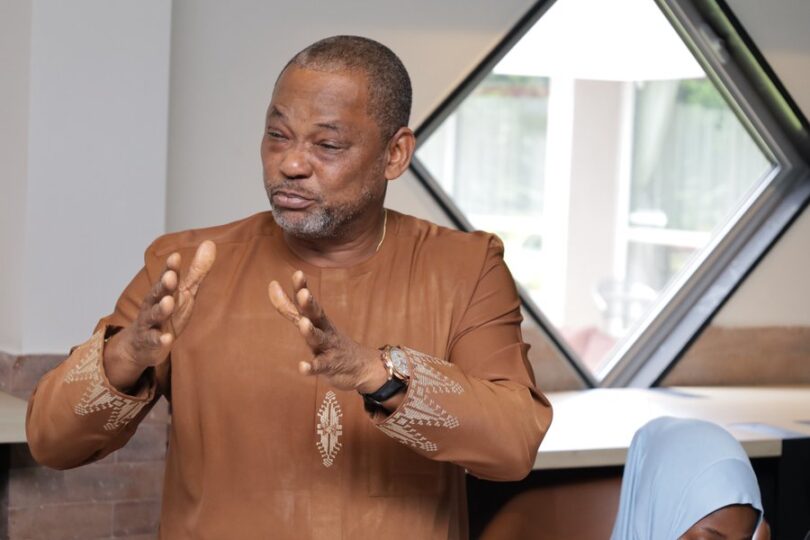

As questions continue being asked about reviving Nigeria’s sports sector back to the glory days of yore, a former zonal director in the erstwhile Federal Ministry of Sports & Youth Development, Dr Ademola Are has suggested the employment of Physical Education graduates to instill effective running of the National Sports Commission (NSC) in its daily operations.
Dr Are, who is now a two-term president of Nigeria Rugby Football Federation (NRFF) since 2021 and first vice-president for the Union of West African Rugby Federations (UWARF) since March 2025, gave his suggestions amidst other revelations in this exclusive interview with Sports247…
Q: Thank you, sir, for giving us some of your precious time to hear from you. Let’s start with an introduction … who is Dr. Are?
A: You are welcome. Thank you for this opportunity. Dr. Are is a passionate and humble gentleman from the family of Major Emmanuel Olatunji Ali (retired) and Alhaja Suwebat (nee Laguda) from Lagos State.
I was born on April 30th, 1961, at Marcy Hospital, near Ita Faji, Lagos Island. I grew up at Lagos Island, and my basic education was at Holy Cross Primary School. I attended Baptist Academy for my secondary education in O-levels and A-levels.
I then attended the University of Lagos for a Bachelor of Education degree in Physical & Health Education (popularly known as PE). I also had my masters in Sports Administration at UNILAG, which is the University of Lagos.
Apart from that, I’ve attended many courses overseas, as well as at ASCON (Administrative Staff College of Nigeria) near Badagry in 1997. I also attended a senior programme at the Administrative Staff College, Kuru, Jos.
All the courses I’ve attended have been in the area of management. Some of them even took me to the UK, USA, South Africa and some other countries like that. It’s all in search of more knowledge and fresh ideas for effective sports administration.
Q: That’s very elaborate and quite exciting. Were you into sports while you were growing up?
A: Yes, I was into sports right from my primary school days, and my first prize was at The Redeemed Christian Church of God. That was when they were starting off newly, and I was in Primary 6. It was at the Redeemed Church that I won my first prize as a sports student.
My games master was Mr Ajayi. Thereafter, at Baptist Academy, I was the games prefect, and one of my colleagues was Tajudeen Disu, who went on to play for the famed Abiola Babes FC of Abeokuta and the Super Eagles of Nigeria.
I also played hockey at Baptist Academy, and I was the team captain.
I also participated in some athletics events, and I was in charge of all sports activities when I was a student at Baptist Academy. During that time, we won the Lagos State Schools Hockey Championship throughout my years at Baptist Academy, and that boosted my interest in sports.
It was from Baptist Academy that I was picked to represent Lagos State at the National Sports Festival, Oluyole ’79 in Ibadan. Thereafter, I went to the University of Lagos, where I recided in El-Kanemi Hall throughout my stay in the institution. I became the sports secretary for UNILAG and represented Union Bank in hickey.
I was part of their team to the John F.K. Hockey Cup in the USA in 1981, 1982 and 1983, when we won the competition.
Q: That was surely great. Was there any reward for your achievements?
A: When I was the sports secretary at UNILAG, I was able to enjoy certain benefits. I had many privileges as the sports secretary, but I also achieved many things outside the arena. I was the one who introduced floodlights at UNILAG Sports Centre.
That was sometime between 1983 and 1984. I was also the sports secretary who brought Chief MKO Abiola to UNILAG during the final of Akintunde Ojo Memorial Football Competition.
He immediately granted me a scholarship to go for my masters, but I couldn’t benefit from that opportunity because I already had a Lagos State scholarship.
I also had a federal government scholarship, which made my options quite difficult. In fact, things were very rosy at that level, because I was deeply and actively involved in sports.
Q: Tell us about the lights you got at UNILAG Sports Centre. How did you do it?
A: The lights at the sports centre were inspired by what I saw when we went for NUGA at Ahmadu Bello University. I noticed that their basketballers were training in the night under floodlights. I told myself, ‘Since ABU can have it, why not UNILAG?’
So, I started thinking about how to make it work. What eventually helped me was that, in those days, the students used to pay a token fee for sports development.
So, I approached the university authority through the sports director at that time, Mr Adebanwo. I suggested to him that we needed to spend some of the money on a viable project for the sports centre.
After initial reluctance and much pressure from me, they agreed, and we got the lights. That’s what the students are still enjoying up till now.
Q: Tell us about your academic progression after leaving UNILAG…
A: I actually had my masters in UNILAG after my first degree. I later went to the US for an exchange programme that lasted three months.
Many people thought I would stay back in the US, but I felt home is always the best. No matter where you are, home is better.
That’s why I decided to come back home, and I soon went for my NYSC service in Ondo State…
Q: How did you then join the Federal Ministry of Sports?
A: During my NYSC year, I was the overall parade commander for Ondo State and I won the special service award. It was during my set that the then president, General Ibrahim Babangida, started the policy of automatic employment for NYSC awardees.
I won a national award and the gold medal, which I still have displayed on my wall, qualified me for automatic employment.
Although they gave me the employment during the passing out parade, I did not accept it immediately, because I went back to UNILAG for my masters. Fortunately for me, after my masters, the job was still available for me, and I took it up in Abuja.
However, at that point, I only thought that I would do it for a few years and go back to Lagos. But, as God will have it, I got stuck in the federal civil service…
Q: Why did you initially think you would do the job in Abuja for only a few years?
A: My original plan was that I would get a job at Union Bank in Lagos. At that time, they were giving employment to players and coaches of their hockey team.
I was playing hockey for them – first as a secondary school student and later on as an undergraduate. So, I wanted to enjoy the benefit of employment attached to it.
I was ready to work for them, but I was advised against it by the man who was in charge of their sports at that time, Mr Owopetu.
He said, ‘Look, go to the civil service. It will be better for you. That’s where you will have job tenureship and security of appointment.’ His words helped me in making up my mind.
That’s how I joined the Federal Ministry of Youth, Sports, Culture & Social Development instead of seeking employment with Union Bank. All the same, I still remember they were giving us holiday jobs. Those were some of the things that kept me busy and focused while I was a student.
However, despite the opportunities looking rosy at Union Bank, I took the advice of Mr Owopetu. That was how I found myself in the federal civil service.
Q: In what department did you start when you joined the ministry of sports?
A: Actually, I did not start immediately in the ministry of sports. Although I opted for the Federal Ministry of Youth, Sports, Culture & Social Development when I applied, they did not give me something in sports.
My hope had been that they would put me in a sports department from the beginning, but they sent me to social development, where I was told to work with visually challenged people.
My first place of work was at the blind centre of Air Force Base, Ikeja. I was training visually challenged people on how to do recreational activities and sports. They had their own way of doing things, and I was meant to guide them.
Q: How were you able to cope with that task, or had you done it before they took you there?
A: No. I never had previous experience in that job, but there was a teacher who I worked with at that time. We worked closely together, and we were able to teach many blind people how to be useful socially.
At the end of the day, we were able to encourage them and provide ideas through which they could be rehabilitated in their various states. They were given money, equipment and links that would help them start their own business at their various bases.
Q: How did you then join the sports sector?
A: I reapplied for deployment to sports during the tenure of Dr. Amos Adamu. I wrote a letter to the Civil Service Commission, which then recommended me to the ministry.
I had actually applied a long time earlier in the time of Babayo Shehu, after I went to see him with one Mr Adedoyin, who was the admin officer; but they had a lackadaisical attitude about it.
Unfortunately, they did not want me to cross from social development to sports. I waited for them to reply, but they did not – yet I did not give up. The minister at that time was Air Commodore Bayo Lawal.
He encouraged me to meet Babayo Shehu in his office, and I went there, but they kept me waiting. I later had to force myself into his office, and he promised to get back to me; but he never did up till the time he died.
All the same, I was later able to move to sports during the time of Dr. Amos Adamu. I was posted to Kaduna as a zonal coordinator.
Incidentally, Babayo Shehu’s younger brother was living in the hostel there as a squatter. I just told him the story about his brother, but I did not force him out. That’s an example of the coincidences of life.
He was actually living in the sports hostel, which was not approved for him. I found out, but I allowed him to stay, in spite of what his brother did to me. God knows the best.
I later met Babayo Shehu before his death, and I told him what he did. He then apologised, and that’s how the matter ended. The botttomline is that my route into sports administration was not as smooth as people might think.
Q: What was your tenure like up until you retired from service?
A: I came in as a senior sports officer, and I grew through the ranks, up to the post of director grassroots sports. It was during my time that we introduced the National Youth Games.
We organised it consecutively at the University of Ilorin for five years, no break. We were able to manage the situation with the limited human power, structures, equipment, finance and environment that were available.
I should say we did very well during my time as zonal coordinator in Kaduna; but how I got there was another interesting story about my civil service career.
It happened after Chief Patrick Ekeji called me one day and said he wanted to send me to Kaduna, if I would accept the offer. I accepted and drove myself in my car all the way to Kaduna.
I was there for five and a half years. During that time, there was a great turnaround for sports in the North-West zone. It is also interesting to know that the title of ‘Doctor’ that I have before my name was given to me when I was in Kaduna.
It was an honour given me by Commonwealth University because they were amazed by the rate and quality of my activities. They invited me to Switzerland and I went there physically for the formal presentation. That’s how I became Dr. Are.
People started calling me ‘Dockie, Dockie’ and, to that, I say all thanks to God. It’s not by my effort alone, but through the help of my creator.
Probably, it’s because of my experience doing grassroots activities that I was able to do my best in Kaduna. I also thank the wonderful staff who worked with me. Most of them are now assistant directors, full directors and in other top positions. They are doing well wherever they find themselves.
Q: After Kaduna, what came next for you?
A: Incidentally, I had two tenures in Kaduna. I was initially taken away from Kaduna and given a new role in Abuja. I had not settled down fully when all the sports directors in the North-West zone went to meet Dr Adamu and begged him to send me back to Kaduna.
They told him that the person who took over from me was messing up. So, I was sent back to Kaduna for a second tenure. At a point, I remember that Dr. Tijani Yusuf told me jokingly that even if I turn Ahmadu Bello Stadium into something that looked like London, I can’t take it to Lagos.
I said no problem and continued doing what I loved doing. I faced the job to the best of my ability, and I was able to achieve what I could … all of which are on record for everyone to see.
Q: You are now retired … tell us about it …
A: By and large, I retired from the federal civil service, but I am not tired of doing sports activities and programmes. Sports have always been part of my life.
So, when I retired, I was called upon to contest for the position of the president of Nigeria Rugby Federation. That is also another very interesting part of my story.
It did happen that my advent into rugby was a deliberate move that came in response to a call by the then honourable minister, Chief Sunday Dare. He said he wanted me to go to rugby and sanitise the place to the best of my ability and experience in administration.
He urged me to make sure everything went well in rugby … without any noise, litigation or rancour. He wanted me to take peace making efforts there and settle everything amicably.
I thank God that, today, all negative issues have been put under the carpet through constant dialogue and reaching out to major stakeholders.
Q: So, what’s it been like as president of Nigeria Rugby Football Federation since 2021?
A: Since I joined them, rugby has been able to rise. Though it’s rising slowly, it’s surely rising. From zero level, we are now number seven in Africa and number three for Rugby Rising in the world. We are also one of the five most advancing and fast developing countries in the world of rugby in terms of age-group activities.
We are doing our best, and I know we can do better, but one problem is always funding. One of my philosophies is ‘if you tell me you can’t employ me because I don’t have the experience, how will I then get experience if I am not employed?’
It’s the same regarding our activities in running rugby – how will we do things without money? We need funds to make sure we develop rugby properly.
Apart from that, everything is peaceful in rugby because we allow the status quo to remain in some areas because we don’t want to rock the boat, and we want to maintain peace.
That’s what we are enjoying now and that, to me, is more important for now than any crumbs we want to see coming our way. By and large, things are moving one way or the other.
Q: What has been the secret of your progress this far? And, do you have any support from your family?
A: Yes, my family is always there to support me. I am happily married with children and, by the grace of God, they are doing well. There’s nothing like a secret of success for me. It’s just God that’s on my side.
At the same time, I want to thank my bosses – past and present – at the National Sports Commission … Dr Amos Adamu, Dr Akin Amao, Chief Patrick Ekeji, Honourable Bukola Olopade, Alhaji Shehu Dikko; I thank them all for their support.
I also remember Abba Yola of blessed memory … very quiet, hard-working, and unassuming person. These are people that I’ve worked with over the years; and I thank them all for helping me one way or the other.
There’s also Peter Nelson, Steve Olarinoye, Mr. Alex Onyewenwa, and so many others. I am grateful for the privilege of working with them, and I thank God for making it possible. I thank God for the opportunities that I had with so many people who have imparted my professional career.
I sincerely appreciate having them around me. I also thank my family for standing by me and for all journalists who publicise my activities while also keeping me on my toes to do more.
Q: Let’s go back to the beginning; tell us about your most memorable day when you were in secondary school…
A: That should be when I won my first medal in sports. It came from a 400m race in athletics…
Q: That’s a surprise … how come then that it was in hockey you made your biggest marks … instead of athletics?
A: It so happened that at Baptist Academy, where I had my secondary school education, we had the opportunity of taking part in so many sports activities. I loved athletics, but there were no tartan tracks at that time, and we often had to run barefooted.
On the other hand, hockey became very attractive to me because it’s a team sport and we were always in a group. All of us used to camp in the hostel together, and that brought us closer as a team.
We were training every day and playing matches almost every day as well. We were always happy as a group. On the other hand, athletics depends on your individual efforts for you to win anything.
Moreover, looking at my propects at that time, it appeared that it would be tough for me to make it big in athletics. There were many top athletes that were doing well at that time, and I felt there wouldn’t be any space left for me to fit into.
Q: What about school football in those days?
A: Yeah, school football was also quite interesting at that time. We had young talents like Henry Nwosu and many others coming up. The reigning schools were CMS Grammar School, Saint Finbarr’s College, Saint Gregory’s College, Igbogbi College, and so many others. My school, Baptist Academy, was also good in football, but I had already settled into hockey.
I was not in the football team, but all of us were always together as sports students. I then became the sports prefect and I had to lead the teams. My name is still in their record books and also pasted to the wall in the office.
I was always in charge any time we went for sports competitions. I would be in front leading songs and chanting to cheer the team up. I only specialised in hockey because I felt there were more opportunities for me there.
Union Bank was there, and they were always going round to scout for players. They encouraged us by giving us holiday jobs or part-time employment, and they paid us stipends.
They gave us rare opportunities and, as a young person who needed lots of support, what Union Bank did was a huge motivation for me. On the other hand, it was like nobody cared for secondary school athletics in those days.
Q: What were your most memorable moments playing hockey as a student?
A: We were able to win so many medals for Baptist Academy as a hockey team. At that time, about six or seven of us were in the national team. One of the big players then was the present secretary-general of Nigeria Olympic Committee, Popoola. He was also playing for Union Bank, and he used to come from University of Ife.
Many others like that made the place very lively and successful. We were all together having fun and winning competitions. We were so good individually as well as collectively, and many of us became sports administrators as we got older.
Q: Very interesting memories, but what can you say about the changes that have occurred nowadays compared to back then?
A: Yes, so many things have changed. In those days, our parents used to take us out to do sports. They would buy kit for us and take us round to see competitions. Also, in those days, most schools were involved in sports.
Many of them operated with the boarding house system. It was like that until Governor Jakande came and scrapped it. Many football fields and playgrounds were turned into classroom blocks. The boarding system was also scrapped.
In our early days as students, the boarding house system really encouraged and motivated us. It assisted so much in the development of sports among students.
In those days, all schools had time for sports. Between 4pm and 6pm every day, we would all step out of the hostel to engage in one sport or the other. If you want to run, play football or go for hockey, you could do whatever you wanted to do. That really encouraged most of us.
Another thing was when you saw your colleagues come to school in national team jerseys. It was always a moment of joy for us. Money was not there, but we were happy to be in groups with our kit.
You would see us in track suits … green and white. So, everybody was happy. It’s not like nowadays, when students hardly engage in sports and even those who are there wear all sort of track suits as a team.
Sadly, even athletes in our national teams now wear multi-coloured kits and different designs to represent the country. There is no longer one uniform of track suits for Nigeria’s representatives.
*Watch out for the really EXPLOSIVE concluding part of this interview with Dr Ademola Are….