
Thousands watched the nail-biting return to Earth for the four crew members during a perilous landing which saw them lose contact with mission control for six minutes
From a dramatic lift-off to a “bulls-eye” landing it’s been the trip of a lifetime for Artemis II’s four-person crew who completed history yesterday after a successful splashdown.
Their first words after checking in with mission control after a re-entry 32 times faster than the speed of sound were, “What a journey.”
The Mach 32 fiery descent had not been not witnessed since NASA’s Apollo lunar missions of the 1960s and 1970s and drew crowds to watch history in the making.
Hundreds gathered at a watch party at the Air and Space Museum in San Diego close to the landing site, while thousands more watched on TV and Netflix.
Commander Reid Wiseman, pilot Victor Glover and mission specialists Christina Koch and Jeremy Hansen travelled deeper into space than any other humans have ever done before.
READ MORE: Artemis 2 astronauts to splashdown wearing gravity suits in 2,700C heatREAD MORE: The jaw-dropping speed Artemis II will splash down to Earth is hard to fathom
They were said to be ‘happy and healthy’ as they were helped from the Orion capsule onto an inflatable having splashed down in the Pacific Ocean after a 10-day journey.
Orion’s three main parachutes deployed slowing the spacecraft to less than 200 feet (61m) per second before they hit the water at speeds of 17mph..
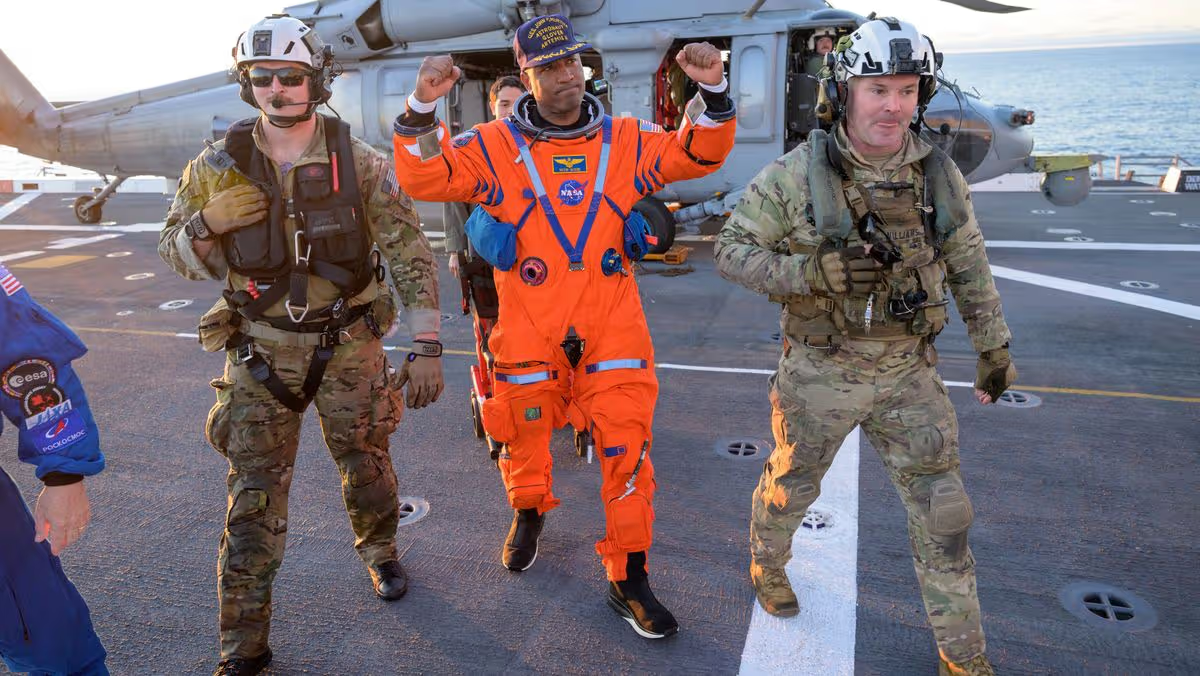
The crew landed right on schedule and within a mile of its target. “A perfect bull’s-eye splashdown,” reported Mission Control’s Rob Navias. They were hoisted into US helicopters and flown to the USS John P Murtha, where they were seen walking, smiling and hugging crew members on deck before receiving medical check ups.
The mission tested space hardware and life support systems that will be crucial to Nasa’s plans for the next lunar landing in 2028 and its ambitious future quest to build a moon base by the end of the decade.
It was successful but yesterday’s landing was said to be the most perilous point of the trip. Particular attention was focused on the capsule’s critical heat shield, designed to endure extreme temperatures during atmospheric reentry. During the spacecraft’s previous unmanned test mission in 2022, the shield’s outer surface returned with significant pockmark damage resembling the lunar surface.
Lead flight director Jeff Radigan, like many observers, expected to experience some of that “irrational fear that is human nature,” particularly during the six-minute communications blackout before parachute deployment.
But there was relief and cheers as the capsule hit the water unscathed. Jared Isaacman, Nasa’s administrator, called the astronauts “almost poets”, and “ambassadors for humanity”.
Donald Trump, the US president, posted that he “could not be more proud” of the astronauts, and space agency.
Nasa’s associate administrator Amit Kshatriya told reporters at the Johnson Space Center in Houston that the success of the Artemis II mission belongs to thousands of Nasa workers, and partners in the international and private space communities.
“You all heard the crew’s words during the mission. They were incredibly inspirational. They carried the torch from Apollo around the far side of the moon. Their words belong to them. We’ll get to hear from them as soon as they’re back here. But tonight belongs to the team that built the machine that they rode.
“The path to the lunar surface is open, but the work ahead is greater than the work behind us. It always will be. 53 years ago, humanity left the moon. This time we return to stay. Let us finish what they started. Let us focus on what was left undone. Let us not go to plant flags and leave, but to stay with firmness in our purpose, with gratitude for the hands who built the machines and with love for the ones that we carry with us.”
Sean Quinn, Nasa’s exploration ground systems manager, said he had taken a phone call from Artemis II commander Reid Wiseman as he awaited the start of the briefing: “It was so great to hear his voice and tell us that all the crew is OK, and we could say that we did our mission. We accomplished what we set out to do.
“I’m very proud of the efforts of the team that supported both the launch and recovery operations, alongside our navy partners. All the hard work and dedication over the last couple years paid off today, and the team did a great job.”
The mission saw the astronauts fly around Earth’s closest neighbour and sets the stage for future lunar landings. An announcement of Artemis III is expected ‘soon’ according to entry flight director, Rick Henfling.
It’s the start of a new era of space exploration, one that Nasa hopes will lead to a dedicated “Moon base”.
As splashdown time approached earlier, the family of Canadian astronaut Jeremy Hansen were waiting along with the rest of the world to see the Artemis II crew return.
Ashley Hansen, one of the astronaut’s twin daughters, told reporters her mum and brother watched the splashdown from Mission Control, while she watched in Montreal, Canada with her sister.
“I’m just going to give him the biggest hug. I think that we’re all just going to be astonished he did it,” she said.
Ashley, 20, said once her family is reunited they will sit down to chat with her dad about his adventure from start to finish saying: “I reckon that’s going to be the greatest story of all time.”
Artemis II neither touched down on the moon nor circled it. Yet it shattered Apollo 13’s distance record, marking the farthest any human beings have ever traveled from Earth when the crew hit 252,756 miles (406,771 kilometers).
Then, in the mission’s most emotionally charged moment, the tearful astronauts requested permission to name two craters after their lunar spacecraft and Wiseman’s late wife, Carroll.
During Monday’s record-shattering flyby, they captured never-before-seen footage of the moon’s far side, along with a total solar eclipse. The eclipse, in particular, “just blew all of us away,” Glover said. Their awe and passion captivated audiences worldwide, along with their stunning photographs of the moon and Earth.
The Artemis II crew echoed the spirit of Apollo 8’s pioneering lunar voyagers with Earthset, capturing our Blue Marble descending behind the gray lunar surface. It evoked memories of Apollo 8’s iconic Earthrise photograph from 1968.