The Artemis II crew are preparing for re-entry back to earth, after travelling further away from our home planet than anyone ever has before – but getting home is itself filled with danger
The Artemis II crew are about to face the most dangerous part of their mission, getting home.
The world has watched captivated as four astronauts ventured further away from planet Earth than anyone has ever managed before – with photos and video clips from their voyage into space sweeping across the internet. After breaking records and inspiring people the world over, NASA’s Victor Glover, Reid Wiseman, and Christina Koch, as well as Canadian Space Agency astronaut Jeremy Hansen, are heading home.
One exceptionally memorable moment during the daring journey saw the crew name a “bright spot” crater after Commander Reid Wiseman’s late wife, Carroll Taylor Wiseman, who died from cancer back in 2020 – giving new meaning to the often uttered phrase, ‘love you to the moon and back’. “We all pretty much broke down right there,” Wiseman has reportedly said, adding it was the “pinnacle” of the adventure for him.
WATCH Artemis II’s re-entry live on the Mirror Blog
But now after preparing for years and conducting their mission, it’s time for the four strong crew of highly trained astronauts to return home – which might be one of the biggest challenges yet. Due to arrive back home, in the early hours of Saturday morning, safely managing their splash landing in the ocean off the coastline of San Diego is no mean feat, with officials “anxious” about the process that will see their craft turn into a “fireball” as it re-enters the Earth’s atmosphere at speeds up to 23,839 mph, this is 40 times the speed of a normal airplane flight.
As the Orion capsule heads home, it has to go through three trajectory correction burns – this is where it fires up its thrusters to ensure it’s exactly on the correct route path home and crucially that it’s moving at the perfect speed required for the trip. The final burn happens just five hours before the big moment of re-entry into the Earth’s atmosphere.
Before they reach this point though, the astronauts need to don their spacesuits inside the crew module, which will break away from the service module – this part of the capsule contains the engines that have moved the craft through space, and will burn in the atmosphere, so it isn’t coming with them.
About 76 miles from the surface of the Earth, things start heating up – literally. Plasma that is incredibly hot will in just seconds “build up” around their craft because of the friction caused by the atmosphere and temperatures can reach up to 1600 degrees celsius. The crew will be kept safe from these super-high temperatures through a heat shield that has been exposed ahead of time, but during these moments all communications with NASA will be totally blocked by the plasma.
However, during in the uncrewed first Artemis mission back in 2022, “chunks came off” of the heat shield and it “cracked” reports The Sun. Luckily the craft in that test did make it back to earth, so NASA ruled it was safe for use on this mission. Based on the test flight, the space agency has made some alterations to the route home, ensuring that the moment of re-entry into the atmosphere is as short as possible, but the crew will be coming back at a higher speed.
The heat shield is completely crucial to the astronaut’s safe return, so the prospect of it not operating perfectly keeps one NASA administrator “up at night” because there is “no plan B”. Jared Isaacman has explained: “In terms of what keeps me up at night, my blood pressure will be elevated until they’re under parachutes in the water off the West Coast.
“There’s no plan B there. That is the thermal protection system. The heat shield has to work.”
However one heat shield expert has issued a stark warning about the system and the “serious risk” associated with it. “The technical and organisational issues associated with the Orion heat shield represent a serious risk. History shows accidents occur when organisations convince themselves they understand problems they do not. This issue exhibits the same patterns that preceded past catastrophes,” said former astronaut and NASA engineer Charlie Camarda.
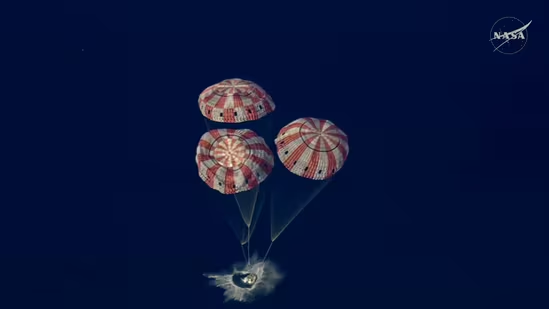
After getting through the extreme heat at the re-entry point, the cover has to fall away from the crew module to allow their speed to slow and for the parachutes that do this to work properly. There are two parachutes – 23 feet in width – that will help the slow down the velocity, and they are deployed at 25,000 feet, hopefully getting the module down to 307 miles per hour.
In a carefully planned and choreographed procedure, three smaller parachutes come into play at about 9,500 feet which pull out the main parachutes that do the work of slowing things down even further – these final three are huge at 115 foot wide – and they will help the capsule get down to just 17mph from 130mph so they can splashdown safely.
Amit Kshatriya – NASA associate administrator – has said they are “confident” this will all work out as planned, but adds, “The crew has done their part, now we have to do ours,” with the four astronaut’s lives in their hands. “Every system we’ve demonstrated over the past nine days – life support, navigation, propulsion, communications – all of it depends on the final minutes of flight,” he said, per Sky News.
“We have high confidence in the system and the heat shield and the parachutes and the recovery systems we put together. The engineering supports it. The Artemis I flight data supports it. All of our ground test supports it, our analysis supports it.”
However, Kshatriya is feeling “anxious” no matter how well prepared they are. “There’s no question that I’ll be anxious,” he has said. “But we’ll be with the families. We’ll be with them. We’ll all be together. I have full confidence in the team.”
He continues, “it’s impossible to say you don’t have irrational fears left…But I would tell you I don’t have any rational fears about what’s going to happen.”
Pilot of the Artemis II mission Victor Glover admitted recently that the prospect of the “fireball” return has been on his mind since the very moment it was confirmed he and his crew would be undertaking the long journey into space and home again. “I’ve actually been thinking about entry since 3 April, 2023, when we got assigned to this mission,” he said during their 10-day record-breaking mission.
“There are so many more pictures and stories, and I haven’t even begun to process what we’ve been through. We’ve still got two more days, and riding a fireball through the atmosphere is profound as well.”
Do you have a story to tell? Email: emma.mackenzie@reachplc.com