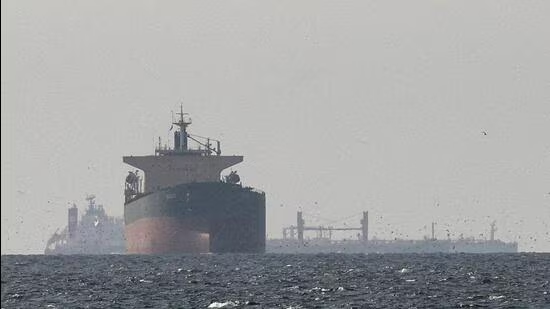
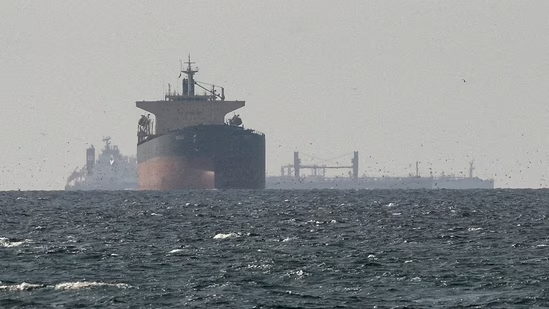
Since the two-week ceasefire was announced between the US and Iran, the Strait of Hormuz has seen some movement of ships. On April 9, four tankers and three bulk carriers passed through the strait, news agency PTI reported. This brings the total number of ships that have crossed the Strait of Hormuz since the ceasefire announcement to 12, according to data firm Kpler.
On April 8, Iran agreed to halt the conflict for two weeks and allowed ships to pass through the strait in coordination with its armed forces. The response from Iran’s government suggested that while it has agreed to a temporary halt in hostilities, it will continue to control the Strait of Hormuz.
This was reflected in an incident involving a Botswana-flagged liquefied natural gas tanker, Nidi, which attempted to exit the Persian Gulf via a route ordered by the Revolutionary Guard but suddenly turned around and headed back early Friday, according to ship-tracking data cited by PTI.
Also Read | Mojtaba Khamenei signals new Strait of Hormuz phase amid shaky ceasefire: ‘Not seeking war, won’t forfeit rights’
However, other ships not transmitting their locations may also have passed through. In peacetime, the strait typically sees well over 100 ships passing through it daily.
Trump not pleased with Iran over Hormuz control
US President Donald Trump is not pleased with Iran’s control over the Strait of Hormuz and has alleged that it is charging ships for passage.
On Thursday evening, Trump appeared to cast doubt on the effectiveness of the ceasefire that has halted the conflict.
“Iran is doing a very poor job—dishonorable, some would say—of allowing oil to pass through the Strait of Hormuz,” he wrote on his social media platform. “That is not the agreement we have!”
Also Read | Trump wanted Iran ceasefire ‘at least since March’, Asim Munir emerged as key link, says report
The post came after Trump earlier said, “There are reports that Iran is charging fees to tankers going through the Strait of Hormuz—they better not be, and if they are, they better stop now!”
The White House had earlier echoed this stance, saying that while it supports reopening the strait as part of the ceasefire deal, Trump opposes Iran’s military, which continues to control the waterway, from seeking to raise revenue by charging tolls on passing ships.