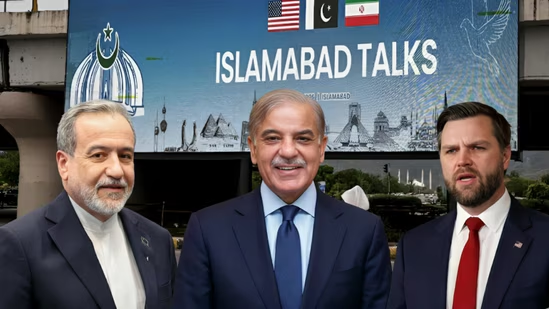
Iran and the United States head into high-stakes talks in Islamabad on Saturday with both sides openly wary of each other. While Tehran has reiterated that it approaches negotiations with “goodwill but no trust,” Washington has also signalled caution.
Iranian Parliament speaker Mohammad Bagher Ghalibaf on Friday night reiterated Tehran’s deep distrust of the United States. According to the Tasnim News Agency, he said, “Our experience of negotiations with the Americans has always been met with failure and breach of promise. They attacked us twice in the middle of the negotiations. We have goodwill but no trust.” Track US-Iran war live updates.
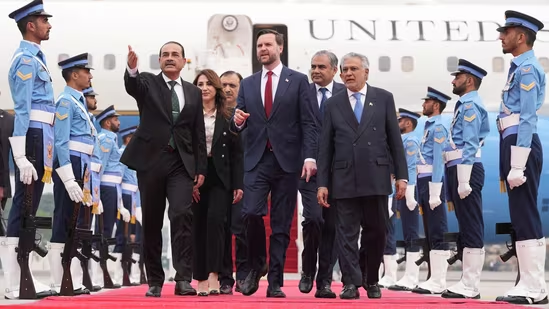
Ghalibaf made the remarks upon arriving in Islamabad, where he is leading a high-level delegation for expected discussions involving the American side. His comments came in response to recent statements by US Vice President JD Vance.
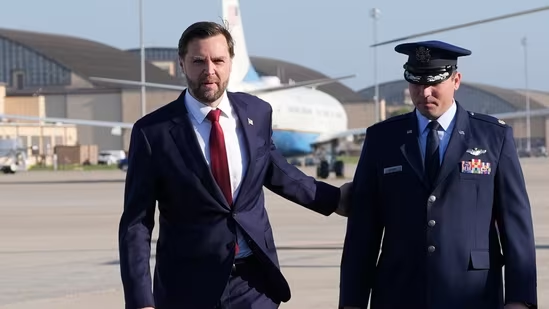
Vance heads to Pakistan
Earlier in the day, Vance said that “If the Iranians are willing to negotiate in good faith, we’re certainly willing to extend the open hand,” but warned that “if they’re going to try to play us, then they’re going to find the negotiating team is not that receptive,” AFP quoted him as saying.
Vance is travelling to Islamabad along with US President Donald Trump’s son-in-law Jared Kushner and special envoy Steve Witkoff.
Sharif says ‘make or break’ moment
Pakistani Prime Minister Shehbaz Sharif described the upcoming negotiations as a difficult but decisive phase.
“A temporary ceasefire has been announced, but now an even more difficult stage lies ahead: the stage of achieving a lasting ceasefire, of resolving complicated issues through negotiations,” he said. “This is that stage which, in English, is called the equivalent of ‘make or break,’” AFP reported.
According to a statement from Pakistan’s foreign office, Ghalibaf’s delegation was received upon arrival by deputy PM Ishaq Dar, chief of defence forces and army chief field marshal Asim Munir, national assembly speaker Sardar Ayaz Sadiq and interior minister Mohsin Naqvi.
As reported by Islamic Republic of Iran Broadcasting (IRIB), the Iranian delegation includes representatives from security, political, military, economic and legal fields.
The team includes foreign minister Seyed Abbas Araghchi, secretary of Iran’s defence council Ali Akbar Ahmadian, and central bank governor Abdolnaser Hemmati, along with several members of parliament.
What are key Iranian demands
Tehran has continued to stress preconditions laid out earlier by Ghalibaf, warning that failure to meet them could derail the process, as reported by Press TV.
In a post on X, Ghalibaf said two key steps agreed between the parties remain unfulfilled. According to him, both the Lebanon ceasefire and the release of frozen Iranian assets are essential conditions before any formal dialogue begins in Islamabad.
He said: “Two of the measures mutually agreed upon between the parties have yet to be implemented: a ceasefire in Lebanon and the release of Iran’s blocked assets prior to the commencement of negotiations. These two matters must be fulfilled before negotiations begin,”
However, Israel has maintained that the two-week ceasefire does not extend to Lebanon.
This comes as Israeli strikes following earlier hostilities linked to Hezbollah have left heavy casualties in the region. Lebanese authorities say more than 1,950 people have been killed in recent weeks, including over 350 on a single day during renewed strikes.
What’s on US’ list of demands
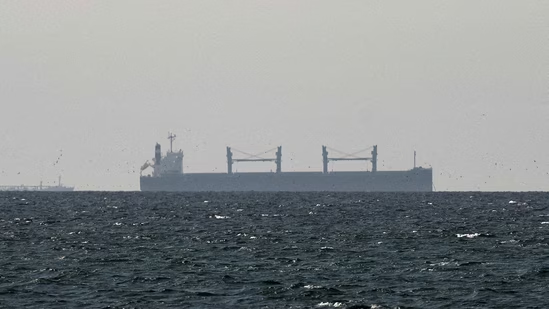
The reopening of the Strait of Hormuz—through which nearly one-fifth of the world’s crude oil passes—is expected to be a key issue in the Islamabad peace talks.
US President Donald Trump said the vital shipping route would be opened “fairly soon.” While talking to reporters, he added, “We’re going to open up the Gulf with or without them… or the strait as they call it,” he said. “I think it’s going to go pretty quickly, and if it doesn’t, we’ll be able to finish it off. We will have that open fairly soon.”
When asked what a successful deal with Iran would look like, Trump kept the focus narrowly on nuclear concerns, saying: “No nuclear weapon. That’s 99 percent of it.”
Official sources cited by news agency AFP indicate that the discussions are expected to cover multiple sensitive issues, including Iran’s nuclear enrichment programme and ensuring the free flow of trade through the Strait of Hormuz.
Trump had earlier posted on his TruthSocial account that Iran has “no cards” in the negotiations, apart from what he described as “a short-term extortion of the World by using International Waterways.”