
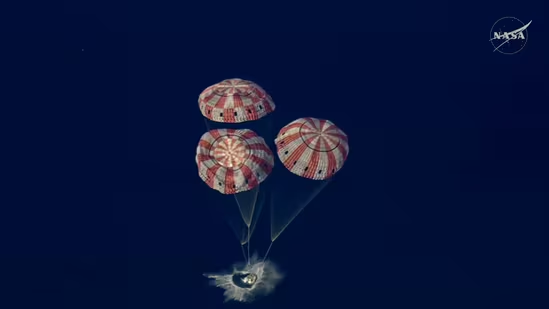
Artemis II’s astronauts returned to Earth on early Saturday morning (IST) after a historic 10-day journey to the moon and back. The spacecraft carrying the astronauts splashed down safely in the Pacific Ocean.
NASA was able to regain contact with the Artemis II crew, which consists of Commander Reid Wiseman, pilot Victor Glover, Christina Koch and Canada’s Jeremy Hansen, after they entered the Earth’s atmosphere.
The astronauts will be taken by the recovery team and medically evacuated before being flown to a US military ship.
Crew ‘in stable condition’: NASA official
Mission commander Reid Wiseman said the crew were “stable” and “green.”
“They’re in great condition, that’s what that means,” Rob Navias, a NASA public affairs official who narrated on the agency’s livestream, said.
As the astronauts made their way back to Earth, the spacecraft travelled at speeds exceeding 30 times the speed of sound and faced extreme heat reaching nearly half the temperature of the Sun’s surface. This was an important test of the heat shield, which had run into issues during an earlier trial mission.
The Artemis II re-entry, however, proceeded smoothly without any problems.
About the mission
The roughly 10-day mission, which started with a launch from Florida on April 1, was filled with several firsts, records and remarkable moments. It was seen as an important step towards future missions that will land astronauts on the Moon.
This was the first crewed flight under NASA’s programme aimed at maintaining a long-term human presence on the Moon, including plans to build a base in the future.
The second stage of the Artemis programme served as a test flight to confirm the dependability of the Orion capsule, which had not previously carried astronauts.
The journey also set a new record, as the four astronauts became the first humans to travel the greatest distance from Earth, reaching 252,756 miles (406,771 kilometres).
As they moved through deep space and orbited the Moon, the astronauts captured thousands of images, creating an impressive collection that drew attention back on Earth.
They also observed a solar eclipse, along with unusual meteorite impacts on the lunar surface that left NASA scientists amazed.
The mission included several milestones: Glover became the first person of colour to travel around the Moon, Koch became the first woman, and Canadian astronaut Hansen became the first non-American to do so.
With inputs from agencies