
The final and most hair-raising part of NASA’s Artemis 2 mission to the Moon is nearly upon us, with the astronauts smashing into the Earth’s atmosphere at almost 25,000mph
NASA’s Artemis 2 mission has captured the imagination of the whole world, but the best could be yet to come, with the four astronauts set to return to Earth in spectacular fashion.
The Orion spacecraft is currently hurtling through space towards the Earth and will reach the atmosphere while travelling at an astonishing speed of 11km per second – that’s 25,000mph, or 40 times faster than a passenger jet.
After launching on April 1 and travelling farther from Earth than any humans in history, the Orion crew will blaze a trail across the skies when they finally return home this weekend.
READ MORE: Artemis 2 produces first ever photos from far side of Moon – stunning pics revealedREAD MORE: Artemis 2 astronaut’s emotional words before spacecraft passed behind Moon
Artemis 2 landing will produce insane temperatures
After smashing through the Earth’s atmosphere, travelling at more than 30 times the speed of sound, the spacecraft will have to slow to a safe speed for landing.
As it crashes into the top of the atmosphere the craft will create a shockwave that will see the surrounding air reach temperatures of 10,000C or more. To keep humans inside safe, Orion’s heat shield is made of Avcoat, a mixture of silica, epoxy and resins that NASA also used for the original Apollo missions to the Moon.
After the initial shockwave, the heat shield will experience temperatures of around 2,700C as the crew module plummets through the atmosphere on re-entry. The coating of 200 Avcoat tiles is just a few inches thick and designed to burn away, transferring heat away from the spacecraft.
READ MORE: Artemis 2 crew face communications blackout as astronaut says ‘let’s pray’READ MORE: Artemis II breaks radio silence with four historic words as it emerges from Moon
Artemis 2 astronauts face wild gravity during landing
The astronauts will fall 400,000ft through Earth’s atmosphere and be completely out of communication with mission control as superheated plasma around the capsule disrupts radio signals.
During this descent, the crew will experience 3.9Gs, or nearly four times normal gravity. This means their bodies will feel four times heavier. Astronauts have to train to withstand these high g-forces on re-entry. As Orion slows it will start to cool and radio communications will resume.
READ MORE: Artemis 2 crew share dramatic pictures of Earth tens of thousands of miles awayREAD MORE: Artemis 2 toilet breaks moments after NASA launches astronauts on Moon mission
Time of Artemis 2 landing and how to watch
At around 35,000ft, around the cruising altitude of a passenger plane, Orion will open its first of two sets of parachutes designed to slow it for the final landing. The main chutes will open at around 6,000ft, and at 1,500ft they will fully open for a gentle landing.
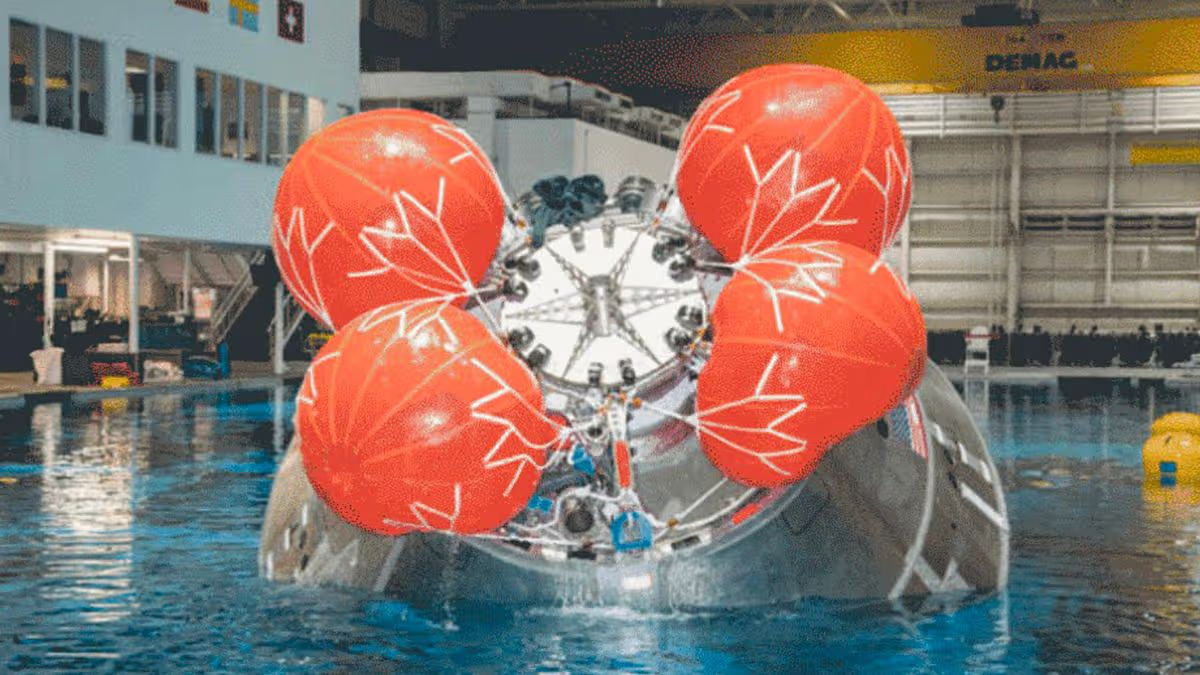
Orion is set to splash down off the coast of San Diego at 8.07pm Eastern Time on Friday, or 1am UK time on Saturday morning. A system of five airbags on top of the capsule will inflate, turning Orion right side up if the capsule lands upside down.
Then, helicopters from the US Navy vessel John P. Murtha will rescue the astronauts from their space capsule and fly them to the ship for a hero’s welcome and a post‑mission medical. You can watch the whole thing live here.