Dr Mathias Basner has researched astronauts who have been working on the International Space Station and has now told of the impact of space travel on the human body.
Astronauts can take months to fully recover from a space mission – but the Artemis crew should be ready for life on Earth ‘after a few hours’.
Commander Reid Wiseman, mission specialist Christina Koch, pilot Victor Glover and Canadian astronaut and mission specialist Jeremy Hansen are due to land off the coast of Florida in the the early hours of Saturday UK time.
UK astronaut Tim Peake told how they would spend their last few hours in space getting the seating ready for re-entry into the Earth’s atmosphere.
And they will wear suits designed to combat gravity. He told the BBC: “They will make sure the spacecraft is at the right angle for re-entry They will get seating out that has been stowed away and get into the suits.”
Dr Mathias Basner, 54, has carried out research on space crews working on the International Space Station since 2008, including twins Scott and Mark Kelly.
READ MORE: The jaw-dropping speed Artemis II will splash down to Earth is hard to fathomREAD MORE: Artemis II astronauts face ‘most dangerous part of mission’ yet as ship faces 2,700C re-entry
He said: “Space is a very hostile environment, tiny little mistakes can cause catastrophic events and in the end a loss of the mission. They have to perform at their best all the time every time. We know astronauts are highly trained so the tests we use on Earth, they cannot be too easy. They have 10 different tests looking at memory, vigilance, risk-taking, and even emotional recognition.”
Speaking to the Mirror ahead of the Artemis landing, he added: “On short missions of 10 days, they can recover pretty quickly. Any issues are usually fully resolved soon after they return to Earth.
“It is not a long enough time to affect your bones, your heart. If you are away for a long time, you may get issues and have to rebuild muscle mass. But they should be back to themselves, how they were 10 days ago, after a couple of hours.”
Scientists will be desperate to assess the Artemis crew for the impact of deep-space radiation. He added: “What could be a real show stopper is the impact of radiation – we don’t really have a good understanding of what it can do and the potential outcomes.
“We look at people working at Antarctic stations on earth because they are working in darkness for such a long time and have to work in small teams.
“So there are a lot of features which are comparable with space travel. With radiation, it would be completely unethical to expose anyone to that here on Earth.
“To a certain extent it is down to chance – events that you cannot really predict, if there is damage to your DNA and you do not fully recover. Any participants in space are guinea pigs to a certain extent; that is really important to the crews.
“They want us to understand the impact of space flight so they can help others in the future, that is one of their big motivations, to gain more knowledge.
“If we could have a magnetic shield for space craft, that would be ideal but that is still science fiction now – it is something that may change in the future.
“The other great thing would be if they could travel quicker, propulsion, if we could speed up the spacecraft and get to Mars in a week instead of four or five months, that would be so much better because it would lessen the exposure to risks.”
The research community is very excited about their return. “NASA has been very cautious,” added Dr Basner, who is German born and based at the University of Pennsylvania.
“The Artemis crew is experiencing radiation exposure. You can be rescued on the ISS, like Sandra Bullock in Gravity, you can be back in a couple of hours.
“But going to the moon you have to do the whole trip and there is no turning back. You have solar flares and cosmic rays bombarding the crew and you cannot protect them. In fact some shielding causes secondary radiation and can be even worse. So we are looking at what it does to the crew.”
Wiseman, 50, is a Navy veteran with 16 years of experience as an astronaut and has already spent six months in space. He has a lifelong love of flying, but on the ground he is afraid of heights.
Glover, 49, a former test pilot has been an astronaut for 12 years and has six months in space. While in the military, Victor’s call-sign was IKE, which stands for ‘I Know Everything’.
Fellow American Koch, 47, is an electrical engineer who has spent one year of her 12 years as an astronaut in space. She made history by taking part in the first all female spacewalk while on the International Space Station.
Canadian Hansen, 50, is a fighter pilot with 16 years of astronaut experience, but this is his first mission. Canada’s Prime Minister Mark Carney spoke with the Artemis II crew – and joked that he hoped Hansen was enjoying Maple Syrup and not Nutella.
Carney praised the record-breaking lunar mission and Canada’s first deep space astronaut. He told him: “A lot of Canadians just want one point of reassurance: that the preference is for maple syrup over Nutella on your pancakes in the morning.”
The call, livestreamed from the Canadian Space Agency, covered risk-taking, collaboration and national pride. The crew was preparing for a high-speed re-entry and splashdown after travelling farther from Earth than any humans before.
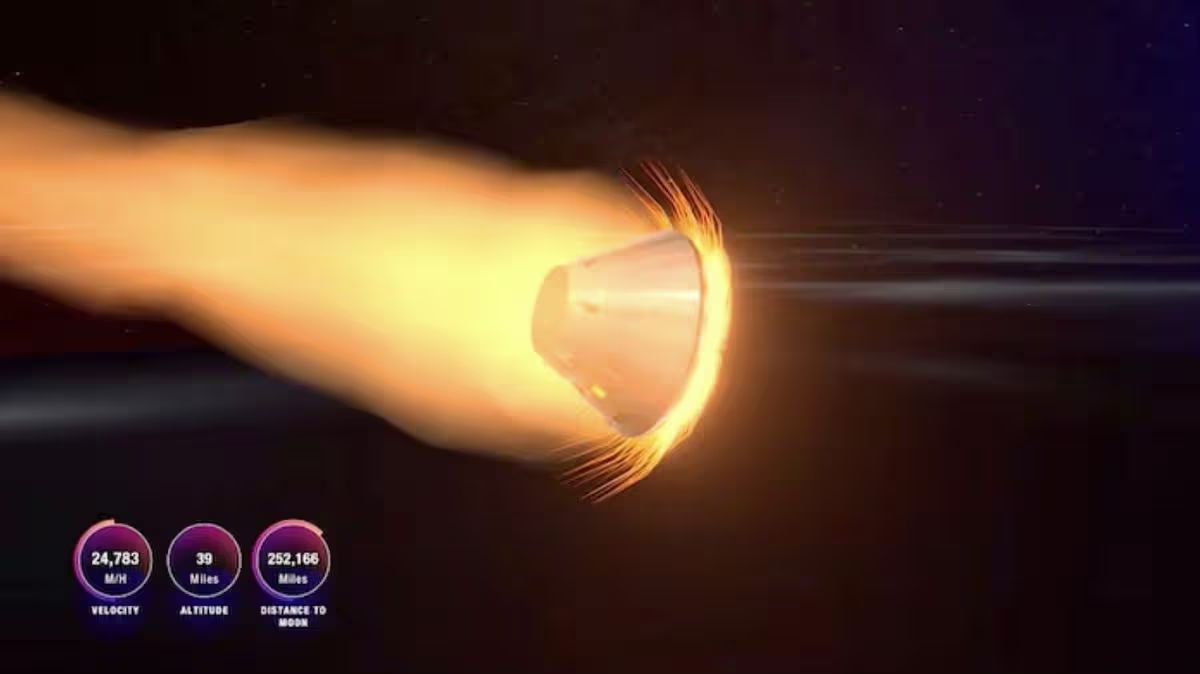
The crew module will separate from the rest of the spacecraft, and the capsule will turn so its heat shield can bear the brunt of the fiery temperatures generated on re-entry and keep the astronauts safe inside.
The spacecraft must endure temperatures of about 2,700C. The heat shield, damaged during the first Artemis mission, will be vital. Once the spacecraft is safely through, a series of parachutes will be deployed to slow it down.
The astronauts will make a gentle splashdown in the Pacific Ocean off the coast of California, where a recovery team will wait. Glover admitted: “I am really looking forward to seeing those three beautiful parachutes and splashing down in the Pacific Ocean. I know that that’s when my wife will have her first real, true exhale, and that means a lot to me.”
He told the BBC : “This is really challenging for the families, so I know that’s a moment that will be really special for my wife, and that makes it special for me.”