It started as a change in route because of a storm, but it turned into a surprising discovery. As a team of 93 international researchers on the German research ship Polarstern was working in the northwestern Weddell Sea when bad weather forced them to take shelter near Joinville Island. While waiting for the storm to pass, they noticed something unusual, a piece of land that was not shown on modern maps, in an area long marked as a danger zone.
A ‘dirty iceberg’ that turned out to be something else
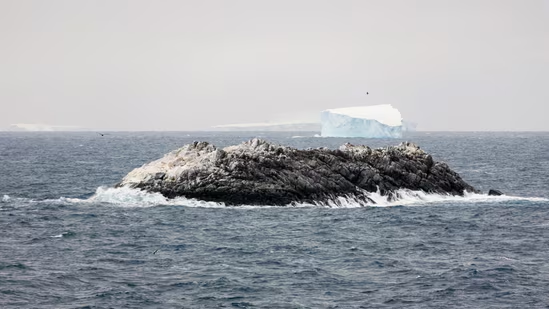
As per a press release by the institute, at first, the discovery did not seem important. From a distance, the crew saw what looked like a dirty iceberg. Simon Dreutter, a mapping expert from the Alfred Wegener Institute, decided to take a closer look.
“Looking out of the window, we saw an ‘iceberg’ that looked kind of dirty,” Dreutter said. “On closer inspection, we realized that it was probably a rock.”
The team then changed direction and moved closer. As they approached, they realized it was not just a rock.
“It became increasingly clear that we had an island in front of us!” Dreutter said.
The Polarstern moved to within about 500 feet of the formation and the team used a drone to get a better view from above.
Also Read: Weather Bee: Western disturbances have kept summer cool, but not brought enough snow
What the drone revealed
The drone images showed something surprising. The island rises about 50 feet above the water and it’s around 165 feet wide and about 426 feet long which is roughly the same size as the Great Pyramid of Giza.
Even with its size, it had never been officially recorded.
The expedition began on February 8, 2026 with the team studying the northwestern Weddell Sea. Maps of the area had marked it as a place with unknown dangers but did not clearly explain what those dangers were.
“On our route, the nautical chart showed an area with unexplored dangers to navigation, but it wasn’t clear what it was or where the information came from,” Simon Dreutter said. “I scoured all the coastlines we had here in the bathymetry lab and went back to the bridge.”
Also Read: Enhance ocean observations to forecast extreme weather: Parliamentary committee
Even satellite images did not clearly show the island. Researchers said, “On the satellite images analyzed, the island could hardly be distinguished from the numerous icebergs drifting around in the immediate vicinity due to its ice cover.”
The island was basically hidden among the ice, making it very hard to spot. Experts also found that its marked position on maps is about a mile away from where it actually is, and they still do not know why.
This discovery is now leading to updates in global navigation maps and raising questions about what else might still be hidden under Antarctica’s ice.