
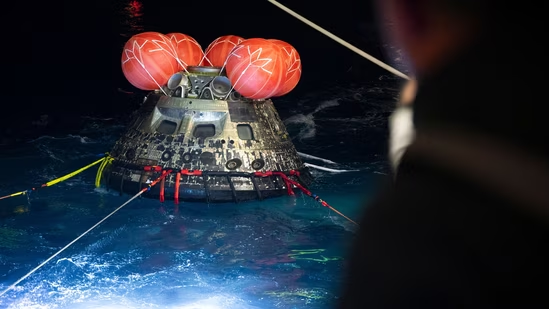
NASA has outlined its next steps in lunar exploration following the successful splashdown of the Artemis II mission. The space administration has now signalled a transition towards a more advanced mission for Artemis III and IV.
The Artemis II spacecraft returned safely to Earth after a 10-day journey around the Moon, marking the first crewed lunar flyby in over 50 years. The mission validated critical systems needed for long-duration deep-space travel.
NASA officials and mission planners have indicated that after reaching this milestone, attention will now turn to future missions that are intended to test lunar landing capabilities and increase human presence beyond Earth.
Read more: Major milestone for NASA as Artemis II splashes down after historic Moon mission
What comes after Artemis II?
The success of Artemis II is being seen as a critical turning point in modern space exploration.
The mission tested Orion’s life-support systems, navigation, and heat shield under real deep-space conditions. Astronauts travelled over 250,000 miles from Earth during the mission, the farthest distance reached by humans since the Apollo era.
NASA officials have described the mission as a “foundation” for future exploration, enabling more complex missions in the coming years.
NASA’s next major mission, Artemis III, is expected to build on the success of Artemis II by testing key technologies required for future Moon landings.
According to NASA’s roadmap, Artemis III is currently targeted for around 2027. The mission will involve astronauts launching aboard the Orion spacecraft and conducting docking tests with commercial moon landers developed by companies like SpaceX and Blue Origin.
Read more: Artemis 2 Moon flypast today, Netflix to livestream: All about Nasa mission’s big day
Future moon landing and long-term goals
Reuters has reported that China wants to send its own crewed spaceship to the moon by 2030. However, NASA aims to accomplish the goal ahead of China.
NASA has now confirmed that the first crewed Moon landing under the Artemis programme is now expected to take place during Artemis IV, tentatively scheduled for 2028. The organization’s official page states that Artemis IV will aim to explore the moon’s South Pole region.
In addition to motivating the Artemis Generation, NASA states that the astronauts’ observations, samples, and data will deepen our knowledge of our solar system and home planet.
The organization’s overarching goal is to develop a sustained lunar presence as a prelude to a future human mission to Mars.