Paul Townend has been cleared of any wrongdoing after sickening incident cast a cloud over the second day of the Randox Grand National meeting.
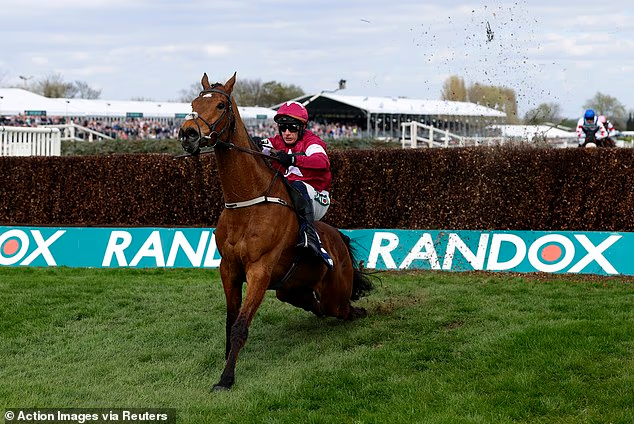
Gold Dancer, Townend’s mount in the William Hill Mildmay Novices Chase, had produced a brilliant round of jumping in the Grade One contest, with the exception of the last fence. The gelding, owned by Gigginstown House Stud, sprawled on landing after hitting that obstacle.
It looked momentarily as if Townend – the seven-time Irish champion, who is regarded as the best National Hunt rider of his generation – might slip out of the saddle but he regained his balance and was able to cajole Gold Dancer for the last furlong to win the race and claim the £67,524 first prize.
There was, however, a desperate aftermath; 50 yards after crossing the line, Townend looked behind and immediately dismounted the seven-year-old. He was quickly attended to by racecourse vets but, on examination, they discovered Gold Dancer had broken his back and the gelding was euthanised.
Inevitably, there was outrage and opprobrium rained down on Townend. PETA (People for the Ethical Treatment of Animals) said the meeting should be called ‘The Grand Massacre’ as they pointed out that 68 horses had been fatally injured at Aintree since 2000.
Figures released by the British Horseracing Authority (BHA) in January showed that the fatal injury rate of horses in 2025 had dropped to 0.22% (193 from 86,281 runners across all courses), which was down from 0.25% in 2024.
Gold Dancer has died at Aintree after being put down – moments after winning his race

The horse was significantly ahead in the race as it was whipped after the fall by jockey Paul Townend
Townend was approached for comment but did not wish to speak after the race. The BHA stewards held an enquiry when he returned to the weighing room, as is standard, and after listening to all evidence they said no blame could be attached.
The BHA released a statement saying: ‘We are all saddened by the fatal injury of Gold Dancer and our thoughts are with everybody connected to the horse. After the race, the stewards held an enquiry to consider the circumstances of this incident and took evidence from vets and the horse’s jockey.
‘Paul Townend told the stewards that, following a bad mistake at the final fence, Gold Dancer took a stride or two to gather himself but felt sound and continued running in a straight line to the finish.
‘He then reported that Gold Dancer’s action changed after the line, as he rounded the bend and changed from a canter to a trot, at which point he immediately dismounted to allow veterinary surgeons to quickly attend to the horse.
‘The veterinary assessment was that the appropriate course of action was to humanely euthanise the horse.’
They added: ‘Having reviewed the footage of the incident, James Given, the BHA’s Director of Equine Regulation, Safety and Welfare, agreed that Gold Dancer’s action was typical of a horse in the closing stages of such a race, that he appeared sound until rounding the bend.
‘As is the case with any fatal injury, the incident will now be looked at in detail through our fatality review process, which is part of the sport’s commitment to ongoing improvements in racehorse safety.’
Given, a respected figure within the industry and a former trainer, gave an interview to ITV Racing, in which he said: ‘I was in the enquiry and gave evidence. I was able to watch the incident from front on and behind and the horse stayed (ran) on as straight to the line.
‘He didn’t show any signs of deviating off a straight line or not being asymmetric. The back legs were following the front legs and it was only after they had gone past the winning line and turned left, the action changed.
‘That was the only point at which Paul became aware. I don’t believe he was able to notice that (the horse had been injured) at all. I have tried to demonstrate that by the way I have explained I could see the horse was asymmetric and had not deviated off a straight line.

Townend continued to whip the horse – which was clearly struggling – until it crossed the line before dismounting
‘The horse felt normal to him. It was only after the horse changed from a canter down to a trot that he felt something wrong and he behaved exactly as he should have done, pulling the horse up and jumping off him straight away.’
Eddie O’Leary, brother of Ryanair boss Michael who owns Gigginstown House Stud, said: ‘It’s terribly sad for the horse. What could Paul Townend do? He felt fine, it was just when he pulled up that something was wrong.’
An Aintree Racecourse statement read: ‘The winner of our second race of the day, Gold Dancer, was pulled up after the line and dismounted.
‘He was immediately attended to by our expert veterinary team but sadly he could not be saved. Our heartfelt condolences are with his connections.’
Animal right group Animal Aid, meanwhile, issued a statement within minutes of the events taking place.
They said: ‘The fact that the ‘winner’ of this race was dead minutes later proves that this so called ‘sport’ has no winners. Injuries and deaths such as these are common in racing, occurring on average every other day across the country.
‘It’s no accident – it’s a predictable consequence of pushing horses beyond their physical limits. Injury and death go hand in hand with racing, and that’s why Animal Aid is calling on the public to turn their backs on this ‘sport’ and boycott horse racing.’
Campaign Manager on Horse Racing at Animal Aid, Isobel McNally, added: ‘This is a horrifying thing to happen to an animal, all in service of an event that, looking at ITV coverage, appears to be more of a social event for attendees.
‘Everyone who has bought a ticket or placed a bet has paid for this horse to die. We all have the opportunity to fix this problem very easily. We can go and drink somewhere else. We can place bets on something else. Animals’ lives should never be the collateral damage in anyone’s good time.’
The RSPCA said: ‘We are devastated by Gold Dancer’s death. ‘This is the 42nd fatality linked to competitive horse-racing in the UK this year alone – and it is only April.
‘Lessons must be learned from any tragedy like this – around the contributing factors, pre- and mid-race decision-making, and means of prevention.
‘We will be speaking with the British Horseracing Authority later today (10 April) to discuss the incident, understand their assessment of what happened, and how it could have been prevented – including an update on the welfare of other horses who are reported to have fallen today.
‘The RSPCA continues to engage with the industry in the hope of seeing greater safety measures introduced to the sport, and improvements for equine welfare both on and off the track.’