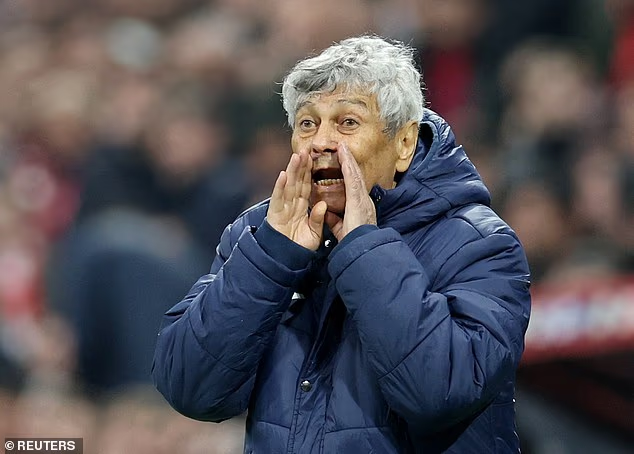
Romanian football has been rocked by the news of their recent men’s national team manager Mircea Lucescu dying, less than a fortnight after trying to guide them to this summer’s World Cup.
Lucescu’s death at the age of 80 at the Bucharest University Emergency Hospital was announced by the Romanian Football Federation (RFF) on Tuesday.
He was taken to hospital late last month after falling ill during a meeting before a training session with Romania, ruling him out of a friendly in Slovakia on March 31.
It has been reported that he suffered a heart attack on the morning of Good Friday too.
Lucescu had a lengthy coaching career and was in his second spell with the Romanian national team until stepping down on April 2 due to his health.
The week before on March 26, Lucescu was unable to guide Romania past Turkey in their World Cup play-off semi-final – as the visitors lost 1-0 in Istanbul.
Romanian football icon Mircea Lucescu has died at the age of 80, it was announced on Tuesday
In a statement the RFF, who have suspended the search for Lucescu’s replacement for an indefinite period, paid tribute to such a pivotal character in Romanian football.
‘It is a black day for Romania and for world football. A man who lived through and for football in every second of his existence has left us,’ they said.
‘He was a man who loved this sport more than anything in life, and his impact on our football is immeasurable.’
The Bucharest University Emergency Hospital also paid their respects, stating: ‘Mr Mircea Lucescu was one of the most successful Romanian football coaches and players, the first to qualify the Romanian national team for a European Championship, in 1984.
‘Entire generations of Romanians grew up with his image in their hearts, as a national symbol.’
Known for his tactical discipline and talent development, Lucescu leaves a legacy as one of the most successful coaches in European club football in terms of number of trophies won.
His most prominent period of success came during a 12-year tenure at Shakhtar Donetsk, where he led the side to eight Ukrainian league titles and the 2009 UEFA Cup. He also guided the club to the Champions League quarter-finals in 2010-11 – the furthest they have ever progressed in the competition.
He also secured championships in Turkey with rivals Galatasaray and Besiktas, and spent time in Italy with Inter Milan and Brescia.
A former national team captain who led Romania to Euro 1984 as a young coach, Lucescu is widely credited with modernising the country’s football infrastructure.
During his playing days as a winger he won seven league titles and the Romanian Cup for Dinamo Bucharest. He established himself as one of the country’s most decorated figures, captaining Romania at the 1970 World Cup and winning 64 caps over more than a decade.
‘European and world football have lost an exceptional figure whose influence, stature and legacy will endure for generations to come,’ said UEFA President Aleksander Ceferin.
‘Mircea Lucescu was one of the game’s true originals – a man of rare football intellect, remarkable dignity and passion, whose contribution to the sport is difficult to measure in words alone.
‘His presence shaped teams, inspired players and colleagues, and left a lasting imprint on football far beyond the touchline.’