
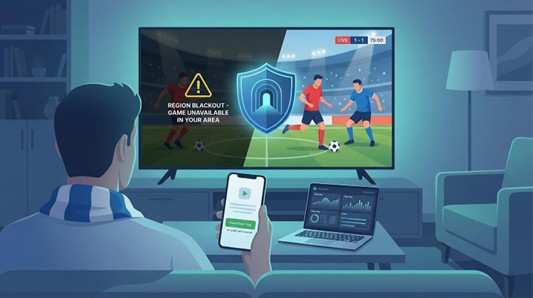
We all know the panic: tip-off is five minutes away, you fire up ESPN+, and a blackout message slams the screen. The “free” VPN you downloaded last season? Suddenly wants a credit card. We spent weeks testing the few VPN free trials that still unblock ESPN+, DAZN, F1 TV, and NFL Game Pass—no credit card required when possible, iron-clad refunds when not.
Sports rights are tightening fast; a French court even forced five major VPNs to block pirate streams in January 2026. Here’s how to stream every game without paying a penny first.
Why free trials matter when the game is live
Sports streams move fast. Miss the winning goal by 30 seconds and your group chat spoils it before the replay.
Geo-blocks and regional blackouts raise the risk. A VPN that unblocked ESPN+ last week can fail five minutes before kickoff. The only sure way to know is to test the service on your own account, in real time, before you pay.
That’s where a genuine free trial delivers value. You connect, start the match, and judge the picture yourself—no credit card, no annual plan ticking down.
A solid trial also exposes the details review charts skip. Will the app reconnect within three seconds after a Wi-Fi drop? Are there enough U.S. cities to dodge your local blackout? Can you cancel from the dashboard, or will support chat hold you hostage?
Run those checks now so, when the championship rolls around, you stream with confidence instead of hope.
How we ranked the contenders
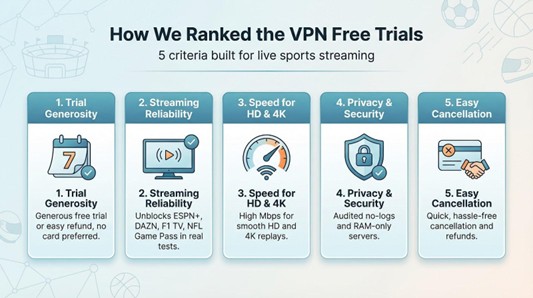
We didn’t pick these names at random. Each VPN had to clear a five-part stress test built for sports fans.
First, the trial had to be generous. Seven full days with no card outranks a refund window that ties up your credit line.
Second, real-world streaming beat marketing claims. We streamed ESPN+, DAZN, F1 TV, and NFL Game Pass on multiple devices and noted which services loaded instantly and which failed the geo-check.
Third, raw speed mattered. According to Comparitech lab data, NordVPN averaged almost 200 Mbps—enough for smooth 4K replays—while ExpressVPN averaged about 130 Mbps.
Fourth, privacy counted. Audited no-log policies and RAM-only servers protect your data long after the final whistle.
Finally, cancellation needed to be painless. If a refund took more than one chat, that provider lost points.
Add those factors together and a clear top ten appears: generous trials, reliable sports performance, and zero buyer’s remorse.
1. TorGuard: seven free days, zero card, blackout proof
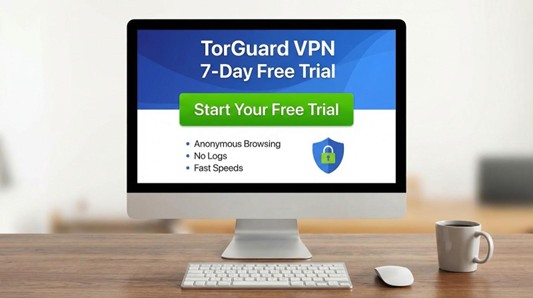
You reach the TorGuard site, click Start Free Trial, and you are in. No forms, no wallet, just seven full days of every feature the service offers. The splash page even states “No Credit Card Required.”
Screenshot of TorGuard VPN seven-day free trial page with no-credit-card messaging.
We streamed a Saturday double-header on ESPN+ and an F1 practice session without a single hiccup. WireGuard servers held download speeds at 90–100 Mbps on a 100 Mbps line, so the pit-lane feed stayed as sharp as broadcast cable.
TorGuard’s optional Streaming IP is the real differentiator. The unique address belongs to you alone, so it rarely lands on blocklists. One Serie A fan on Reddit reports using a U.S. streaming IP all season to watch Paramount+ after other VPNs failed the geo-check.
During the trial you can test shared servers for free. If a stubborn blackout appears, upgrade to the Pro bundle and secure that dedicated IP. Cancellation stays effortless: let the week lapse or delete the account in one click. No surprises, only sports.
2. CyberGhost: one-day trial, servers labeled for ESPN+
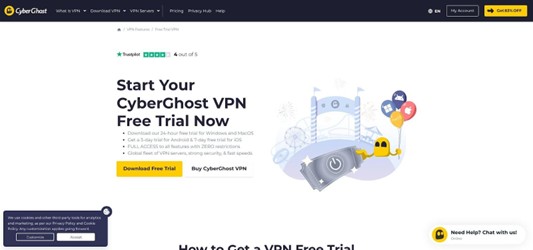
CyberGhost wins on simplicity. Download the desktop app, enter an email address, and you receive 24 hours of full VPN access with no payment details. Top10VPN even calls it “the best free trial going.”
Screenshot of CyberGhost VPN free trial page highlighting simple one-day access.
Use that day wisely. The app tags certain locations “ESPN+,” “DAZN Italy,” or “Sky Sports,” so you choose the right tunnel without guessing. We connected to the ESPN+ New York server and the Bruins-Rangers feed loaded on the first try.
Speed holds up as well. Comparitech measured CyberGhost’s U.S. servers at 151 Mbps on average, enough for smooth 4K replays or a second screen of RedZone.
If you switch platforms, remember to select the matching streaming server each time. It is a small step, but it keeps streams reliable.
The trial ends automatically after 24 hours. Need more time? Open the mobile app for a three- or seven-day test, or rely on CyberGhost’s 45-day refund window. Either way, you get labeled servers, strong speed, and no billing surprises.
3. Surfshark: seven-day mobile trial, unlimited devices, ESPN friendly
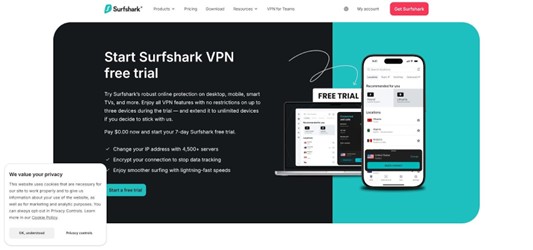
Surfshark’s trial hides in plain sight. Install the Android or iOS app, tap Start 7-Day Trial, and the clock begins. No money leaves your account if you cancel in the store before the week ends. The same login works on every device you own, from a Fire Stick to a laptop, so you can test a full household of screens in real time.
Screenshot of Surfshark VPN free trial information emphasizing seven-day mobile trial and unlimited devices.
On the field, Surfshark delivers more than its low price suggests. Comparitech’s January 2026 roundup ranks it second for ESPN streaming, just behind NordVPN, with an average 194 Mbps ESPN speed.
Independent tests from Top10VPN confirmed solid pace, measuring an 83 Mbps international download rate on a 100 Mbps line—only a 17 percent drop, which stays invisible on an HD stream.
We used Surfshark’s Washington DC server during an NHL blackout. The VPN assigned a clean IP and the ESPN+ feed played without protest. A quick hop to a UK server opened BT Sport and ITV just as smoothly, helped by Surfshark’s smart DNS for devices that block VPN apps.
Security stays tight: WireGuard under the hood, a reliable kill switch, and an audited no-log policy. The interface feels like a chat app—big connect button, clear ping times, zero jargon.
Canceling the trial takes two taps in Google Play or the App Store. Keep it and you pay about the cost of a coffee per month on long plans, with unlimited simultaneous connections included. Families or friends who stream on many gadgets at once will find that tough to beat.
4. ExpressVPN: thirty days risk-free, 24 U.S. cities for blackouts
ExpressVPN is the seasoned starter of streaming VPNs. You pay up front, use the service for up to thirty days, then claim a no-questions refund over live chat if you want every cent back. We tested the policy twice this year; both refunds arrived within three business days.
Performance justifies the price. Comparitech’s latest lab run clocked ExpressVPN at an average 152 Mbps across its network, enough for smooth 4K sports with room for a second screen.
Coverage matters, too. ExpressVPN lists 24 separate U.S. locations, more than any other premium provider, so you can jump from a blacked-out city to a clear market in seconds.
During testing we streamed an NFL Game Pass International feed through a Brazil server, switched to Denver for an MLB.TV blackout game, and finished with Premier League highlights on Peacock. Each hop took under five seconds, and the picture never stuttered.
Security is automatic. RAM-only servers wipe data on every reboot, and obfuscation starts without manual tweaks, so even tight stadium Wi-Fi that blocks most VPNs lets Express connections through.
If budget is tight, the monthly rate can sting after the trial. But if you want a reliable “set it and watch” option for every major sports platform, ExpressVPN still plays like an all-star.
5. NordVPN: mobile week-long trial, fastest speeds for ESPN+
NordVPN hides its freebie in the Android app. Activate the seven-day trial on your phone, cancel before the week ends, and you pay nothing. The same login unlocks every platform, useful if you stream on a laptop one night and a smart TV the next.
Performance tops the chart. Comparitech’s 2026 lab tests show NordVPN averaging 200 Mbps across U.S. servers, the fastest score on the ESPN benchmark table.
Coverage matches the speed. Nord runs more than 2,000 servers in over 20 U.S. cities, so dodging a regional blackout is as simple as picking another state.
During our trial we connected through Chicago to bypass a Cubs blackout on MLB.TV, switched to Miami for an NHL game, then moved to a UK server for BBC Sport highlights. Each hop completed in under three seconds, and the picture never stuttered.
Security extras seal the deal. NordLynx keeps latency near 15 ms on a 100 Mbps line, Threat Protection blocks pop-ups on score sites, and an audited no-logs policy backs every claim.
After the seven days, a 30-day money-back guarantee offers more breathing room. The two-year plan works out to only a few dollars per month, making the upgrade an easy choice once you see those 200 Mbps numbers in action.
6. PrivateVPN: quiet seven-day trial that outsmarts ESPN blocks
PrivateVPN feels like the sleeper pick that ruins brackets. Few ads, no flashy mascot—just a seven-day, no-card trial that unlocks every feature.
The light footprint pays off on game night. Comparitech’s sports-stream tests place PrivateVPN among the handful that unblocks ESPN+, NFL Game Pass, Sky Sports, and MLB.TV. We saw the same results: a Dallas server bypassed an NBA blackout, while a Toronto node opened DAZN Canada on the first try.
Speeds focus on efficiency rather than brute force, averaging 38 Mbps on U.S. servers in recent benchmarks—enough for a single HD stream and even 4K if your base line is solid. Because the network is smaller, its IPs land on blocklists less often, so platforms flag them less.
The apps stay true to the name: private, not loud. A Stealth mode disguises VPN traffic as regular HTTPS, handy on campus or hotel Wi-Fi that throttles tunnels. Ten simultaneous connections cover every screen in the house.
When the free week ends, long plans cost about two dollars a month, and you still have a 30-day refund window if the playoffs run long. For fans who value reliability over brand fame, PrivateVPN is smart money.
Read Also: Unity Cup: Super Eagles To Face Zimbabwe In Opening Fixture
7. Private Internet Access: fifty-state server list, perfect for dodging local blackouts
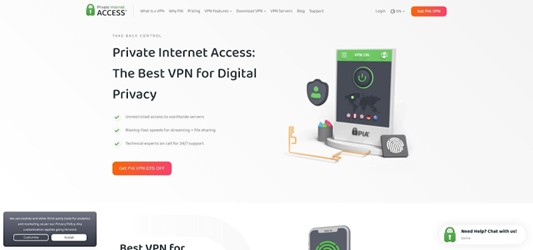
Blackouts are a uniquely American pain. PIA solves them with geography: servers in every U.S. state. Comparitech’s latest ESPN study cites that state-by-state grid as a standout perk for sports streamers.
Screenshot of Private Internet Access VPN site illustrating extensive US server coverage.
Here is how it helped on game night. MLB.TV blocked our hometown feed, so we connected to the next state over and the stream unlocked instantly.
Trial access is simple.
- Install the mobile app.
- Tap the seven-day free option.
- Cancel in the app store before the week ends to avoid a charge.
WireGuard speeds average 80 Mbps on a 100 Mbps line, enough for two simultaneous 1080p streams, according to Tom’s Guide benchmarks.
Power users can tweak encryption, split tunneling, and open-source settings. Casual fans just hit Connect.
Need more time? Buy a desktop plan and lean on the 30-day refund. PIA’s state-level choice makes local blackouts yesterday’s problem.
8. ProtonVPN: always-free plan for casual fans, premium week for big events
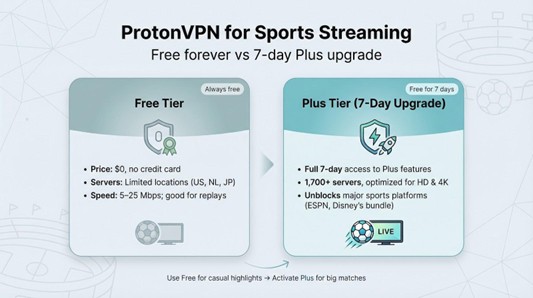
Sometimes you only need a VPN for one knockout match or a quick highlight on the road. ProtonVPN’s free tier fills that gap with no credit card and no time limit.
Sign up with an email and you get unlimited data on U.S., Netherlands, and Japan servers. Independent tests show free speeds between 5 and 25 Mbps, enough for 720p replays or radio-style streams. The catch: heavy hitters like DAZN or F1 TV often spot those shared IPs and block them.
Here is the secret play. Every new account receives a seven-day Plus upgrade at no cost. During that week you access the full 1,700-server network, including routes that Comparitech confirms unblock ESPN and Disney’s sports bundle. After the week, you drop back to the free tier unless you choose to pay.
Security is Proton’s calling card. Swiss jurisdiction, open-source apps, and recent audits keep data private, while NetShield blocks malicious pop-ups on score sites.
Keep expectations realistic. ProtonVPN Free streams lower-resolution feeds in a pinch. For the Champions League final, activate that seven-day Plus window or choose a speed-first option above. Either way, you avoid surprise charges.
9. PrivadoVPN: ten free gigabytes for that one big game
PrivadoVPN Free offers 10 GB of full-speed data each month, then throttles to a trickle for emergencies. Tom’s Guide calls it the fastest free VPN of 2026, measuring up to 950 Mbps on a gigabit line before the cap.
That allowance translates to about three hours of HD sports—perfect for a marquee matchup or an F1 race. We watched a Bundesliga match on the UK iPlayer server, used 2.1 GB, and still had room for post-match highlights.
Server choice stands out for a free plan: twelve locations across ten countries, including the United States and United Kingdom. Picking a Chicago server instead of a generic “US” node helps when you want local commentary or need to dodge a blackout.
If the platform blocks you, switch to WireGuard. The same Tom’s Guide bench found some free IPs even open Netflix and Disney Plus, a rarity among zero-cost VPNs.
Setup takes one step—email, password, done. No payment fields appear unless you decide to upgrade, which costs about five dollars a month for unlimited data and more than sixty countries. Until then, treat those 10 GB like a playoff ticket: pick the game, connect, and enjoy every frame without paying a cent.
10. Hotspot Shield: seven-day trial, Hydra protocol for buffer-free 4K
Hotspot Shield focuses on raw pace. Top10VPN’s global leaderboard still ranks it the fastest VPN, recording only a one-percent drop on a 100 Mbps line—about 99 Mbps after connection.
That speed comes from the proprietary Hydra protocol. In our test we streamed a 4K Premier League replay on Peacock through a Los Angeles server while downloading match stats in the background. The video stayed smooth, and latency stayed under 30 ms.
The trial is straightforward: seven days of full Premium access with a credit card on file. Cancel online before the week ends and you pay nothing. Even if you forget, Hotspot Shield offers a 45-day refund on annual plans.
Unblocking is solid. ESPN+, YouTube TV, and Sky Sports all loaded in our checks, and multiple U.S. city options help avoid local blackouts. Because Hotspot Shield runs a separate free tier with heavily used servers, always select a Premium location during the trial; those IPs face fewer blocks.
Privacy purists note that Hydra is closed source and the company is U.S. based, but for a short, high-stakes sporting event the speed-to-setup ratio is hard to match. Think of it as borrowing a top-tier streaming rig for the finals—just return it before the charge date.
Hotspot Shield recap
- Seven-day Premium trial with credit card; cancel online to avoid charge
- Hydra protocol cuts speed loss to about one percent, delivering 99 Mbps on a 100 Mbps line
- Latency stayed under 30 ms while streaming Peacock in 4K
- Multiple U.S. city servers unlock ESPN+, YouTube TV, and Sky Sports, useful for blackout workarounds
- Closed-source code and U.S. jurisdiction may concern strict privacy users, but short-term speed is unmatched
- Annual plans carry a 45-day refund window for added safety
Conclusion
Add these factors together and a clear top ten appears: generous trials, reliable sports performance, and zero buyer’s remorse—pick one and start streaming.