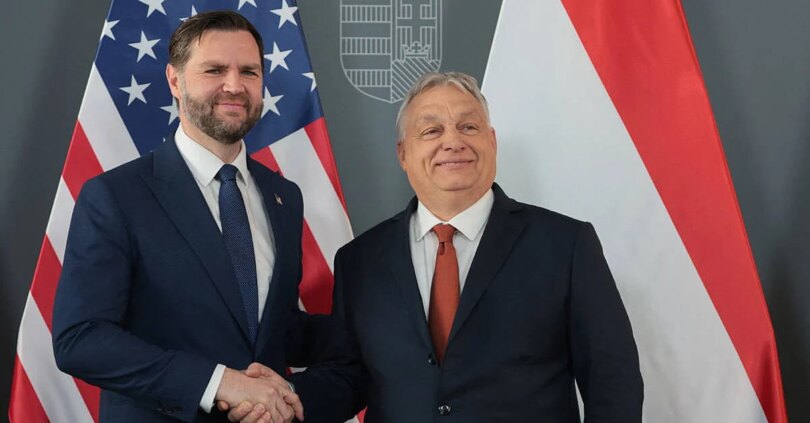
US vice president JD Vance arrived in Hungary on Tuesday on a mission to boost the campaign of nationalist prime minister Viktor Orban, who faces the toughest re-election bid of his career.
During the two-day visit, coming just days before the April 12th parliamentary election, Vance will meet Orban and attend a rally with him.
Vance and his wife Usha were greeted at the airport in Budapest by Hungarian foreign minister Peter Szijjarto.
“This visit clearly shows that there is a new golden age in US-Hungary relations,” Szijjarto told Hungarian state television as Vance landed.
He said Hungarian leaders would discuss migration, global security, economic and energy cooperation with Vance.
Bloomberg News reported that Hungarian oil company MOL would agree to buy 500,000 tonnes of oil from the US for about $500 million (€434 million).
Trump support for like-minded leaders
The rare in-person gesture of support for Orban by a senior US official is the latest example of president Donald Trump’s efforts to prop up like-minded right-wing leaders, including in Argentina and Japan.
Opinion polls show that Orban, whom Trump has already publicly endorsed and praised as “a truly strong and powerful leader”, and his Fidesz party face the most challenging election since returning to power in 2010. In most independent surveys, they trail the centre-right Tisza party, led by Peter Magyar.
In a post on X ahead of Vance’s arrival, Magyar warned against foreign interference.
“This is our country,” he wrote. “Hungarian history is not written in Washington, Moscow, or Brussels – it is written in Hungary’s streets and squares.”
Orban’s self-described “illiberal democracy” mirrors key themes of Trump-era America: harsh anti-immigration policies, disdain for liberal norms, hostility toward global institutions, and attacks on the media, universities and nonprofit groups. He was the first European leader to endorse Trump during his 2016 presidential bid.
Hungarian foreign minister Peter Szijjarto (R) welcomes US vice president JD Vance (C) and his wife US second lady Usha Vance (2nd L) as they arrive at Budapest Ferenc Liszt International Airport in Budapest, Hungary. Photo: Jonathan Ernst/AFP via Getty Images
“JD Vance’s visit is not routine diplomacy but a clear endorsement of Viktor Orban ahead of the toughest election of his life,” said Asli Aydintasbas, visiting fellow at the Brookings Institution think tank.
“For the Trump administration, Orban is not just a fellow conservative but a central figure in efforts to establish an illiberal bloc inside Europe. If Orban falls, the movement would suffer,” Aydintasbas said.
Orban has long been at loggerheads with the European Union over a range of issues, including Ukraine. He has maintained cordial ties with Moscow, refuses to send weapons to Ukraine, and says Kyiv can never join the EU.
“It’s actually shocking that instead of speaking out against Orban’s ties to the Kremlin while Russia wages its brutal war against Ukraine, the Trump administration is not just staying silent – they’re actively supporting him,” said an EU diplomat.
Far-right souring on Trump
Trump’s “America First” agenda increasingly looks like “America Alone” to allies and adversaries alike, as military campaigns and a deepening rift with Europe mark the first 15 months of his second term.

World
ICE arrested more than 800 people after tips from US airport security agency
Now, Europe’s far-right and populist movements are souring on the Republican president despite shared positions on immigration and climate change. Some of their leaders have pushed back against his attempts to acquire Greenland from Denmark and his erratic tariff policy.
Political analysts say US support for Orban, including Vance’s trip, may not be enough to sway voters, as domestic issues such as the cost of living dominate the election.
The trip briefly takes Vance out of Washington, where Trump and his top aides are grappling with how to wrap up the war on Iran, now in its sixth week with no clear off-ramp in sight. The conflict has driven up gas prices, dragged down Trump’s approval ratings and intensified Republican anxiety about November’s midterm elections.
Vance, an isolationist who has advocated against Washington’s entanglements in foreign wars, has played a role in the indirect communications with Iran to end the war. He was among a handful of Trump aides who initially expressed caution about the conflict.