
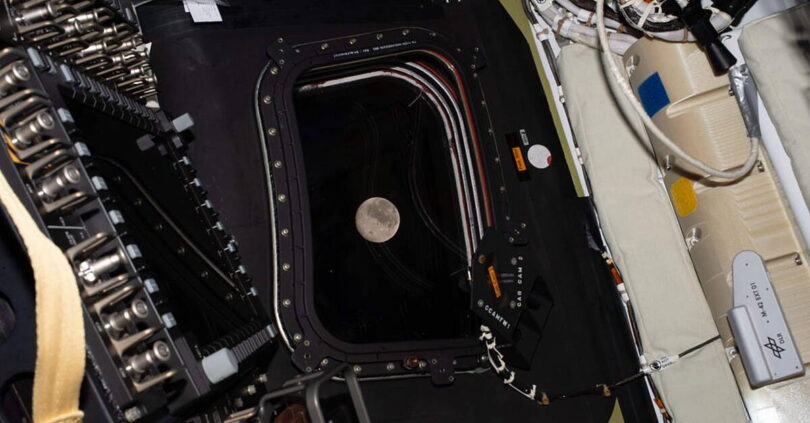
With the Moon now filling their windows, the Artemis II astronauts set a record as the farthest humans from Earth during a lunar flyby promising magnificent views of the far side never before witnessed.
The six-hour flyby is the highlight of Nasa’s first return to the Moon since the Apollo era with three Americans and one Canadian — a step toward landing boot prints near the Moon’s south pole in just two years.
First came a prize — and bragging rights — for Artemis II.
Less than an hour before kicking off the fly-around and intense lunar observations, the four astronauts surpassed the distance record of 248,655 miles (400,171 kilometres) set by Apollo 13 in April 1970.
They kept going, hurtling ever farther from Earth.
Before it was all over, Mission Control expected Artemis II to beat the old record by more than 4,100 miles (6,600 kilometres).
The astronauts woke up to the voice of Apollo 13 commander Jim Lovell, who recorded the message just two months before his death last August.
“Welcome to my old neighbourhood,” said Mr Lovell, who also flew on Apollo 8, humanity’s first lunar visit.
“It’s a historic day and I know how busy you’ll be, but don’t forget to enjoy the view.”
Approaching the near side of the Moon.
The Artemis II astronauts have surpassed the record for the distance from Earth at 1:56 ET (1756 UTC). This record was previously set during the Apollo 13 mission when the astronauts traveled 248,655 miles from Earth. The Moon continues to… pic.twitter.com/OapAGgGMex
— NASA Artemis (@NASAArtemis) April 6, 2026
They took up with them the Apollo 8 silk patch that accompanied Mr Lovell to the Moon, and showed it off as the crucial flyby approached.
It’s just a real honour to have that on board with us,” said commander Reid Wiseman.
“Let’s go have a great day.”
Artemis II is using the same manoeuvre that Apollo 13 did after its “Houston, we’ve had a problem” oxygen tank explosion wiped out any hope of a moon landing.
Known as a free-return lunar trajectory, this no-stopping-to-land route takes advantage of Earth and the Moon’s gravity, reducing the need for fuel.
It is a celestial figure-eight that will put the astronauts on course for home, once they emerge from behind the Moon on Monday evening.

Commander Wiseman, pilot Victor Glover, Christina Koch and Canada’s Jeremy Hansen were on track to pass as close as 4,070 miles (6,550 kilometres) to the Moon, as their Orion capsule whips past it, hangs a U-turn and then heads back toward Earth.
It will take them four days to get back, with a splashdown in the Pacific concluding their test flight on Friday.
Their expected speed at closest approach to the Moon is 3,139 mph (5,052 kph).
Artemis II is Nasa’s first astronaut moonshot since Apollo 17 in 1972.
It sets the stage for next year’s Artemis III, which will see another Orion crew practice docking with lunar landers in orbit around Earth.
The culminating moon landing by two astronauts near the Moon’s south pole will follow on Artemis IV in 2028.