
Football is Nigeria’s heartbeat. Today, football analysts use advanced metrics to explain what really happens on the pitch. At Completesports.com, we regularly publish data-driven articles that use these insights in modern football metrics analysis.
In this article, Completesports.com’s ALLI FESOMADE helps you understand all the professional terminologies analysts use in modern football metrics analysis conversations.
To make things clearer, we’ll also group them into categories; Performance Metrics, Tactical & Analytical Metrics, as well as Normalization Metrics.
This categorization makes them easier to understand. Performance Metrics show what happened, Tactical & Analytical Metrics explain how it happened while Normalization Metrics allow analysts and journalists to make fair comparisons across different contexts.
This piece demystifies the technical jargon around ten (10) of the most common metrics you’ll hear in modern football analysis, interpreting what they mean, how they’ve been used in practice and how they are mostly calculated.
Also Read: Top 7 Super Eagles Number 9s In Modern History
So, whether you are an enthusiast, an analyst, a journalist or a fan, by the end of this comprehensive article, you’ll not only understand the jargon but also be able to use it confidently in your own football work and conversations around modern football metrics analysis.
Performance Metrics
These measure direct outcomes or contributions on the pitch. They are mostly actions that you can count, observe or determine with a model. Examples include Expected Goals (xG), Expected Goals on Target (xGOT), Goals Prevented, Expected Assists (xA), Expected Threats (xT), Non-Penalty Goals, etc. Let’s discuss a few of these.
1. Expected Goals (xG)
Expected Goals measures the likelihood of a shot becoming a goal, expressed as a value between 0 (no chance) and 1 (certain goal). The calculation is based on thousands of past shots, considering factors like distance, angle, body part used, type of chance, number of defenders, and goalkeeper positioning, to mention a few.
Out of all these, Angle and distance are the most important metrics to any xG model. xG is powerful for evaluating chance quality, but it doesn’t measure finishing skill directly. Different providers may calculate slightly differently, so context matters in modern football metrics analysis.
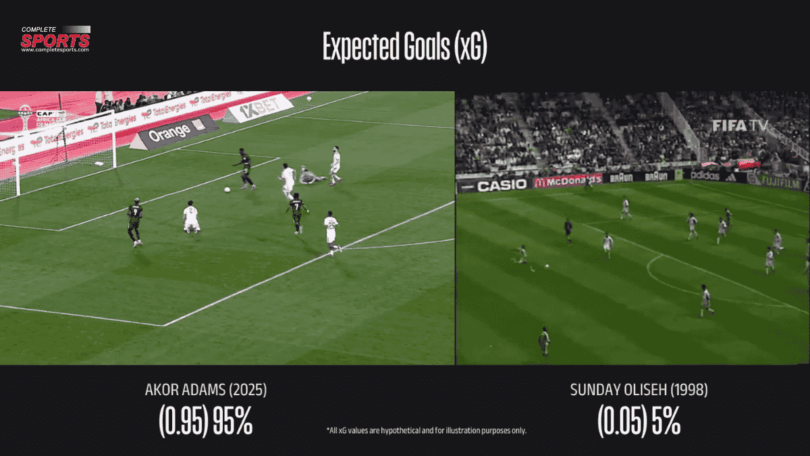
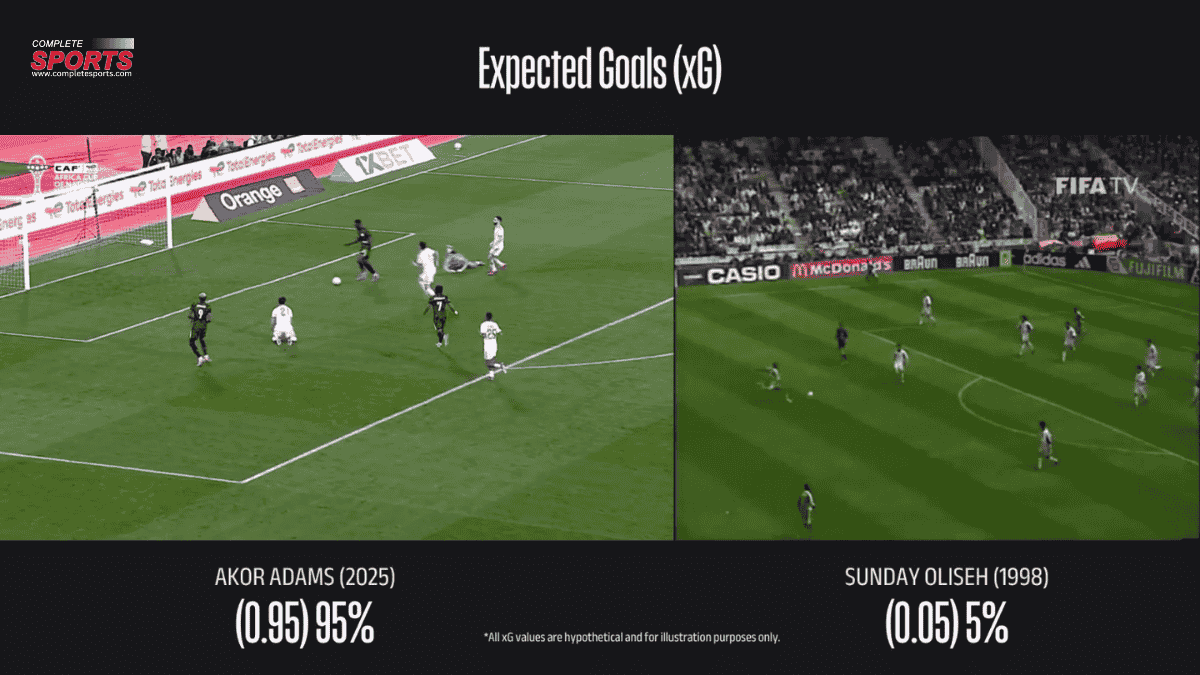
For example, comparing Akor Adams’ empty net tap-in against Algeria at AFCON 2025 and Sunday Oliseh’s famous 30-yard strike in 1998, at the point where Akor Adams was going to shoot, an xG model might put his chance of scoring at 95%, unlike Oliseh, who might only hypothetically have a 5% chance of scoring that screamer.
Over a match, xG shows whether a team created enough good chances to deserve a win. Nigeria’s 2.82 xG against Mozambique but four goals scored means they outperformed their xG, while scoring two from 3.36 xG against Algeria shows underperformance.
2. Expected Goals on Target (xGOT)
Expected Goals on Target (xGOT) builds on xG by measuring the likelihood of a shot becoming a goal after it has been taken and is on target. The value adds further context by considering shot placement, crediting the shots that head towards the top corner compared to those that are straight down the middle of the goal.
Also Read: EXCLUSIVE: Nigerian Footballers In Europe’s Top Five Leagues — Data Reveals The Most Dangerous Attackers
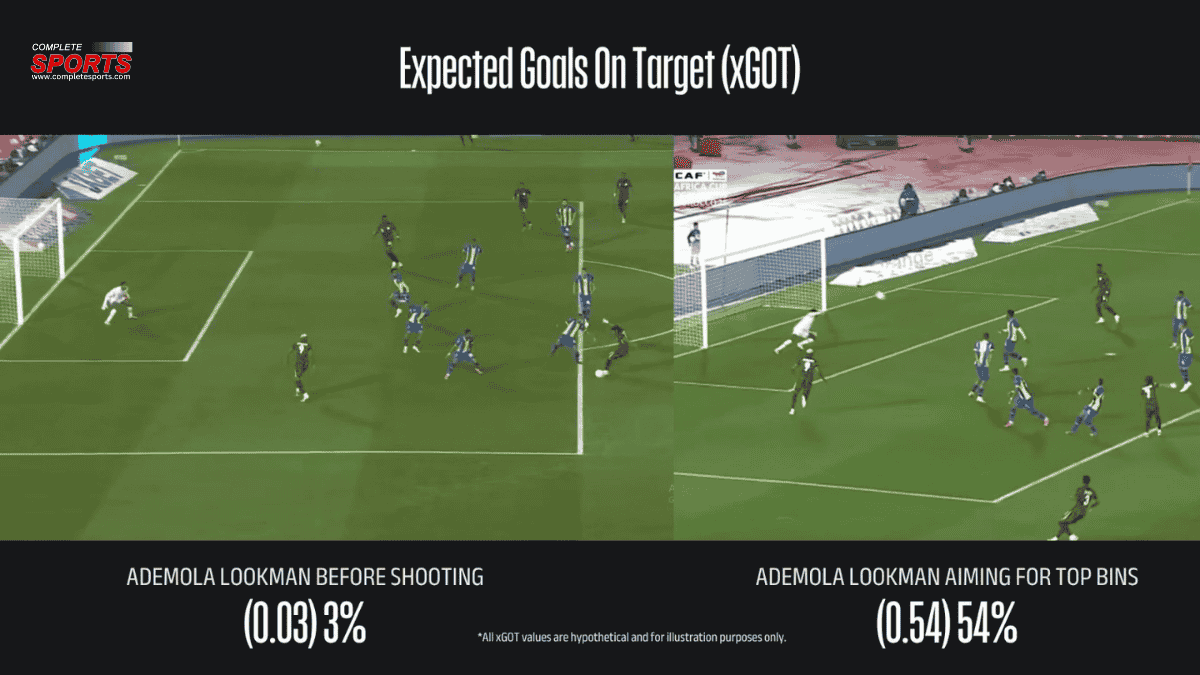
As you would imagine, only shots on target are included, since off-target attempts have zero chance of scoring unless deflected. For example, before Ademola Lookman shoots from outside the box against Tanzania, his chance might be just 0.03 xG (3% chance). Once he strikes towards the top corner, the probability rises to, say, 0.54 xGOT (a 54% chance of it being a goal), crediting the execution.
What analysts often interpret xGOT to mean is to get a clearer idea of a player’s shot execution. If a player or team has an xGOT value that is consistently higher than their xG, this tells us that they are shooting at a better rate than the quality of the chances they are getting.
3. Goals Prevented
Since we have been talking about xG and xGOT, we have been seeing things from the players’ point of view. But there is another point of view we should consider. If xGOT measures the quality of a strike, what about the goalkeeper employed to stop those strikes? Shouldn’t it measure the quality of saves made? That brings us to Goals Prevented.
Goals Prevented = xGOT – Goals Conceded
If opponents generate 3.0 xGOT but the goalkeeper concedes only one goal, the Goals Prevented is +2.0, meaning the keeper saved two more than expected. The higher the Goals Prevented value, the better the shot-stopping performance.
To add some context, Chiamaka Nnadozie recorded 0 Goals Prevented in several WAFCON 2025 matches simply because opponents had no shots on target. This doesn’t mean she wasn’t impactful.
Typically, keepers from mid- or lower-tier teams tend to rank highly in this metric because they face more shots, while goalkeepers of top teams may have fewer opportunities to build up this metric. Now you understand why big teams go to mid-table or bottom-ranked clubs to reinforce their goalkeeping departments.
4. Expected Assists (xA)
Just like you can expect goals from a shot, analysts also want to measure if you can expect assists from a pass. xA works like xG with values between 0 (no chance) and 1 (certain assist). It values creative players who consistently deliver dangerous passes, even if their teammates miss.
This means Alex Iwobi’s through balls may still carry high xA even if strikers fail to convert. Traditional assists can be a very poor indication of a player’s creative ability in modern football metrics analysis.
Also Read: EXCLUSIVE: Nigerian Footballers Ranked – Data Reveals Best Passers In Europe’s Top Five Leagues
This means Alex Iwobi’s through balls may still carry high xA even if strikers fail to convert. Traditional assists can be a very poor indication of a player’s creative ability. One player could play a simple pass for their teammate to bury in the top corner, while another could run the length of the field and put it on a plate for their teammate to score.
Both scenarios are hardly comparable. Also, an assist depends heavily on the receiver to finish the chance. Looking at the 2025/26 season, Alex Iwobi is expected to deliver about 3 assists every 90 minutes played based on his 3.37 xA value, according to Understat’s model.
Being a set-piece taker can inflate a player’s creative output because they can deliver the ball, unopposed, into a dangerous area with more players to attack the ball. So, Ademola Lookman, who takes setpieces for the Super Eagles, might have a higher xA than Alex Iwobi. That’s why analysts partition xA based on game situations like open play, corners, etc.
Tactical & Analytical Metrics
These metrics explain how a team plays. Provides insights into their style, pressing intensity, territorial dominance, or possession patterns. Over recent years, FIFA has developed its own unique framework for analysing the game. Examples include Passes Per Defensive Action (PPDA), Field Tilt, Game State, Sequences and Possessions, Possession in Contest, Progressive Passes, Passing Networks, Possession Value (PV), Ball Carries etc.
5. Ball Carries
Ball Carries measure how often and how effectively a player advances the ball by moving with it at their feet. Unlike passes, which transfer the ball between teammates, ball carries touch on a player’s ability to progress play themselves.
Whether by driving forward into space, breaking defensive lines, or dragging opponents out of position, Ball Carries are central to modern football metrics analysis
Ball Carries are often the first thing a player does after receiving the ball. Analysts track ball carries to understand which players are responsible for moving the game upfield.
Also Read: EXCLUSIVE: Nigerian Footballers – Best Defenders In Europe’s Top Five Leagues (2025/26 Season)
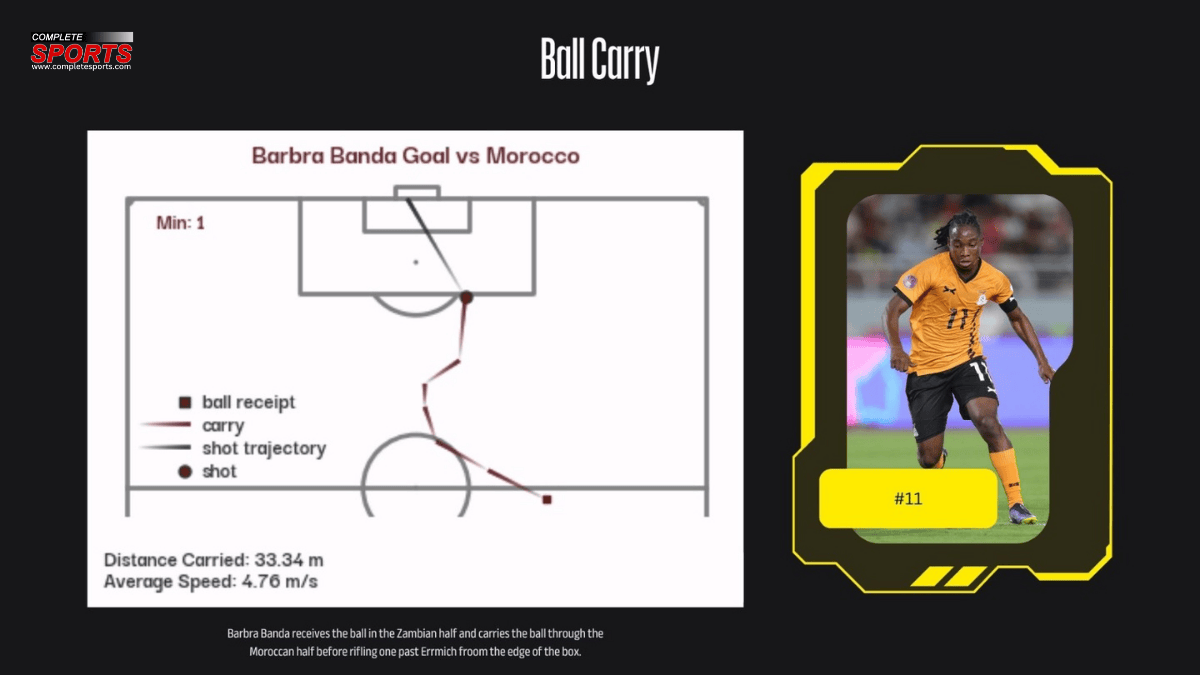
A high number of progressive carries often indicate a player who takes responsibility for advancing attacks rather than relying solely on passing. For example, Babra Banda (Zambia) scored in the first minute of the 2024 WAFCON opener, receiving the ball in her half and carrying it through the Moroccan half before rifling one past Er-Rmichi in goal.
6. Game State
Game State refers to whether a team is winning, playing a draw, or losing. It provides crucial context when teams are performing certain actions, because a team’s approach may change depending on the scoreline. A side chasing the game will tend to take more shots and risks, while a team protecting a lead may likely sit deeper and create fewer chances.
For example, say Sporting Lagos didn’t attempt a single shot in the second half against Enugu Rangers. You might be tempted to say it’s poor attacking play, but what if they had built a 2-0 lead before half-time and were protecting their lead? That changes the context.
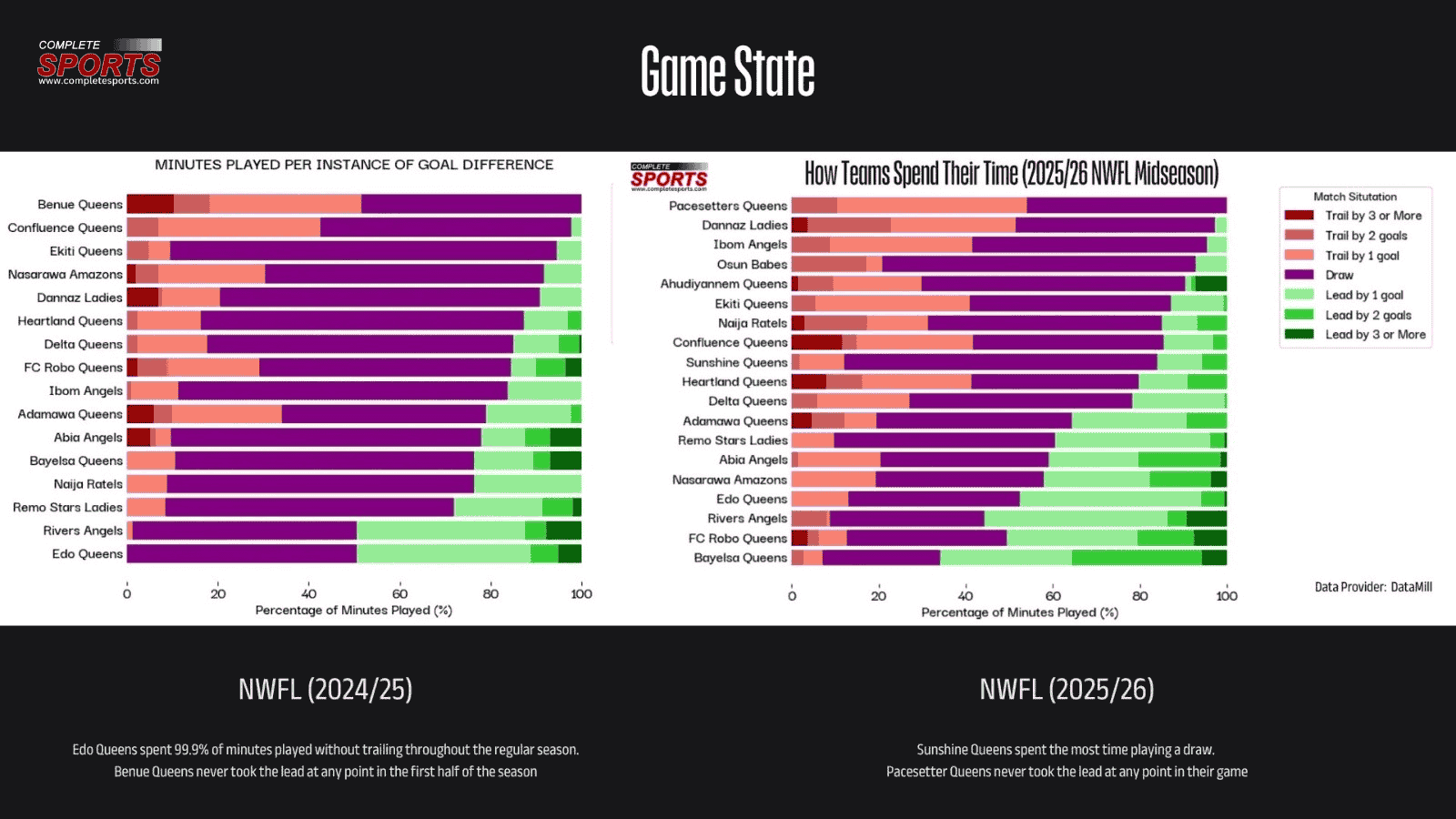
Edo Queens went almost the entire 2024/25 NWFL season without trailing. A total of 1259 minutes out of a possible 1260 without going behind (99.9% of minutes played). In the 2025/26 season, Sunshine Queens have spent the most time drawing games in the NWFL as well.
Analysts accumulate game state data to get insight into how teams spend their gametime. They also use it to explain the tactical approach taken by a team because it provides useful context.
7. Passes Per Defensive Action (PPDA)
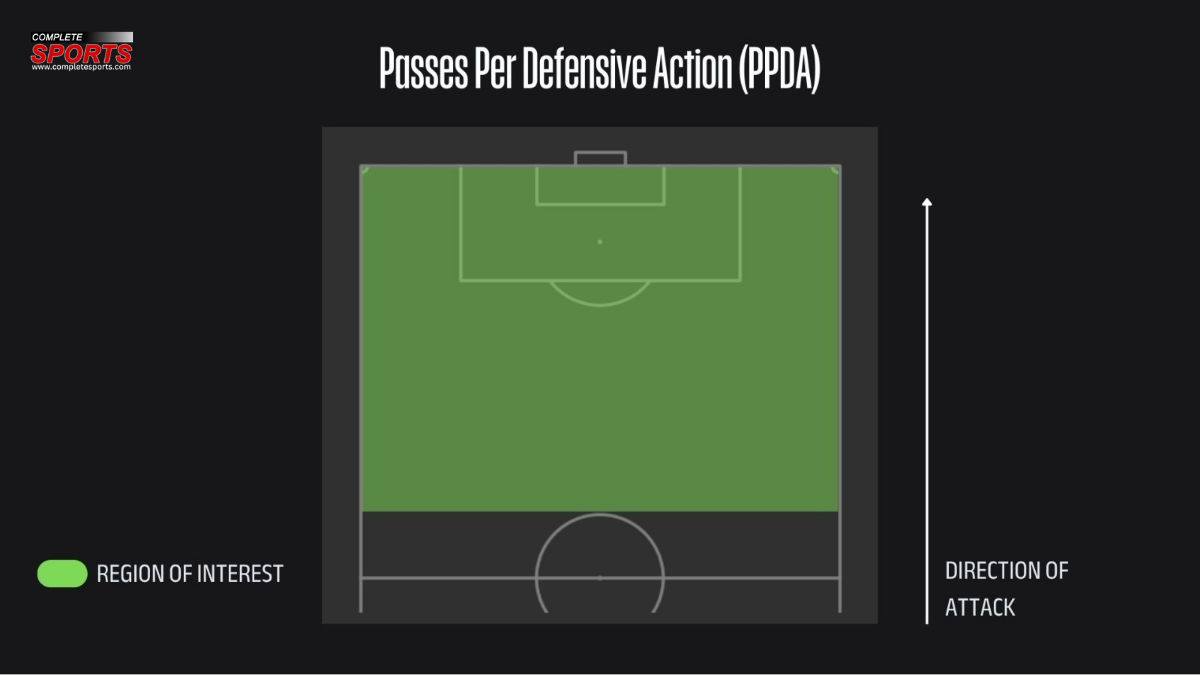
Passes per defensive action (PPDA), put simply, counts how many passes a team allows the opposition to make before attempting to win the ball back with a defensive action, such as a tackle, interception, or clearance. Modern analysis calls that “pressing”. It focuses on the final 60% of the pitch, where pressing is most relevant.
At the Cup of Nations group stage, whenever Nigeria played, you could notice the intensity with which they approach the opposition players to try to win back the ball. A low PPDA means aggressive pressing, while a high PPDA suggests a more passive style.
Let’s say Enyimba often win the ball back after just five (5) passes, showing intense pressing, whereas Ileogbo United allow 15 passes before regaining possession, showing a looser approach. A downside of PPDA is that it doesn’t give us any indication of the success of that strategy. Rather, it is only more indicative of a team’s style in winning the ball back.
8. Field Tilt
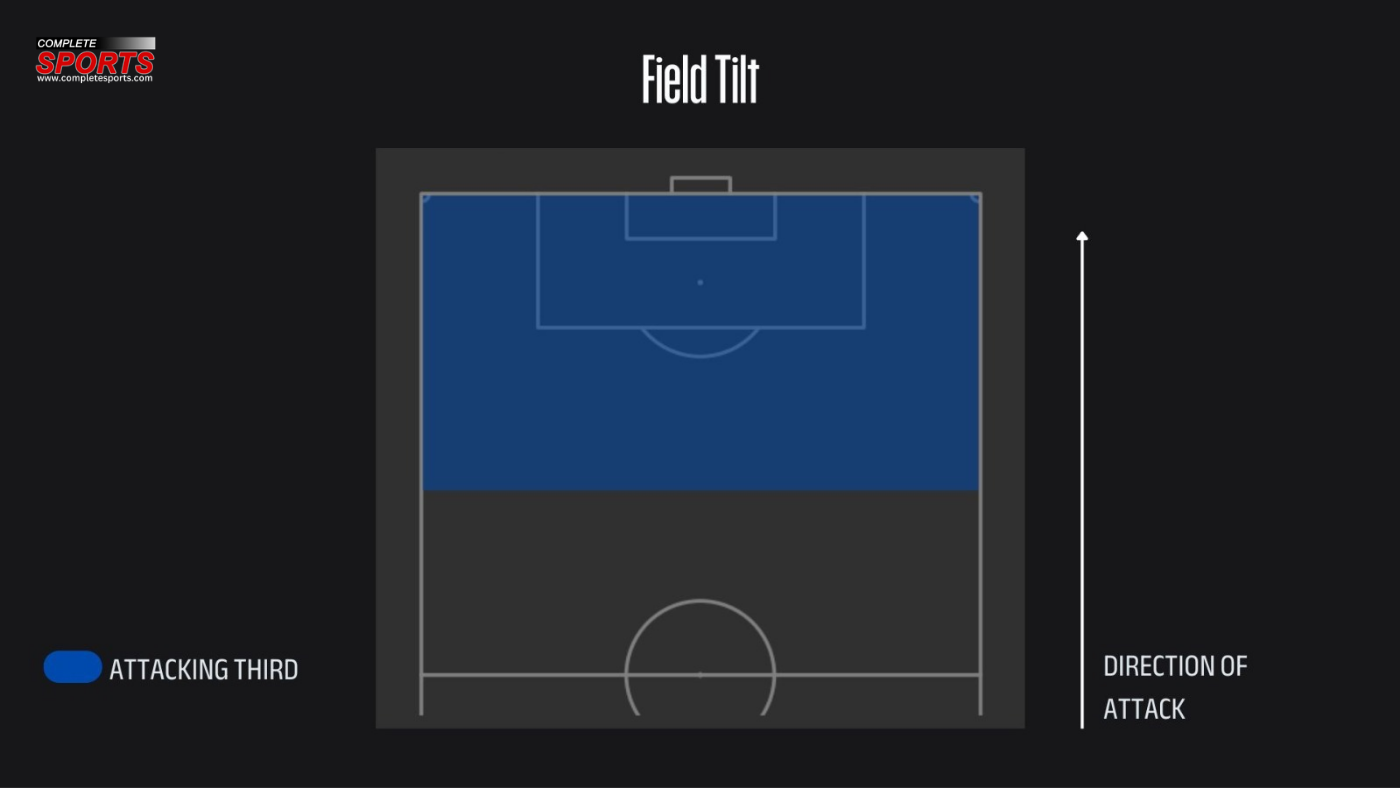
Field Tilt shows territorial dominance between teams by comparing touches or passes in the final third, otherwise called the attacking third. Fans often assume that having more of the ball means dominance but that’s not always true, because possession alone doesn’t tell us where the ball is being played.
Field Tilt (%) = Team’s Final Third Passes ovet Total Final Third Passes x 100
For example, if Nigeria completes 80 final-third passes and South Africa completes 20, Nigeria’s Field Tilt is 80%. High values suggest the team is pressing high and circulating the ball in dangerous areas, while low values may indicate defending deep or struggling to progress play.
Also Read: EXCLUSIVE: NWFL 2025/26 Midseason Data Reveals Surprising Trends, Title Contenders, Relegation Battles
When measured in intervals, Field Tilt can also reveal momentum shifts after a goal, substitutions, or tactical changes. For instance, the Super Eagles having 72% ball possession and 82% Field Tilt against Ghana shows they kept the ball in attacking zones.
Meanwhile, the Super Falcons could record just 35% possession against the United States yet still achieve 45–50% Field Tilt, proving efficiency despite limited time on the ball. Field Tilt doesn’t measure chance quality. Counterattacks can bypass it, so it’s best paired with xG, Ball carries or Progressive Passes.
Normalization & Contextual Metrics
These adjust raw numbers to make fair comparisons across players, matches, or competitions. They provide context by scaling, averaging, or ranking. Examples include: Per Match, Per 90 Metrics, Possession-Adjusted Metrics, Relative Performance Index (RPI), Percentile Rankings,
Per 60 minutes of ball-in-play, Per 30 minutes in/out of possession, Proportion/Per cent of Time.
9. Per 90 Metrics (P90)
Per 90 (P90) normalizes player or team statistics to a standard 90‑minute match, allowing fair comparisons regardless of minutes played. Raw totals can be misleading because substitutes and regular starters cannot be judged equally without adjustment.
When performing analyses like completesports.com did in our ET5 series, using raw, total numbers for a metric can be misleading, as it does not account for the minutes played to reach that number.
P90 Value = Metric Total Value over / Total Minutes Played x 90
Using three (3) Super Eagles invitees for the four-nation tournament as examples:
– Phillip Otele (1 goal, 420+ minutes) scores 0.21 goals P90 while
– Collins Yira Sor (4 goals, 1100+ minutes) scores 0.32 goals P90 and
– Fernandez (5 goals, 1700+ minutes) scores 0.26 goals P90.
10. Possession-Adjusted Metrics (PAdj)
PAdj normalizes defensive actions like tackles, interceptions, and blocks based on how much time a team spends without the ball. Raw numbers can be misleading because defenders on low-possession teams naturally face more opportunities to perform defensive actions, while those on dominant sides have fewer.
PAdj Value = Raw Defensive Actions Count over Opponent Possession Time (in Minutes) x Standardized time (e.g., 30 minutes, 60 minutes)
For example, if Deborah Abiodun makes five (5) interceptions while Nigeria defends for 10.5 minutes, her PAdj interceptions per 30 minutes of opponent possession equal 14.3. This adjustment allows fairer comparisons between defenders on struggling teams and those on possession-heavy sides.
PAdj is useful for evaluating defensive contribution, but it doesn’t fully capture the quality or context of actions. High-possession teams often defend differently, so analysts combine PAdj with other metrics to build a fuller picture of defensive effectiveness.