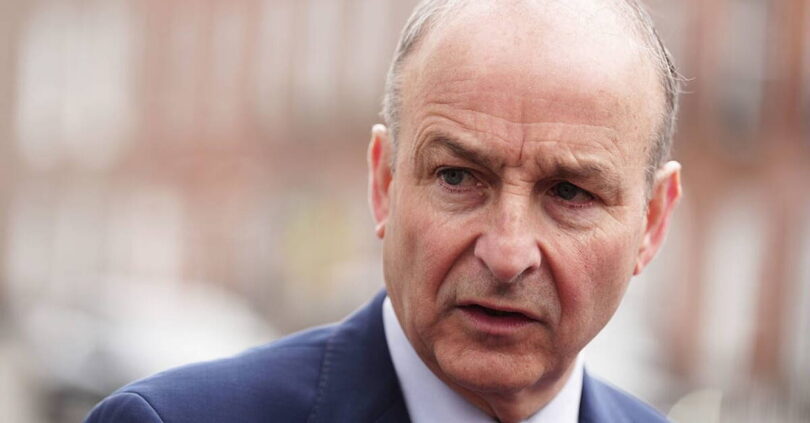
The threat from US president Donald Trump to bomb Iran “back to the Stone Age where it belongs” was “unacceptable”, Taoiseach Micheal Martin has said.
The Taoiseach said that the citizens of Iran and the Middle East need the conflict to end, and said if it “continues at length”, it will have “very significant impacts” on the world economy.
He said the Irish Government was not looking at fuel rationing “at this stage”, adding that they were keeping some financial “firepower” for later in the year.
During a 19-minute address to the nation, the US leader said they were “on track to complete all of America’s military objectives shortly”.
Trump urged countries that rely on the vital Strait of Hormuz shipping lane for oil to “build up some delayed courage” and “just grab it”, but added that it “will open up naturally” once the conflict ends.
He also said he would hit Iran “extremely hard” in the next two to three weeks.
Asked about Trump’s “stone age” threat, Martin said the citizens of Iran have “no act or part” in the war and must be protected.
“That’s unacceptable. Every person involved in war has to prioritise civilian protection and innocent civilians,” he told Newstalk radio.
President Trump delivered a powerful speech tonight. He was clear about our objectives in Iran:
• Destroy their weapons factories
• Destroy their navy
• Destroy their air force
• Destroy their chances of ever having a nuclear weaponThe President’s leadership sends a…
— Secretary Marco Rubio (@SecRubio) April 2, 2026
“We all know that the Iranian regime was a very oppressive one but this war is creating death, destruction to people in Iran who had no act or part in the regime.
“So for the people of Iran, in the first instance, for the people in the Middle East, more generally, this war must end.”
Martin said that threatening civilians was “wrong” but said it was “not clear” whether the threats were directed at Iran’s civilian population and infrastructure.
“(We) could be forever trying to interpret President Trump in terms of what he said and what actually gets done, and that’s always been the feature,” he said, adding the US had stopped bombing oil infrastructure.
Martin said no government can compensate every person and sector during the energy crisis caused by the war in Iran.
He said that hauliers were “key to trade” as they are “key to getting food on our shelves”, and said other State supports need to be targeted towards “those who need it the most”.
“We don’t believe fuel capping would work, and it’s an endless sort of commitment,” he said.
“We think what we’ve done so far makes sense. I think a more targeted approach is the way to go, to be frank with you.
“I think we also are cautious, because we don’t know quite know what’s around the corner here and in terms of how this long this war is going to continue, and we need to keep some firepower.”
Martin called Israel’s ground invasion of Lebanon a “wholly disproportionate” response to “unacceptable” attacks from the militant group Hezbollah.
Asked about the consequences of pulling out over 360 Irish peacekeepers would be “very very serious”.
“We need to be careful that we would take out any international observance in Lebanon, because a similar fate (to Gaza), particularly in south Lebanon, could await the inhabitants there if there is no one to hold Israel to account.
“(That is) a sense a lot in the international community have, and the very mere presence of UNIFIL is in itself a factor that can limit the nature and scale of Israeli attacks.”
The Taoiseach said that if the conflict in the Middle East continue “for any length of time” it will have a “very significant impact” on the world economy, livelihoods and subsequently will have a range of secondary effects.
Speaking on Newstalk’s Breakfast show with Anton Savage, Martin said such impacts would include increased inflation and higher costs for products derived from oil such as fertiliser, plastics, helium for semiconductors.
The aviation sector will also come under threat, he said.
“When you think that over the last five, six, seven, eight years, we’ve had one shock after the other, Brexit, Covid, the Russian invasion of Ukraine, different to this crisis, but nonetheless created an energy disruption of a significant kind.
“Then we had the tariffs coming from the US, and now we have this war, and it’s been endless. Cumulatively, all of those will have impact.”
“Hauliers are key to trade, hauliers are key to getting food on our shelves and so on like that. And so that’s why we took specific measures to help hauliers.
“We’ll have to look at the whole area of food production as well in terms of the fertiliser issue and costs there, just say we did in Covid, if you remember, and it wasn’t spoken about as much, but we kept industry going during Covid.
“We took specific measures in terms of enabling pharmaceuticals, enabling all of that. If this continues at length, we have to maintain that sort of support for hauliers. We’d have to look at food production more generally. But we hope this comes to an end sooner.”

World
‘Build up some delayed courage’ and grab Strait of Hormuz, Trump tells nations
The Taoiseach said the government was not considering rationing fuel at this stage
Additional reporting from Vivienne Clarke.