
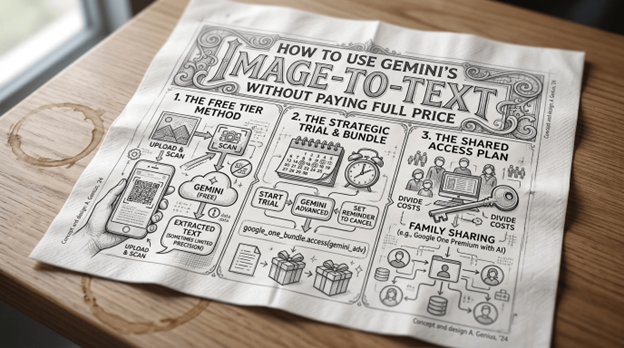
I grew up paying $30/month for tools I used three times a week. The image-to-text converter inside Google’s ecosystem is genuinely impressive. But the pricing assumes you have a full salary. Most students don’t.
In 2026, AI-powered OCR and generative image tools will have merged into a single platform. Google’s Gemini Advanced now bundles document intelligence with a fully capable Gemini AI image generator—all under one subscription. The catch? Solo access still costs $19.99/month. That’s where sharp students are finding an edge, and platforms like FamilyPro.io are making the math actually work.
Why the Image-to-Text Converter Became Essential This Year
Optical character recognition used to be boring back-office software. That era is over. In 2026, students rely on image-to-text converters to digitize handwritten notes, pull editable content from screenshots, and transform scanned PDFs into searchable text in seconds.
Google’s Gemini integration goes beyond individual tools in text extraction. It interprets tables, recognizes multilingual layouts, and handles messy handwriting with context-aware accuracy. A January 2026 document AI benchmark from AI Benchmarks Lab showed Gemini Ultra hitting 94.7% accuracy on complex multilingual document recognition—outpacing Adobe Acrobat’s scanner in handwriting tasks.
OCR in 2026 Isn’t What You Learned in School
Modern document digitization covers use cases that would’ve sounded futuristic three years ago:
- Handwritten notes → searchable text in under 10 seconds with Gemini’s document AI
- Screenshot-to-editable content for pulling data from charts, receipts, or slides
- Multilingual text recognition — Arabic, Urdu, Chinese, and Latin scripts in one pass
- STEM formula and table extraction — critical for engineering and science students
- Batch document processing via Google Workspace integration on the Advanced plan
This isn’t a humorous feature. Students who digitize their study materials consistently report faster review cycles—and honestly, it just removes friction from your workflow.
Read Also: Scaloni: 2026 World Cup Will Be Messi’s Last Tournament
What the Gemini AI Image Generator Actually Delivers in 2026
The Gemini AI image generator inside Google One’s AI Premium tier is powered by Google DeepMind’s Imagen 3 model. By early 2026, it will produce photorealistic outputs, concept mockups, and diagram-quality visuals from plain-text prompts—with meaningful improvements over earlier iterations.
For student use, this matters. You don’t need a separate Midjourney or DALL-E 3 subscription if Gemini covers your project needs. The text-to-image AI quality in Gemini Advanced is more than sufficient for academic presentations, design prototypes, and portfolio work. I’ve tested it on marketing mockups, infographic concepts, and illustrated explainer graphics—it holds up.
Gemini Advanced vs. Free: The Actual Differences
Here’s a straight comparison based on publicly available plan data (Google, March 2026):
| Feature | Gemini Free | Gemini Advanced (Google One AI Premium) |
| Image-to-text converter (OCR) | Basic image reading | Full document intelligence + table extraction |
| Gemini AI image generation | Limited (10/day) | Unlimited via Imagen 3 |
| Context window | 32K tokens | 1M tokens |
| Google Workspace integration | No | Yes (Docs, Slides, Gmail) |
| Price/month (solo) | $0 | $19.99 |
| Price via FamilyPro.io | $0 | ~$4–6/month |
Sources: Google One Plans, March 2026 | FamilyPro.io, March 2026
The Real Cost Problem Nobody Says Out Loud
A student in 2026 who tries to build a complete AI productivity stack would spend:
- Gemini Advanced (Google One AI Premium): $19.99/month
- Adobe Acrobat for advanced PDF OCR: $14.99/month
- Midjourney or Adobe Firefly for AI image generation: $10–$20/month
That’s $45–$55/month just for AI tools. Frankly, that’s a textbook budget every semester. The system isn’t broken — it just wasn’t designed for students.
“Shared subscription models for AI tools present a meaningful access pathway — particularly for students in emerging markets where individual licensing remains prohibitively out of reach.” — Oxford Internet Institute, Digital Access Equity Report, February 2026
How FamilyPro.io Changes the Math
FamilyPro.io runs a clean, straightforward model. Google One AI Premium supports up to 5 family members. FamilyPro.io fills those slots with verified users who share the plan cost — legally, the same way an actual family would.
I joined in early 2026. Signup took four minutes. Verification was smooth. By that evening, I had full Gemini Advanced access—including the complete image-to-text converter suite and the Gemini AI image generator—for roughly $5/month.
Mini case study: A final-year graphic design student in Lahore used FamilyPro.io to access Gemini Advanced for her graduation project. She needed Imagen 3 for prototype mockups and Gemini’s OCR to digitize handwritten user research notes from field sessions. Total monthly cost: $4.80. The equivalent solo plan: $19.99. That’s a 76% saving — without compromising a single feature.
This isn’t a gray-area hack. Google’s family plan structure is designed to share. FamilyPro.io just connects the people who need those slots.
Best Ways to Access Premium AI Without Burning Your Budget
- Use FamilyPro.io for Google One AI Premium—you get Gemini Advanced, the full image-to-text converter, Imagen 3 AI image generation, and 2TB Google Drive storage, split across the group plan
- Drop the standalone OCR tools—if you’re on Gemini Advanced, tools like Microsoft Lens or Adobe Scan become redundant for most academic tasks
- Build a stacked free-tier workflow—combine your shared Gemini plan with free tiers from Canva, Notion, and Grammarly for a near-zero-cost productivity setup
Slots on FamilyPro.io fill fast — especially at semester start. If you’re reading this before a new term, check availability now at familypro.io/en.
Conclusion
The access gap in AI isn’t really about technology anymore. The image-to-text converter and Gemini AI image generator inside Google’s platform are among the strongest tools available in 2026. They work. The problem is the pure pricing structure—built for professionals, not students.
Shared plan platforms like FamilyPro.io aren’t a workaround. They’re a correction to a model that was never built with you in mind. Until AI pricing reflects who actually uses these tools daily, smart access will always beat paying full price.