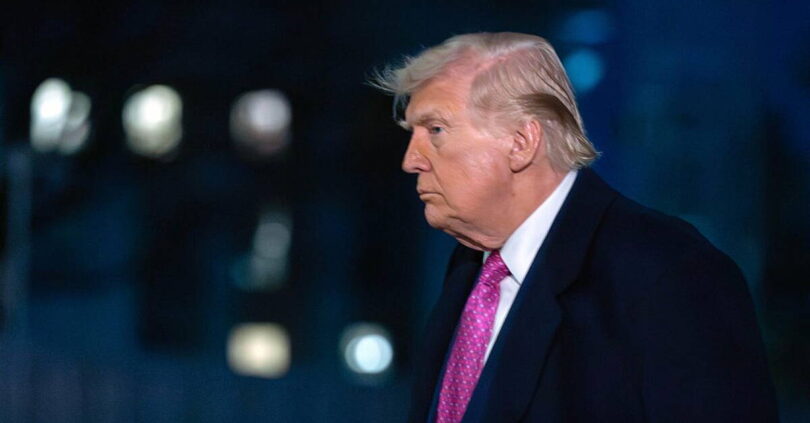
US President Donald Trump threatened widespread destruction of Iran’s energy resources and other vital infrastructure if a deal to end the war with Tehran is not reached soon.
In a social media post, Mr Trump said “great progress is being made” in talks with Iran to end military operations.
But the US president bristled that if a deal is not reached and if the Hormuz Strait is not immediately reopened, the US would broaden its offensive by “completely obliterating all of their Electric Generating Plants, Oil Wells and Kharg Island (and possibly all desalinization plants!)”.
On the ground, the war showed no sign of letting up as Tehran struck a key water and electrical plant in Kuwait, and an oil refinery in Israel came under attack.
Israel and the US launched a new wave of strikes on Iran.
Mr Trump’s social media post and earlier comments in an interview with the Financial Times (FT) that suggested American troops could seize the country’s Kharg Island export hub highlight how he has repeatedly said that talks with Iran are ongoing — and even going well — though Tehran denies negotiating directly.
“The United States of America is in serious discussions with A NEW, AND MORE REASONABLE, REGIME to end our Military Operations in Iran.” – President Donald J. Trump 🇺🇸 pic.twitter.com/0MWL2hSNmK
— The White House (@WhiteHouse) March 30, 2026
But at the same time, he has continually ramped up his threats, as thousands more Marines and other US troops pour into the Middle East.
It remains unclear where the diplomatic effort facilitated by Pakistan stands.
Iran’s attacks on its Gulf neighbours could add another element of uncertainty to any talks.
The United Arab Emirates, which has long billed itself as a beacon of safety and stability in a volatile region, has been hard hit in the war and increasingly is signalling that it wants Iran disarmed in any ceasefire, a term Iran’s theocracy is unlikely to accept.
We’re doing extremely well in that negotiation but you never know with Iran because we negotiate with them and then we always have to blow them up.
In the interview with the FT, Mr Trump said his preference would be to “take the oil in Iran” — a move that would require seizing Kharg Island, the terminal through which nearly all of Iran’s oil exports pass.
“Maybe we take Kharg Island, maybe we don’t,” he continued. “We have a lot of options.”
Also in the interview, Mr Trump said that the US had about 3,000 targets that it would still like to hit in Iran, but added: “A deal could be made fairly quickly.”
He told reporters aboard Air Force One that the US was negotiating “directly and indirectly” with Iran.
“We’re doing extremely well in that negotiation but you never know with Iran because we negotiate with them and then we always have to blow them up,” Mr Trump said.
Twice during Mr Trump’s second term, the US has attacked Iran while in the middle of negotiations, once with the strikes on February 28 that started the current war and also in June 2025.
Iranian Foreign Ministry spokesman Esmail Baghaei acknowledged that Tehran had been given a 15-point proposal from the Trump administration, but said there had been no direct negotiations with Washington so far.
Earlier, Iran’s parliament speaker, Mohammad Bagher Qalibaf, dismissed the talks in Pakistan as a cover to get more US troops into the area.
He said Iranian forces were “waiting for the arrival of American troops on the ground to set them on fire and punish their regional partners forever”, according to state media.
The US has already launched airstrikes once that targeted military positions on Kharg.
Iran has threatened to launch its own ground invasion of Gulf Arab countries and mine the Persian Gulf if US troops land on its territory.
To get an amphibious invasion force to Kharg would mean transiting the Strait of Hormuz and most of the Persian Gulf.
Experts say that holding the island would also be a challenge, because in addition to its missiles and drones, it would be well within artillery range from the Iranian mainland.
Meanwhile, sirens sounded at dawn near Israel’s main nuclear research centre, a part of the country that has been targeted repeatedly in recent days.
Israel’s military also said it had taken out two drones launched from Yemen, where the Iranian-backed Houthi rebels entered the war on Saturday with their first missile attack.
Later, a fire broke out at an oil refinery in the northern city of Haifa, one of only two in Israel, either from a missile strike or from debris falling from an interception. The blaze was quickly extinguished.

Iran kept up the pressure on its Gulf Arab neighbours, as Saudi Arabia intercepted five missiles targeting its oil-rich Eastern province, Bahrain sounded a missile alert and a fireball erupted over Dubai as an incoming missile was taken out by defences.
In Kuwait, an Iranian attack hit a power and desalination plant, killing one worker and injuring 10 soldiers, the state-run KUNA news agency reported.
Desalination plants are crucial to water supplies in the Gulf Arab states and an Iranian attack previously damaged a desalination plant in Bahrain. The facilities are typically paired with power plants because of the large amount of energy required to remove salt from the water to make it drinkable.
Israel’s military launched a new wave of attacks on Iran, saying it was striking “military infrastructure” across Tehran, and explosions were heard in the Iranian capital.

Iranian state media reported a petrochemicals plant in Tabriz, in the north, sustained damage after an airstrike and firefighters had to put out a blaze.
Iran confirmed that the head of the Revolutionary Guard’s navy, Rear Admiral Alireza Tangsiri, had been killed in an Israeli airstrike, as Israel claimed last week.
In Lebanon, which Israel has invaded by ground, an Indonesian peacekeeper was killed and three others were wounded when a projectile exploded near a village in the south.
Over the weekend, Israeli Prime Minister Benjamin Netanyahu said the military will widen its invasion, expanding the “existing security strip” in that country’s south as it targets the Iran-linked Hezbollah militant group.
In Iran, authorities say more than 1,900 people have been killed, while 19 have been reported dead in Israel.
Two dozen people have been killed in Gulf states and the occupied West Bank.
In Lebanon, officials said more than 1,200 people have been killed, and more than 1 million have been displaced.
Six Israeli soldiers have died in Lebanon, while 13 US service members have been killed in the war.
Iran’s attacks on the energy infrastructure of the region and its stranglehold on the Strait of Hormuz, through which a fifth of the world’s oil is shipped in peacetime, have sent oil prices skyrocketing and given rise to growing concerns about a global energy crisis.
In early trading, the spot price of Brent crude oil, the international standard, was around 115 US dollars (£87), up nearly 60% from when the US and Israel started the war with attacks on Iran on February 28.
As pressure has grown on Mr Trump to bring an end to the conflict, the US has presented Iran with a 15-point plan that includes it agreeing to open the Strait of Hormuz to shipping.
Iran, meanwhile, has produced a five-point plan with its own terms, including maintaining its sovereignty over the key waterway.