The World Cup is just around the corner but preparations are already underway to celebrate the tournaments 100th anniversary across three continents.
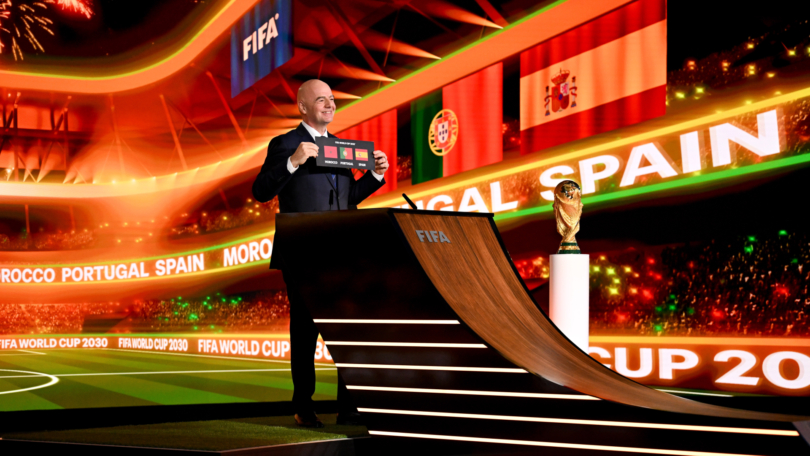
FIFA announced in 2023 that Spain, Portugal and Morocco will co-host the 2030 men’s football World Cup.
10
However, the opening three matches of the tournament will take place in Uruguay, Argentina and Paraguay.
This year is a tester for the tournament to be spread across multiple hosts, with Canada, America and Mexico all putting on games in North America.
The only other time it has happened was in 2002 with South Korea and Japan.
Four South American nations initially submitted a joint bid early in 2023, however, FIFA confirmed a few months later that they were only considering Morocco, Portugal and Spain.
Spain and Portugal made their first bid in 2021 with Ukraine joining them as a third nation in 2022 despite the country being invaded by Russia.
They were soon dropped for Morocco after concerns of the ongoing war was addressed and governance issues in the country’s football association.
Why are the first games being played in South America?
The 2030 World Cup will be held from Saturday, June 8 to Sunday, July 21 and will include 48 teams at 21 venues.
It has been 100 years since the first World Cup and FIFA is commemorating the anniversary.
The first ever tournament was hosted in Uruguay in 1930 with the nation winning the Jules Rimet as the first time winners.
Argentina was the beaten finalists in the competition while Paraguay is where CONMEBOL, the South American football confederation is based.
It is the oldest confederation in the world and the only existing one at the inaugural tournament.

10
At the announcement, FIFA president Gianni Infantino said: “In today’s divided world, where it seems that nobody can agree any more on anything, to be able to agree on something like that is definitely an incredible message of unity and positivity.
“And we need these messages today.
“The FIFA World Cup is unique, and it is a unique catalyst as well for positive social change and unity because these tournaments, 2030, the celebration, 2034.
“They are tournaments to unite, not to divide. They are tournaments, of course, to discuss, to debate and to act.
“But most importantly, today, today is a day of unity and a day of celebration.
“Seven countries have won their World Cup today. Congratulations to Uruguay, Argentina, Paraguay, Morocco, Portugal, Spain and Saudi Arabia.

10
“This is your day. So you should celebrate and we, we celebrate, of course, with you.
“And you, the 211 FIFA Member Associations that I can see on a giant screen in front of me, you are uniting the world.
“You are uniting the world truly, through football, because, of course, football unites the world.”
Which stadiums are hosting the World Cup in 2030?
The opening three games are being staged in South America.
The Estadio Monumental in Buenos Aires, Argentina, which has a capacity of 100,000 people, will host as will the Montevideo in Uruguay and the Estadio Osvaldo Dominguez Dibb which will be brand new in Paraguay.
When the tournament moves to the northern hemisphere, there will be 18 stadiums between the three countries, with Spain staging the most with nine.
Madrid is home to Atletico Madrid and Real Madrid’s stadiums, the iconic Bernabeu and Metropolitano Stadium.
Stadiums will span to the Canary Islands, with Las Palmas Estadio Gran Canaria also another option.

10

10

10
World Cup 2030 stadiums
Morocco
- Adrar Stadium, Agadir – Capacity: 46,000
- Hassan II Stadium, Casablanca – Capacity: 115,000
- Fez Stadium, Fez – Capacity: 55,800
- Marrakesh Stadium, Marrakesh – Capacity: 45,860
- Prince Moulay Abdellah Stadium, Rabat – Capacity: 69,500
- Tangier Grand Stadium, Tangier – Capacity: 75,500
Portugal
- Estadio da Luz, Lisbon – Capacity: 80,000
- Estadio Jose Alvalade, Lisbon – Capacity: 52,095
- Estadio do Dragao, Porto – Capacity: 50,033
Spain
- Camp Nou, Barcelona – Capacity: 105,000
- RCDE Stadium, Barcelona – Capacity: 40,500
- San Mames, Bilbao – Capacity: 53,331
- Estadio Gran Canaria, Las Palmas – Capacity: 44,500
- Bernabeu, Madrid – Capacity: 83,186
- Metropolitano Stadium, Madrid – Capacity: 70,692
- Anoeta Stadium, San Sebastian – Capacity: 42,300
- Estadio de La Cartuja, Seville – Capacity: 70,000
- Nueva Romareda, Zaragoza – Capacity: 43,110
Barcelona’s newly renovated Camp Nou is also an option which seats 105,000 people.
In comparison, Portugal have two host cities with Lisbon and Porto.
Sporting Lisbon, Benfica and Porto’s grounds will all be used throughout the tournament.
In the proposal, Morocco listed six stadiums that included Hassan II Stadium which is currently under construction and will hold 115,000 people – the biggest stadium in the tournament and eventually the world.
How will the tournament work?
The format replicates 2026 and will feature 48 teams again, split up into 12 groups of four and the top two, plus the eight best third-placed teams all progress to the knockout stages.
The expansion that happened for this year’s tournament means 104 matches will be played at the World Cup.

10
FIFA have said they will take into consideration that the teams playing in the opening games in South America will need a different match schedule in order to travel, rest and prepare.
However, there has been controversies surrounding the Centenary Matches with many concerned about the environmental impact caused by the high amounts of pollution due to construction and air travel.
The football organisation defended themselves and said the majority of the tournament is spent in neighbouring countries.
What will the weather be like?
In total, 14 of the 16 host cities are expected to be subject to extreme heat conditions.
FIFA has suggested scheduling kick-off times to evenings rather than throughout the day due to the weather.
About the weather at the event, Infantino said: “We are discussing all the time, and I think it’s not just about one World Cup – I think it’s a general reflection.
“Even to play in some European countries in July, it’s very, very hot. So maybe we have to think.
“There are ways we can optimise the calendar. But we are discussing it and we will see when we come to some conclusion.
“We just have to have an open mind.”
The 2022 World Cup held in Qatar was played in December due to heat levels being too high in the summer.

10

10

10
Who has qualified for the 2030 World Cup
Six countries have automatically qualified already with the six home nations all gaining a place – Morocco, Spain, Portugal, Uruguay, Argentina and Paraguay.
The other places are earned through qualifier games in each continental confederation.
Each continent receives a different amount of places with UEFA (Europe) receiving the most with 16.
After that, it is the Confederation of African football with the second most at nine, followed by the Asian Football Confederation with eight.
Concacaf and Conmebol both have six places, while the Oceania Football Confederation only have one place.
The final two spots will be decided through a play-off tournament featuring six teams.