
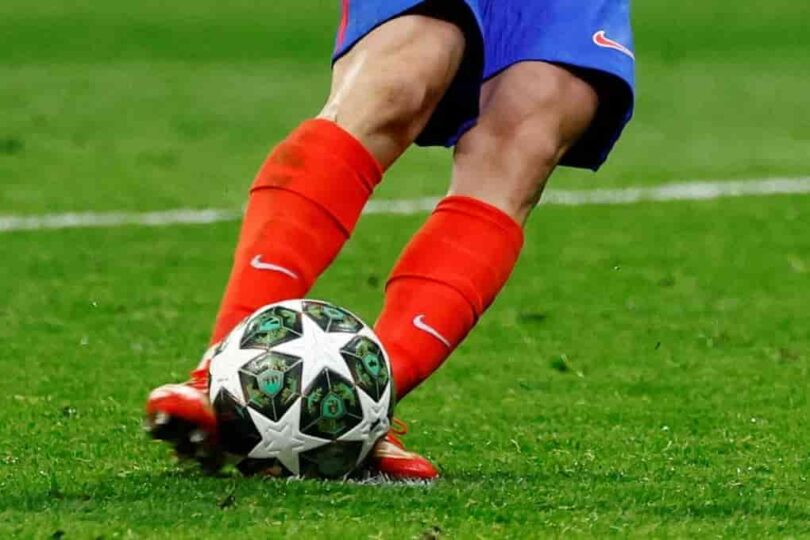
Atletico Madrid might have a powerful case for claiming injustice after Julian Alvarez’s penalty was disallowed of their UEFA Champions League semifinal match in opposition to Actual Madrid. eSportys’ Nsikakabasi Akpan shares perception on this second which has sparked confusion resulting from a potential hole of FIFA’s guidelines on penalties.
The Incident:
In the course of the penalty shootout, Julian Alvarez stepped as much as take Atletico Madrid’s second penalty. After putting the ball, he slipped, however the ball flew into the highest of the online, bringing the rating stage. Nonetheless, simply as Fede Valverde was about to take Actual Madrid’s third penalty, play was stopped by the referee, who consulted VAR about Alvarez’s kick.
Why Was Alvarez’s Penalty Disallowed?

The assessment concluded that Alvarez had touched the ball with each toes, which led to his penalty being deemed invalid. Based on the rule, a participant should not play the ball once more till it has touched one other participant. This interpretation is what led to the penalty being disallowed, however questions stay about whether or not the rule was utilized appropriately.
The FIFA Rule in Query:
FIFA’s rule on penalties states: “The ball is in play when it’s kicked and CLEARLY strikes. The kicker should not play the ball once more till it has touched one other participant.”
Right here lies the confusion. The rule is two-fold. The primary half says the ball should clearly transfer after the kick, whereas the second half focuses on not taking part in the ball once more earlier than it touches one other participant. In Alvarez’s case, VAR targeted on the second a part of the rule, which led to the disallowed penalty. Nonetheless, the primary a part of the rule, which considers whether or not the ball clearly moved after being kicked, appears to have been ignored.
Did the ball clearly transfer? That is the important thing query. NO. After the primary contact, the ball didn’t transfer. The confusion comes from the truth that the main target was positioned on the second a part of the rule, which can have led to a defective determination.
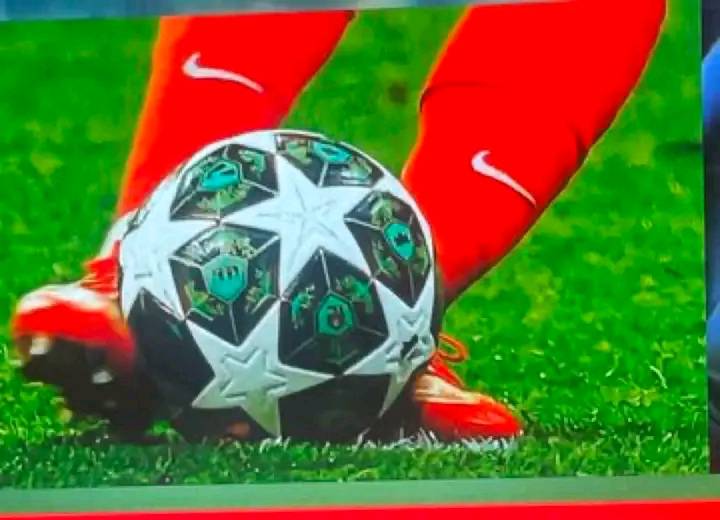
May Atletico Madrid Declare Injustice?
Given the paradox in decoding the rule, Atletico Madrid might moderately argue that the choice was unfair. The rule’s twin situations create room for confusion, particularly when one a part of the rule appears to be disregarded in favour of one other. On this case, the penalty was disallowed because of the thought of ‘double contact’, however the first rule concerning the ball’s motion was not correctly addressed. I do assume the truthful judgement if FIFA had made provision for it within the rule would have been THE KICK IS RETAKEN.
This incident has highlighted a possible hole within the FIFA guidelines and the best way they’re utilized throughout essential moments. It’s potential that after this controversial determination, FIFA will have a look at this rule and amend it to forestall such confusion sooner or later.